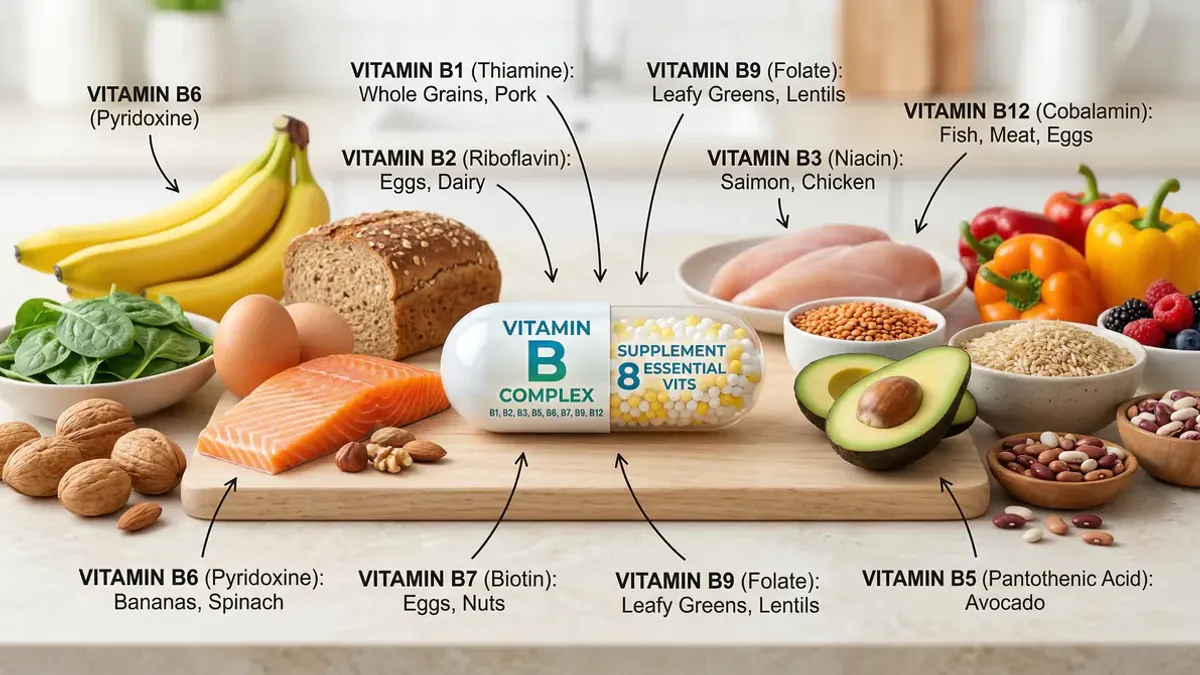
The B vitamins are a group of 8 water-soluble vitamins your body needs every day. They work closely together — hence the name "vitamin B complex" — but each has its own specific functions. In this overview you will find everything you need to know about B1 through B12.
Key takeaways
- There are 8 B vitamins: B1, B2, B3, B5, B6, B7, B9 and B12
- They are essential for energy production, nervous system function and cell formation
- Most people get enough through a varied diet
- High-risk groups for deficiency: vegans (B12) and pregnant women (B9)
What are B vitamins?
B vitamins are water-soluble, meaning your body cannot store most of them for long (with the exception of B12 in the liver). You therefore need them daily through your diet. They play a central role in energy metabolism: virtually every cell in your body requires B vitamins to function properly.
The eight B vitamins are officially numbered B1, B2, B3, B5, B6, B7, B9 and B12. The numbers B4, B8, B10 and B11 no longer exist as official vitamins — they turned out not to be essential nutrients.
B1 (thiamine): energy from carbohydrates
Vitamin B1, also known as thiamine, is essential for converting carbohydrates into energy. Your nervous system and heart muscle depend heavily on thiamine. The recommended daily amount (RDA) is 1.1 mg for women and 1.2 mg for men. Good sources include whole grains, pork, legumes and sunflower seeds.
B2 (riboflavin): cellular energy and skin health
Riboflavin plays a role in energy production at the cellular level and is important for the health of your skin, mucous membranes and eyes. RDA: 1.1–1.5 mg/day. You will find it in dairy, eggs, meat and green leafy vegetables.
B3 (niacin): metabolism and nervous system
Niacin supports energy metabolism, the nervous system and the integrity of your skin. RDA: 14–16 mg NE per day. Rich sources include meat, fish, nuts and whole grain products.
B5 (pantothenic acid): hormones and metabolism
Pantothenic acid is involved in the synthesis of hormones, fatty acids and haemoglobin. A deficiency is rare because B5 is found in almost all foods. RDA: 5 mg/day.
B6 (pyridoxine): protein metabolism and immune system
Vitamin B6 is involved in more than 100 enzymatic reactions, particularly in protein metabolism. It also plays a role in your immune system and the production of neurotransmitters such as serotonin. RDA: 1.3–1.7 mg/day. Good sources include chicken breast, salmon, potatoes, banana and chickpeas. Read more in our article on vitamin B6.
B7 (biotin): hair, skin and nails
Biotin — known from hair and nail products — supports the metabolism of fatty acids, glucose and amino acids. RDA: 40 µg/day. You will find it in eggs (yolk), liver, nuts and seeds.
B9 (folate): cell growth and DNA
Folate is crucial for cell division and DNA synthesis. It is particularly important for pregnant women: a deficiency in early pregnancy may increase the risk of neural tube defects. RDA: 300 µg/day (400 µg for pregnant women). Sources: green leafy vegetables, legumes, whole grains and fortified cereals.
B12 (cobalamin): nervous system and blood formation
Vitamin B12 is essential for red blood cell formation, DNA synthesis and maintaining a healthy nervous system. Unlike other B vitamins, B12 is stored long-term in the liver. RDA: 2.8 µg/day. B12 is found exclusively in animal products — meat, fish, eggs and dairy. Vegans are therefore at risk of deficiency and are advised to supplement daily.
Wondering whether you have a deficiency? Read more about vitamin B12 deficiency symptoms.
Who is at risk of deficiency?
Most people get sufficient B vitamins through a varied diet. Risk groups include:
- Vegans and vegetarians: risk of B12 deficiency (and possibly B2)
- Pregnant women: increased need for folate (B9)
- Older adults: reduced B12 absorption due to stomach changes
- People with gastrointestinal conditions (Crohn disease, coeliac disease): reduced absorption of multiple B vitamins
- Chronic alcohol users: increased risk of B1 and B9 deficiency
- Users of proton pump inhibitors: may reduce B12 absorption
Supplements: when are they useful?
A varied diet covers the full B vitamin requirements for most people. Supplements are useful when a deficiency has been confirmed (via a blood test with your GP) or when you belong to a risk group. B-complex supplements contain all eight B vitamins, but targeted supplementation — such as B12 or folate alone — is often more effective and cost-efficient.
Note on high-dose B6: prolonged intake of more than 25 mg/day via supplements may cause nerve damage. Always follow the recommended dosage on the label.
How many B vitamins are in your food?
You do not need to weigh your food to get adequate B vitamins. A few guidelines that help:
- Eat whole grain products daily (bread, pasta, rice) for B1, B2, B3 and folate
- Have a daily serving of vegetables and legumes for B6 and folate
- Eat fish, eggs or meat weekly for B12 and B2
- If you are vegan: take a daily B12 supplement
With Moveno you can photograph your meals and instantly see which nutrients you are getting — including your B vitamins. Try Moveno free for 7 days.
B vitamins also play a role in digesting protein — read more about high-protein foods. And for a complete eating plan: our beginner's guide to calorie tracking gives you a practical start.