You've probably seen quinoa described as a "superfood" so many times the word has lost all meaning. But there's one fact about quinoa that actually holds up to scrutiny: it's one of the very few plant foods that contains all nine essential amino acids. That's rare — and genuinely useful if you eat little or no meat.
Key takeaways
- Quinoa contains all nine essential amino acids, making it a complete protein — uncommon among plant foods.
- Per 100g cooked: approximately 120 kcal, 4.4g protein, 21g carbohydrates, and 2.8g fiber.
- Always rinse quinoa before cooking to remove saponins, which cause bitterness.
- Quinoa is naturally gluten-free, making it suitable for people with coeliac disease or gluten intolerance.
- Cooking time is short: 12 to 15 minutes, until the white germ ring becomes visible.
What makes quinoa a complete protein?
Most plant proteins are "incomplete" — they're missing one or more of the nine essential amino acids your body can't produce on its own. Quinoa is different. Botanically a seed from the amaranth family (not a grain), it contains all nine, including lysine — an amino acid virtually absent from most cereals.
According to the Voedingscentrum, quinoa is a good protein source for people who eat little or no animal products. The numbers back this up: per 100g cooked, quinoa delivers roughly twice the protein of white rice.
Nutritional values per 100g cooked (verified against Voedingscentrum/NEVO):
- Calories. ~120 kcal
- Protein. 4.4g
- Carbohydrates. 21g, with a relatively low glycemic index
- Fiber. 2.8g
- Fat. ~2g, mostly unsaturated
Why you should always rinse quinoa
Quinoa has a natural coating of saponins — bitter, soapy compounds the plant uses to deter insects and fungi. They're not harmful in small amounts, but they affect the flavour significantly.
Rinse quinoa for at least 30 seconds under cold running water while rubbing with your fingers. You'll see the water turn frothy — that's the saponins washing away. Many supermarket varieties are pre-rinsed, but a quick rinse doesn't hurt and noticeably improves the taste.
How to cook quinoa properly
The ratio is simple: one part quinoa to two parts water or stock. Then:
- Step 1: Bring to the boil. Add rinsed quinoa to boiling water with a pinch of salt.
- Step 2: Simmer. Reduce heat to low and cook for 12 to 15 minutes with the lid on.
- Step 3: Check doneness. Quinoa is ready when the grains are translucent and the white germ ring is visible.
- Step 4: Rest. Remove from heat and let it stand for five minutes with the lid on. Fluff with a fork before serving.
Using stock instead of water adds depth. Lemon zest, roasted garlic, or fresh herbs work well too.
How does quinoa compare to rice and other grains?
Quinoa has more protein than rice, pasta, or couscous. Compared to oats, the protein content is similar, but quinoa delivers more fiber per serving. For a broader look at protein-rich plant foods, read our article on high-protein foods.
For low-carb diets, quinoa isn't ideal — 21g carbs per 100g is not negligible. But for anyone building a varied, plant-forward diet, it's a solid base alongside rice, millet, and buckwheat.
Going gluten-free? Quinoa is naturally free of gluten. Just check the packaging if cross-contamination is a concern.
How much quinoa per day is reasonable?
A typical portion is 50–75g dry, which expands to roughly 150–225g cooked. That delivers 180–270 kcal and 6.6–10g protein — a meaningful contribution to your daily needs.
There's no evidence that eating quinoa daily is harmful. Variety still makes sense: combine it with other grains, legumes, and vegetables for a broad nutrient profile.
Start tracking what you actually eat
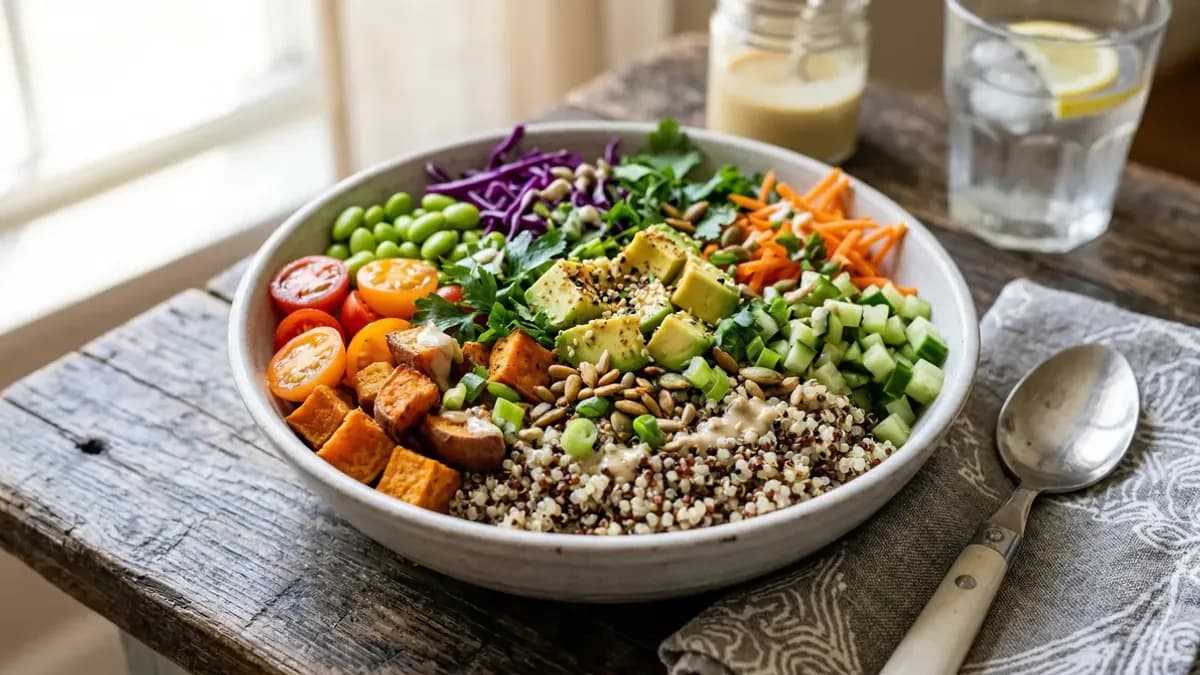
Quinoa is a small change with a noticeable impact on your protein intake. If you also want to work on your calorie intake deliberately, read how to calculate your calorie deficit for a personalised weight-loss plan. Whether you use it as a base for a lunch bowl or as an evening alternative to rice, it fits easily into a varied diet.
Want to know exactly what you're eating each day? With Moveno, you photograph your meal and instantly see the nutrition data. No weighing, no tables — just clarity.
Sources
- Voedingscentrum — Quinoa — nutritional overview and health information on quinoa
- Voedingscentrum — Nutritional value of cooked quinoa — verified values per 50g cooked
- RIVM — Dutch Food Composition Database (NEVO) — reference database for nutritional values