
If you do strength training, you know that protein is important for muscle growth. But the specific recommendations — how many grams, when, and from which sources — remain unclear for many athletes. This article presents the science-backed facts in a clear and practical way.
Key takeaways
- For optimal muscle building, you need 1.6–2.2 grams of protein per kilogram of body weight per day
- Spread your protein intake across 3–5 meals of 25–40 grams for the best utilisation
- Leucine is the key amino acid for muscle protein synthesis — animal sources are richest in it
- Protein intake after training (within 2 hours) may contribute to muscle recovery and growth
- Casein before bedtime supports overnight muscle recovery
- Tracking your food intake is the most reliable way to consistently hit your protein target
Why is protein so important for muscle growth?
Muscles are made up predominantly of protein. When you train, you create microscopic damage to muscle fibres — this is normal and even necessary. During the recovery period after training, these fibres are repaired and strengthened, provided you consume enough protein to support the process.
This process is called muscle protein synthesis (MPS). For maximum MPS, you need two things: a training stimulus and sufficient protein with the right amino acids.
The amino acid leucine plays a special role here. Leucine acts as a kind of 'switch' that activates muscle protein synthesis. Research shows you need at least 2–3 grams of leucine per meal to optimally stimulate MPS.
How many grams of protein per day for muscle building?
The most comprehensive meta-analysis in this area — a review by Morton et al. (2018) covering 49 studies and 1,800 participants — concluded that the optimal protein intake for muscle growth is 1.6 grams of protein per kilogram of body weight per day. For most people, more than 2.2g/kg provides no significant additional muscle growth.
The recommended range is therefore: 1.6–2.2 g/kg per day.
If you also want to lose fat simultaneously (body recomposition), aim for the higher end of the range: 2.0–2.4 g/kg per day helps preserve muscle mass in a calorie deficit.
Example: You weigh 85 kg and train four times per week. Optimal protein intake: 85 × 1.8 = 153 grams per day
The best protein sources for muscle building
Not all protein sources are equally effective for muscle building. Leucine-rich sources stimulate MPS most strongly:
Whey protein — 10–11% leucine. The fastest-absorbing protein source. Ideal immediately after training. Contains all essential amino acids in optimal proportions.
Chicken breast — 8% leucine. 31g protein per 100g. The most versatile protein source for daily nutrition.
Eggs — 8.5% leucine. A complete protein with a biological value of 100. Read more about how much protein is in an egg.
Lean beef — 8% leucine. Also provides creatine (important for strength performance) and iron.
Salmon and oily fish — 8% leucine. Unique for the combination of protein and omega-3, which also has anti-inflammatory effects and may improve muscle recovery.
Dairy (quark, Greek yoghurt) — Rich in casein, a slowly digested protein. Ideal for nighttime.
Plant-based sources — Tempeh and edamame contain relatively high leucine for plant protein. Seitan has plenty of protein but less leucine. Combine multiple plant-based sources for a complete amino acid profile.
How to distribute protein throughout the day
Total daily protein intake is the most important factor. But how you distribute it also matters:
Spread across 3–5 meals. Research shows the body optimally uses around 20–40 grams of protein per meal for muscle protein synthesis. More than 40 grams in one sitting provides no additional benefit — the excess is used for energy or excreted.
At least 2–3 grams of leucine per meal. This is the threshold for activating MPS. You find this in: 200g quark, 150g chicken breast, 3 eggs, 30g whey protein.
After training. For a long time, it was believed you needed to consume protein within 30 minutes after training. Newer research nuances this: the 'anabolic window' is more accurately about 2 hours. But post-workout protein intake remains beneficial.
Before bedtime. Casein protein (from quark, cottage cheese, or casein powder) is digested slowly over 6–8 hours. Studies by the research group of Luc van Loon (Maastricht University) show that 40g casein before sleep increases muscle protein synthesis overnight.
How many calories do you need for muscle building?
Protein alone is not enough. Muscle growth also requires a slight calorie surplus: 200–500 kcal more than your maintenance calories per day. Use a calorie deficit calculator to set the right balance for your goal.
A calorie deficit while trying to build muscle is suboptimal — the body needs energy to create new muscle tissue. For beginners, body recomposition (simultaneously losing fat and building muscle) can sometimes work, but for advanced athletes a split approach (bulking/cutting) is more effective.
Supplements: useful or unnecessary?
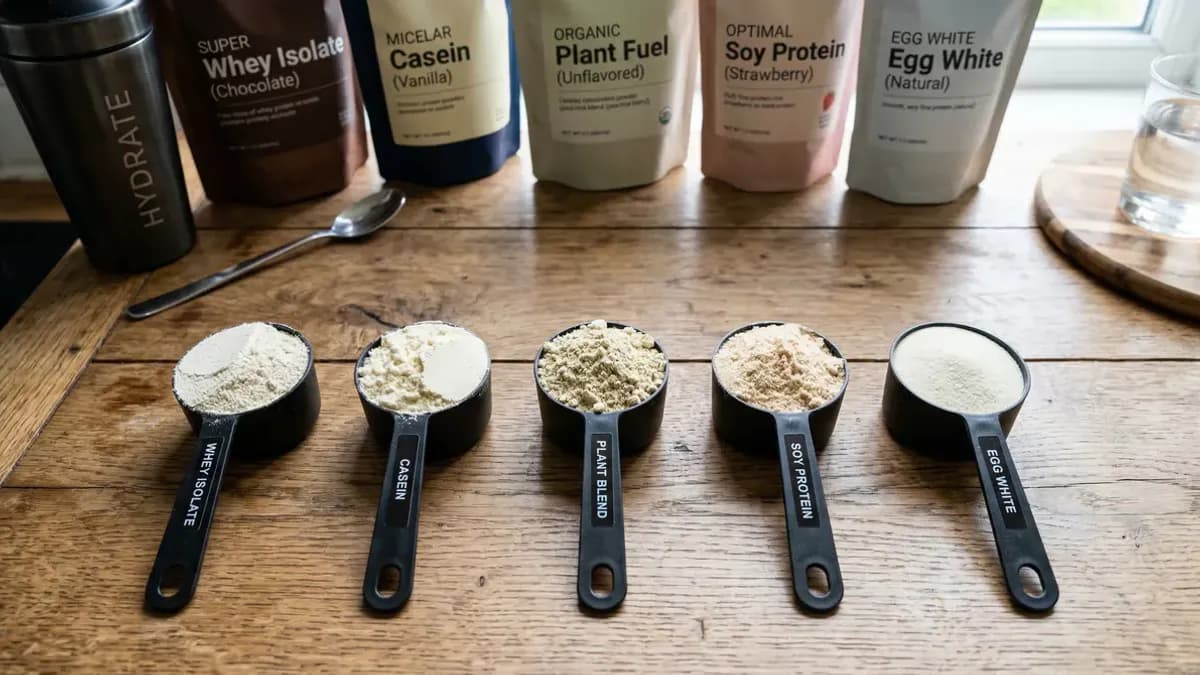
Protein powders are not magic — they are simply a convenient way to supplement your daily protein intake. If you are hitting your protein target through regular food, you do not need a supplement.
But for athletes who struggle to reach 1.6–2.2g/kg through solid food, whey protein can be a practical addition. A 30g whey shake contains around 24–25g protein, prepared in under 2 minutes.
Creatine (not a protein, but a supplement for strength athletes) also has strong scientific evidence for improving strength performance and indirectly supporting muscle growth through higher training volumes.
Tracking your intake
For strength athletes, tracking protein intake is the most reliable way to know whether you are consistently hitting your daily target. Many athletes underestimate how much protein they need and overestimate how much they actually eat.
With Moveno, you photograph your meal and immediately see the nutritional values, including protein content. Also read our guides on high-protein foods and how much protein you need per day.
Sources
- Morton RW, et al. A systematic review, meta-analysis and meta-regression of the effect of protein supplementation on resistance training-induced gains. British Journal of Sports Medicine. 2018;52(6):376-384. https://doi.org/10.1136/bjsports-2017-097608
- Res PT, et al. Protein ingestion before sleep improves postexercise overnight recovery. Medicine & Science in Sports & Exercise. 2012;44(8):1560-1569. https://doi.org/10.1249/MSS.0b013e31824cc363
- Churchward-Venne TA, et al. Leucine supplementation of a low-protein mixed macronutrient beverage enhances myofibrillar protein synthesis. American Journal of Clinical Nutrition. 2012;95(4):912-922. https://doi.org/10.3945/ajcn.111.021907