Protein is one of the three macronutrients and by far the most discussed. Whether you want to lose weight, build muscle, or simply eat more healthily — protein always plays a central role. But how many grams of protein per day do you actually need? And how does the average person meet their protein requirements?
Key takeaways
- The standard RDA of 0.8g protein per kg body weight is too low for most active people
- For weight loss, 1.6–2.0g/kg per day is optimal for preserving muscle mass
- Strength training requires 1.6–2.2g/kg per day for maximum muscle development
- Older adults (65+) benefit from a higher intake than the standard RDA
- Spreading protein across multiple meals improves utilisation
- Tracking your food intake helps you monitor your daily protein consumption
Why does your body need protein?
Proteins are the building blocks of virtually every tissue in your body: muscles, organs, skin, hair, nails, and enzymes are all made up of amino acids — the structural units of protein. Beyond their structural role, proteins are also involved in hormone production, immune function, and oxygen transport in the blood.
Your body can produce 11 of the 20 amino acids. The remaining 9 — the essential amino acids — must come from your diet. A good protein source contains all essential amino acids in the right proportions; this is called a 'complete protein'. Animal products are generally complete protein sources, while plant-based sources often lack one or more essential amino acids (seitan, for example, is low in lysine).
What are the official recommendations?
The Dutch Health Council recommends 0.83 grams of protein per kilogram of body weight per day for adults. For someone weighing 75 kg, that works out to about 62 grams per day.
But this recommendation is designed to prevent deficiency in sedentary people — it is a minimum, not an optimum. For people who exercise, want to lose weight, are getting older, or have specific health goals, the recommendations are significantly higher.
How much protein do you need?
Optimal protein intake varies by situation:
Sedentary (little physical activity): 0.8–1.0 g/kg per day. This is sufficient to maintain muscle mass with a predominantly desk-based lifestyle.
Recreational exercise (2–3 times per week): 1.2–1.4 g/kg per day. Moderate activity requires slightly more recovery capacity.
Regular intense exercise: 1.4–1.6 g/kg per day. Endurance sports such as running or cycling also cause muscle protein breakdown.
Strength training (muscle building): 1.6–2.2 g/kg per day. This is the most well-supported range for maximal muscle protein synthesis. Read more in our guide on protein for muscle building.
Weight loss (calorie deficit): 1.6–2.0 g/kg per day. In a calorie deficit, higher protein intake is essential to preserve muscle mass. Protein is also the most satiating macronutrient, helping you stay full longer.
Older adults (65+): 1.0–1.2 g/kg per day. Ageing is associated with anabolic resistance — your body responds less efficiently to protein, meaning you need more to achieve the same effect.
Pregnancy: 1.1 g/kg plus 25 grams extra. Always consult a doctor or registered dietitian during pregnancy.
A practical example
You weigh 80 kg and train with weights three times per week. Your optimal protein intake would be:
80 kg × 1.8 g/kg = 144 grams of protein per day
That may sound like a lot, but spread across four meals that is 36 grams per meal — very manageable with chicken breast (31g/100g), Greek yoghurt (10g/100g), eggs (6.3g per egg), and cottage cheese (11g/100g).
When is the best time to eat protein?
Research suggests that the timing of protein intake matters less than the total daily amount. That said, a few practical guidelines help:
Spread your protein intake across 3–5 meals of 25–40 grams. Your body can only use a certain amount per meal for muscle protein synthesis — large amounts in one sitting are partly used for energy or excreted.
Consume protein within 2 hours of training. The 'anabolic window' in research is somewhat wider than the strict 30-minute rule, but post-workout protein intake remains useful for recovery and muscle growth.
Also include a protein-rich food before bedtime. Casein — the protein in quark and cottage cheese — is digested slowly and may support overnight muscle maintenance.
High-protein foods at a glance
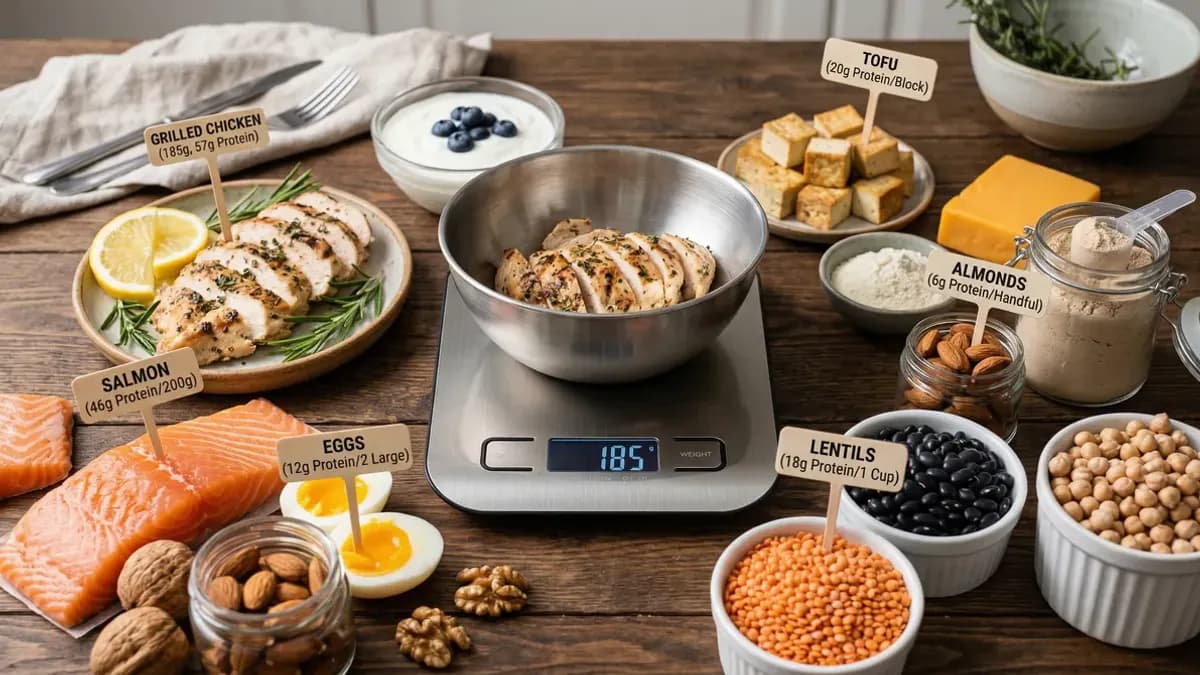
Want to know which foods contain the most protein? Check our comprehensive list of high-protein foods for a full top 30. In brief, the best sources include: chicken breast (31g/100g), tuna (30g), lean beef (26g), tempeh (19g), quark (12g), eggs (13g/100g), Greek yoghurt (10g), edamame (11g), and cooked lentils (9g).
How do you know if you are getting enough protein?
Without tracking, it is difficult to know whether you are hitting your protein target. Many people believe they eat enough protein, only to discover when they track their intake that they are consistently falling short — especially on rest days or during busy periods.
With an app like Moveno, you photograph your meal and immediately see the nutritional values, including protein content. This makes it easy to track whether you are hitting your daily protein target. Also read our guide on calorie tracking for beginners if you are just getting started.
Sources
- Morton RW, et al. A systematic review, meta-analysis and meta-regression of the effect of protein supplementation on resistance training-induced gains in muscle mass and strength. British Journal of Sports Medicine. 2018;52(6):376-384. https://doi.org/10.1136/bjsports-2017-097608
- Stokes T, et al. Recent Perspectives Regarding the Role of Dietary Protein for the Promotion of Muscle Hypertrophy. Nutrients. 2018;10(2):180. https://doi.org/10.3390/nu10020180
- Gezondheidsraad. Eiwitten. https://www.gezondheidsraad.nl/onderwerpen/voeding/eiwitten