
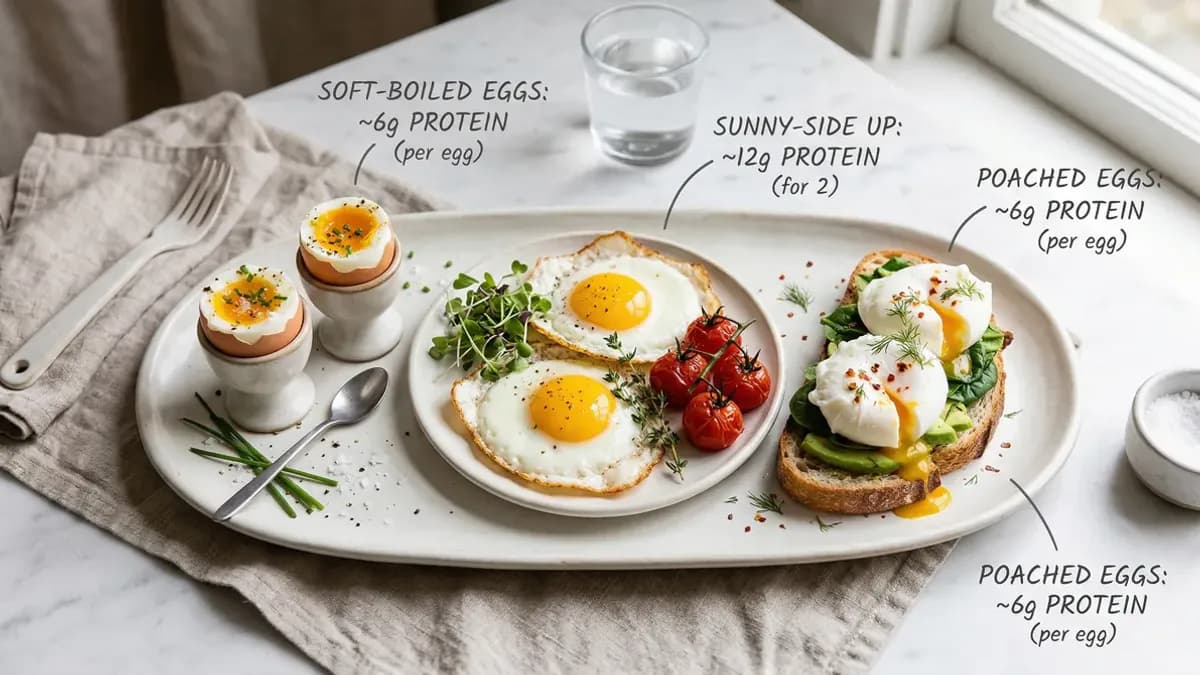
Eggs have been a staple food for centuries. They are affordable, versatile, and highly nutritious. But most people do not know exactly how much protein an egg contains — let alone the difference between the egg white and the yolk, or why the biological value of egg protein is so remarkable.
Key takeaways
- A large egg (63g) contains approximately 7.9g of protein
- The egg white contains 3.6g and the yolk contains 2.7g of protein per egg
- Eggs have a biological value of 100 — the reference standard for protein quality
- Your body utilises egg protein almost completely
- Cooked eggs provide slightly more available protein than raw eggs
- Eggs are one of the most complete and affordable protein sources available
How much protein per egg — by size
Not all eggs are the same size. The protein content varies accordingly:
| Size | Weight | Protein |
|---|---|---|
| Small (S) | ~45g | 5.6g |
| Medium (M) | ~53g | 6.6g |
| Large (L) | ~63g | 7.9g |
| Extra large (XL) | ~73g | 9.1g |
A standard supermarket egg is typically size L (63g), which contains around 7.5–8g of protein per egg. The figure of 6.3g that sometimes appears is based on a 50g egg — a slightly smaller average than the typical supermarket egg.
Want to get 30 grams of protein from eggs? You need approximately 4 large eggs.
White vs. yolk: where is the protein?
There is a persistent myth that the yolk is bad for you and you should only eat the white. The reality is more nuanced:
The egg white: Contains approximately 3.6g of protein per egg and virtually no fat. It consists largely of water and albumin proteins. Very low in calories.
The yolk: Contains approximately 2.7g of protein per egg, but also all the fats, cholesterol, vitamin A, D, E, K, B12, B2, folate, iron, zinc, and choline. The yolk is the most nutritionally dense part of the egg.
Both the white and the yolk contribute to protein intake, but the yolk offers far more micronutrients. Unless you are specifically counting calories or have a cholesterol issue, the advice is simple: eat the whole egg.
Why does egg protein have a biological value of 100?
The biological value (BV) is a measure of how well a protein source can be utilised by your body. A BV of 100 means the protein contains all essential amino acids in optimal proportions — exactly as your body needs them.
The egg was historically used as the reference point (BV = 100) against which all other protein sources are measured. Other sources score lower:
- Whey protein: 104 (higher than egg due to an improved amino acid ratio)
- Chicken breast: 79
- Beef: 80
- Soy protein: 74
- Lentils: 52
In practice, a higher BV means you need fewer grams to deliver the same amount of usable amino acids. Eggs are not only complete in their amino acid profile — they are also highly efficient.
Raw vs. cooked: does it matter?
An interesting fact: raw egg white is only 51% digestible, while cooked egg white is 91% available. This is because heat breaks open the protein structure (denaturation), giving digestive enzymes better access.
The yolk is well digested both raw and cooked.
Conclusion: eat your eggs cooked, poached, fried, or as an omelette. This maximises protein utilisation.
How many calories does an egg contain?
A whole large egg (63g, size L) contains:
- Calories: 88 kcal
- Protein: 7.9g
- Fat: 6.2g (of which 1.9g saturated)
- Carbohydrates: 0.6g
- Cholesterol: 190mg
Eggs are relatively low in calories for the amount of protein they provide. For comparison: 100g chicken breast contains 120 kcal and 31g protein, but eggs are significantly cheaper per euro.
Eggs and cholesterol: the nuance
For decades, eggs were discouraged due to their cholesterol content. More recent research has refined this position. The Dutch Health Council states that for healthy people, eating a few eggs per week has no negative effect on cardiovascular disease risk.
For people with type 2 diabetes or existing heart disease, it may be advisable to moderate consumption and always consult a dietitian.
For healthy, active people, 1–3 eggs per day fits comfortably within a varied diet.
Comparing eggs to other protein sources
How does the egg compare to other popular protein sources?
| Source | Protein per 100g | Kcal per 100g | Cost (NL, approximate) |
|---|---|---|---|
| Chicken breast | 31g | 120 kcal | €€ |
| Eggs | 13g | 143 kcal | € |
| Quark | 12g | 65 kcal | € |
| Canned tuna | 30g | 115 kcal | €€ |
| Lentils (cooked) | 9g | 116 kcal | € |
| Greek yoghurt | 10g | 97 kcal | €€ |
Per gram of protein, eggs are one of the most affordable options — especially when the micronutrient richness of the yolk is factored in.
Practical: how many eggs per day?
There is no magic number, but for most healthy adults:
- 1–3 eggs per day fit very well within a healthy diet
- For strength athletes with high protein targets (see also protein for muscle building): eggs are a valuable addition, but use other sources too for variety
- Combined with other protein sources for a complete daily menu
Want to know more about protein-rich foods in general? See our top 30 high-protein foods or read about how much protein you need per day.
Tracking your intake
With an app like Moveno, you photograph your meal and immediately see the nutritional values, including the protein content of your eggs. This makes it easy to track whether you are hitting your daily protein target. Also read our guide on calorie tracking for beginners to get started.
Sources
- NEVO Online. Dutch food composition database. https://nevo-online.rivm.nl/
- Evenepoel P, et al. Digestibility of cooked and raw egg protein in humans. Journal of Nutrition. 1998;128(10):1716-1722. https://doi.org/10.1093/jn/128.10.1716
- Gezondheidsraad. Richtlijnen goede voeding 2015. https://www.gezondheidsraad.nl
- Voedingscentrum. Eieren. https://www.voedingscentrum.nl/encyclopedie/ei.aspx