What is creatine?
Creatine is a compound that occurs naturally in your body — primarily in muscle cells — and that you also obtain through food, particularly meat and fish. It plays a key role in energy production during short-duration, high-intensity exercise: creatine helps your body regenerate ATP (adenosine triphosphate) more quickly, the universal energy molecule for muscle contractions.
Your body produces creatine on its own, but supplementation can increase the creatine stores in your muscles by 20–40%. That modest difference translates into measurably better performance in explosive and strength-based exercise.
How does creatine work?
During intense exercise, your body rapidly depletes ATP. The phosphate group from creatine phosphate is used to convert spent ADP back into ATP — an extremely fast process that provides a brief boost of additional power for sprinting, lifting and other explosive movements.
With more creatine stored in your muscles, you can:
- Generate higher peak power output
- Complete more repetitions at a given weight
- Recover faster between sets
- Build more muscle mass over time through higher training volumes
What does the science say?
Creatine is the most extensively studied sports supplement in the world. Dozens of meta-analyses and systematic reviews confirm its effectiveness.
A comprehensive 2024 meta-analysis found that creatine supplementation combined with resistance training significantly increased upper-body strength (average 4.43 kg) and lower-body strength (average 11.35 kg) compared to placebo in adults under 50 years of age.
A 2025 systematic review concluded that both beginner and experienced strength athletes benefit from creatine, with beginners showing slightly greater gains given their lower initial training adaptations.
Summarised benefits:
- Strength and explosive power increase by 5–15%
- Greater lean mass gains (average 0.82 kg additional)
- Improved recovery between training sessions
- Possible cognitive benefits (memory, concentration under mental fatigue)
- Promising applications for older adults and certain clinical populations
Which form of creatine is best?
The market offers dozens of variants: creatine monohydrate, creatine HCl, buffered creatine (Kre-Alkalyn), liquid creatine, creatine ethyl ester and more.
Conclusion: Creatine monohydrate is the gold standard. It is:
- The most extensively studied (virtually all research uses monohydrate)
- Proven most effective
- The most affordable option
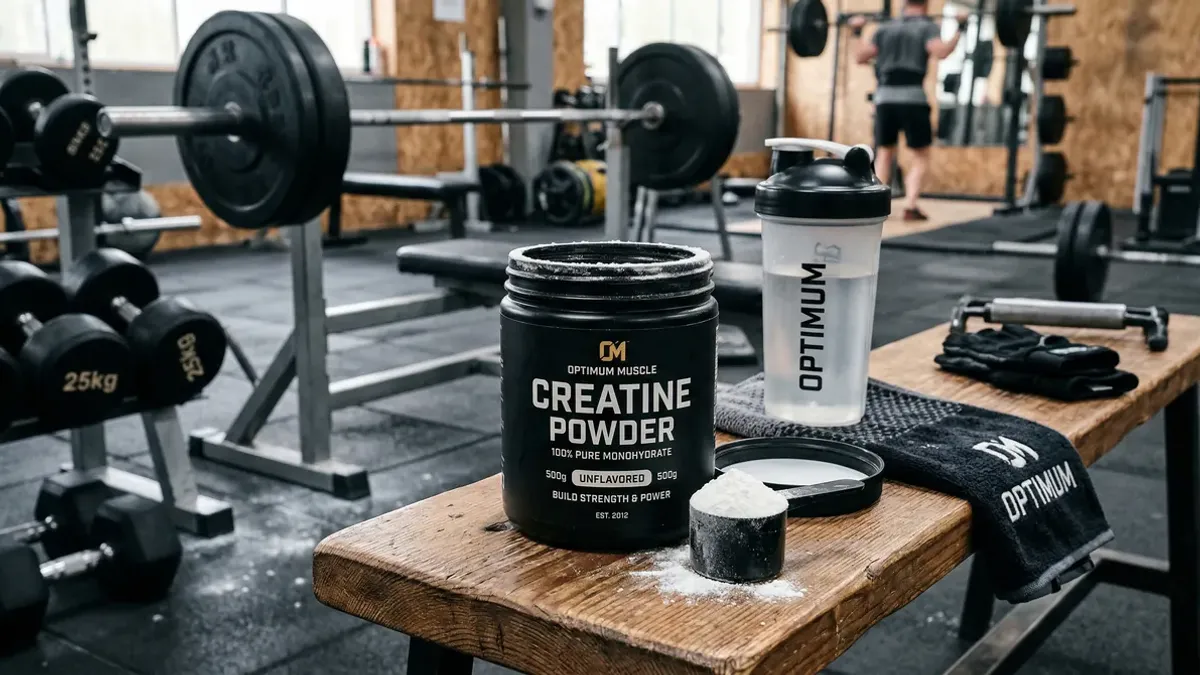
There is no convincing evidence that any other form outperforms monohydrate. Choose micronised creatine monohydrate for better solubility.
Dosage: how much creatine per day?
There are two common protocols:
Protocol 1: Loading phase + maintenance phase
- Loading phase: 20 grams per day (divided into 4 doses of 5 g) for 5–7 days
- Maintenance phase: 3–5 grams per day thereafter
Advantage: muscles become saturated with creatine more quickly. Disadvantage: greater risk of gastrointestinal discomfort during the loading phase.
Protocol 2: Continuous low dosing (recommended)
- 3–5 grams per day, every day (including non-training days)
This protocol achieves the same level of muscle saturation as the loading phase within 3–4 weeks. It is simpler to maintain and carries a lower risk of side effects.
When to take it? Timing matters little. Around training (before or after) may offer a slight advantage, but the effect is small. Consistency is more important than precise timing.
Side effects of creatine
Creatine is one of the most thoroughly documented safe supplements at doses of 3–5 g/day in healthy adults.
Weight gain in week 1: You may gain 0.5–2 kg in the first week due to water retention in the muscles. This is not fat — it is additional fluid that makes muscles appear fuller and more pumped.
Gastrointestinal discomfort: May occur at higher doses (>10 g at once). Spread your intake throughout the day or reduce the dose.
Kidney strain: There is no evidence that creatine causes kidney damage at normal doses in healthy individuals. People with pre-existing kidney conditions should consult their doctor before use.
Creatinine in blood tests: Creatine supplementation raises creatinine levels in blood and urine — this is a normal metabolic by-product, not a sign of kidney damage.
Creatine and nutrition tracking
Creatine affects your body weight (water retention) but not your calorie needs. If you track your nutrition and weigh yourself regularly, account for the weight increase in the first week — it is not body fat.
Want to track what you eat around your workouts too? With Moveno you can scan your pre-workout meal and recovery meal and instantly see your macros.
Who benefits most from creatine?
Creatine is most effective for:
- Strength athletes (weightlifting, powerlifting, CrossFit)
- Sprint disciplines (sprinters, rowers, footballers)
- Team sports with explosive moments (basketball, volleyball, hockey)
Less relevant for:
- Pure endurance athletes (marathon runners, long-distance cyclists) — although some research shows modest benefits here too
Creatine is not recommended for children without medical supervision. For older adults, creatine is particularly promising: it may help slow muscle mass loss and preserve strength with age.
Key takeaways
- Creatine monohydrate is the most researched and most effective sports supplement available.
- Dosage: 3–5 grams per day, every day — no loading phase necessary.
- Expect 5–15% more strength and explosive power, plus greater lean mass gains over time.
- Safe at normal doses; weight gain in week 1 is water retention, not fat.
- Most effective for strength sports and explosive disciplines.
Sources
- Effects of Creatine Supplementation on Muscle Strength Gains — Meta-analysis (PMC, 2024)
- Creatine supplementation and resistance training, novice vs. experienced lifters — Systematic review (2025)
- Effects of Creatine on Upper- and Lower-Body Strength, Meta-analysis (MDPI, 2025)
- Creatine monohydrate for older adults and clinical populations (PMC, 2024)