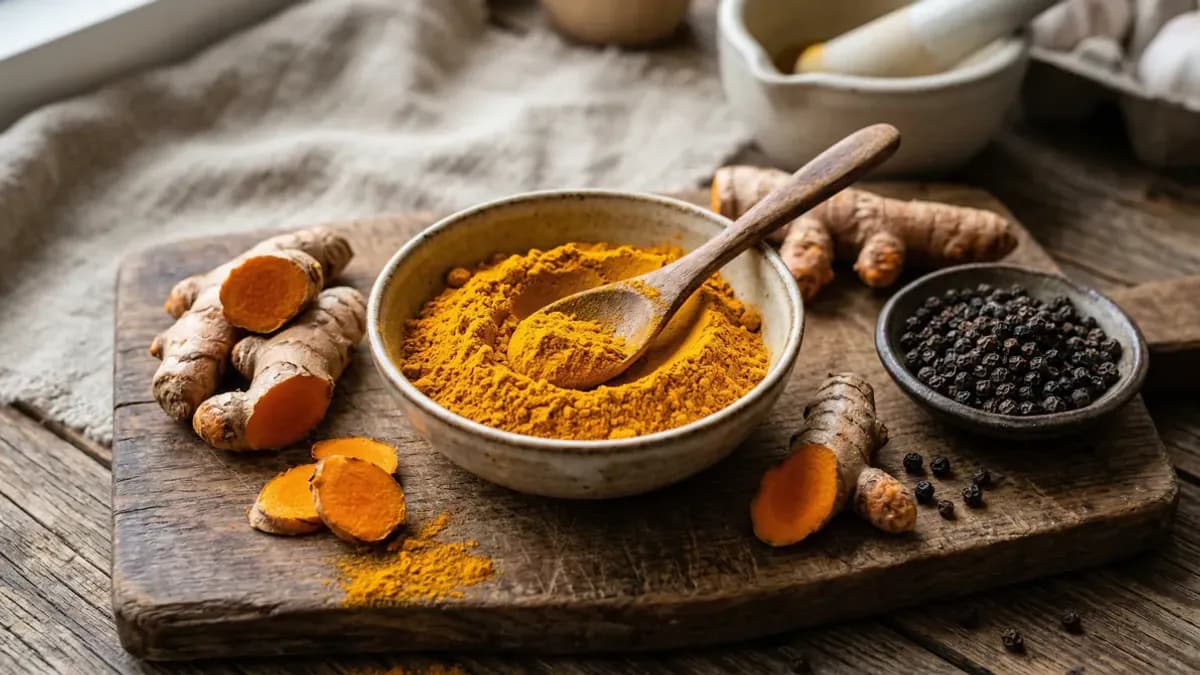
Turmeric has been used in cooking and traditional medicine for thousands of years. The active compound behind most of the research interest is curcumin — a polyphenol that gives turmeric its bright yellow colour. The science is promising, but there's a catch that most articles skip: curcumin is very poorly absorbed on its own.
Key takeaways
- Turmeric contains curcumin, a polyphenol with anti-inflammatory and antioxidant properties that has been extensively studied.
- Curcumin absorption is naturally poor — it is rapidly broken down in the liver and intestinal wall.
- Combining turmeric with piperine (from black pepper) can significantly increase curcumin bioavailability.
- Turmeric also contains manganese, iron, and vitamin B6, contributing modestly to daily nutritional intake.
- For healthy people, using turmeric as a kitchen spice — combined with black pepper and a fat source — is the most practical approach.
What is curcumin and what does it do?
Curcumin is the primary active compound in turmeric, making up roughly 2–5% of the dried spice by weight. It belongs to the polyphenol family — plant compounds studied for their anti-inflammatory and antioxidant properties.
Research suggests curcumin may contribute to reducing chronic low-grade inflammation as part of a varied diet. For healthy individuals, the key word is "may" — the evidence is promising but not conclusive enough to treat turmeric as medicine.
Why curcumin absorption is the real problem
Here's what most articles don't tell you. Even at a dose of 2g of curcumin, serum levels are either undetectable or very low when taken alone. The compound is rapidly metabolised in the liver and intestinal wall, meaning little of what you consume reaches systemic circulation.
This is why simply adding more turmeric to your food probably won't produce measurable health effects. Supplements with concentrated curcumin extracts attempt to address this — but for everyday kitchen use, there's a simpler solution.
Black pepper: the bioavailability solution
Piperine — the active compound in black pepper — inhibits the enzyme that breaks curcumin down. A landmark study by Shoba et al. (1998, published in Planta Medica) found that co-administering 20mg of piperine with 2g of curcumin increased bioavailability by 2,000% in human volunteers.
Translate this to your kitchen: a pinch of black pepper added to any turmeric dish is a simple habit that extracts more value from each serving. Add a fat source too — curcumin is fat-soluble, so cooking with oil helps absorption further.
The practical formula: turmeric + black pepper + fat (olive oil, coconut oil, full-fat yoghurt).
How to use turmeric in cooking
Turmeric is versatile but strong — a little goes a long way. Practical applications:
- Curries and rice dishes. The classic use. Combine with black pepper and a good oil.
- Golden milk. Warm plant milk with turmeric, ginger, pepper, and a pinch of cinnamon.
- Soups and stews. Half a teaspoon through a lentil or carrot soup adds depth and colour.
- Smoothies. A small pinch (0.5g) blends almost undetected with mango or pineapple.
Want to track your spice intake alongside your full nutrition data? With Moveno, you log ingredients easily and see the complete nutritional breakdown of your meal.
Turmeric supplements: when does it make sense?
Concentrated curcumin supplementation (500–1,000mg per day, with piperine or in liposomal form) is being studied for people with chronic inflammatory conditions. That's beyond the scope of this article — and beyond the remit of a nutrition app.
If you're healthy and considering turmeric supplements, a conversation with your GP or registered dietitian is more useful than self-selecting high doses.
Nutritional values of turmeric as a spice
Per teaspoon (3g) of turmeric powder: roughly 9 kcal, 0.3g protein, 2g carbohydrates, and 0.7g fiber. It also contains manganese, iron, and vitamin B6 — not in large quantities, but a small contribution to a varied diet.
For anyone focused on eating well, turmeric is an easy addition with negligible caloric impact.
Give turmeric a fair chance in your kitchen
Turmeric deserves a permanent spot in your spice rack — not because it's a cure-all, but because it's a flavourful spice with an interesting profile. Use it daily in small amounts, always with black pepper and a fat source.
Want more clarity on your eating patterns? With Moveno, you analyse meals from a photo — so you know exactly what you're eating, turmeric and all.
Sources
- Voedingscentrum — Kurkuma — general information on turmeric and curcumin
- Shoba G. et al. — Influence of piperine on the pharmacokinetics of curcumin (PubMed) — landmark study on 2,000% bioavailability increase with piperine
- RIVM — Dutch Food Composition Database (NEVO) — reference database for nutritional values