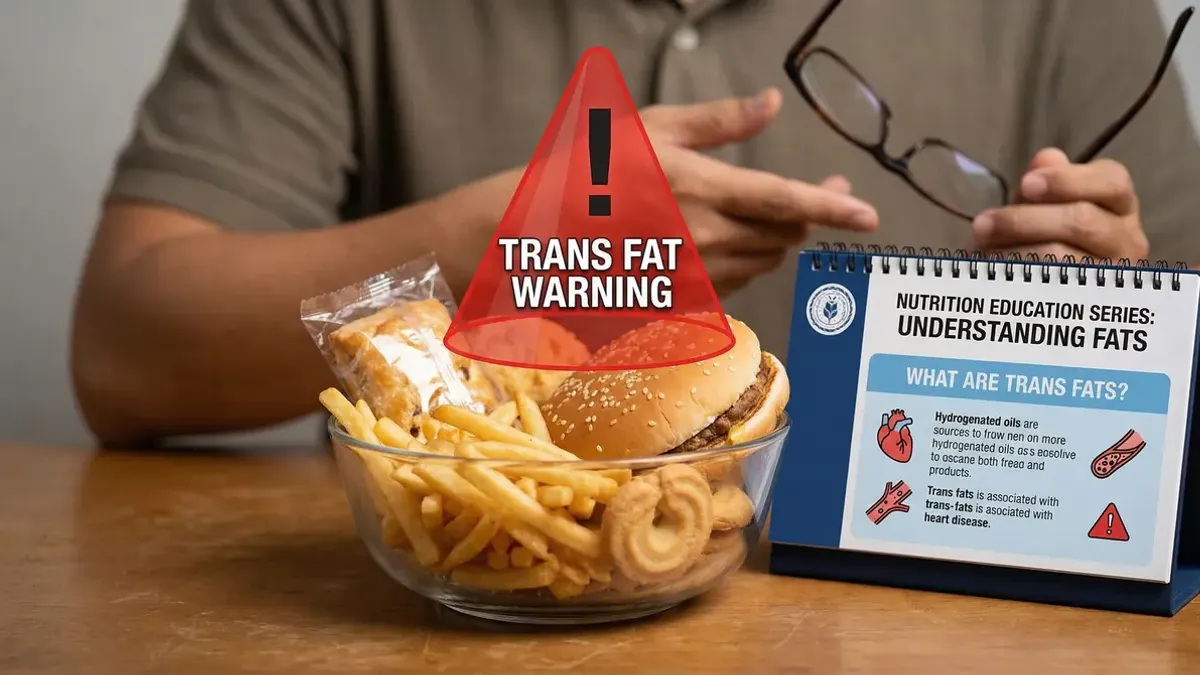
Most debates about dietary fat come with nuance and caveats. Trans fats are different. They are the one type of fat that nutrition scientists, health authorities and regulators universally agree should be minimised — and since 2021, EU law agrees too.
Key takeaways
- Trans fats are the only dietary fat that simultaneously raises LDL (bad) cholesterol and lowers HDL (good) cholesterol — making them uniquely harmful.
- EU Regulation 2019/649, in effect from April 2, 2021, limits industrially produced trans fats to 2 grams per 100 grams of fat in consumer food products.
- Most Dutch consumers eat around 0.7 grams of trans fats per day — well below the Health Council's upper limit.
- The main risk today comes from imported products outside the EU, and some processed baked goods from smaller producers.
- "Partially hydrogenated oil" on an ingredient list is the key term to watch for.
What are trans fats?
Trans fats (or trans fatty acids) are fats with a specific molecular structure. They come in two forms:
- Industrial trans fats: formed when liquid vegetable oils are partially hardened (hydrogenated). This process made fats cheaper, more shelf-stable and firmer — ideal for food manufacturing, harmful for health.
- Natural trans fats: occur naturally in the milk and meat of ruminants like cows and sheep. These appear to have a different — less harmful — effect than industrial trans fats, according to the Voedingscentrum.
The health concerns relate primarily to industrial trans fats.
Why are trans fats uniquely harmful?
Trans fats are the only dietary fat that combines two negative effects simultaneously:
- They raise LDL cholesterol (bad cholesterol) — just like saturated fats do.
- They lower HDL cholesterol (good cholesterol) — something saturated fats do not do.
This combination makes trans fats worse than saturated fats for cardiovascular risk. Even small amounts may increase heart disease risk, according to the Dutch Health Council.
Curious how trans fats compare to saturated fats? Read our guide on those too — the picture is more nuanced than most people expect.
The EU regulation: what changed in 2021?
Before 2021, the EU had no binding limit on trans fats in food. That changed with EU Regulation 2019/649, which came into force on April 2, 2021.
The regulation stipulates:
- A maximum of 2 grams of industrially produced trans fats per 100 grams of fat in food products sold to consumers
- The limit does not apply to naturally occurring trans fats in dairy and meat
- Operators supplying food to other businesses must provide trans fat information when the content exceeds 2 grams per 100 grams of fat
This makes the EU one of the strictest regulatory environments for trans fats in the world.
Where do trans fats still appear?
Thanks to regulation and voluntary reformulation by the food industry, trans fat levels in Dutch products have fallen sharply. Dutch people now consume an average of 0.7 grams of trans fat per day — well below the Health Council's upper limit of 1 percent of daily calories (approximately 2 grams at 2,000 kcal/day).
However, some products may still contain trans fats:
- Imported products from outside the EU, which are not bound by European limits
- Baked goods and biscuits from smaller producers
- Fast food in countries without strict trans fat regulation
Check the ingredient list: "partially hardened fat/oil" or "partially hydrogenated oil" are the terms that signal trans fat content.
How to avoid trans fats
Practical steps:
- Read the ingredient list, not just the nutrition table — small amounts don't have to be separately declared
- Choose soft margarine over hard block margarine (soft varieties contain virtually no trans fats)
- Be cautious with imported products — especially from outside the EU
- Prefer fresh over processed — fresh foods contain no industrial trans fats by definition
If you want to understand your full fat intake, read our guide on food tracking — it's simpler than most people assume.
Are dairy trans fats also dangerous?
Natural trans fats in dairy — such as butyric acid and vaccenic acid — are metabolised differently from industrial trans fats. Some research suggests neutral or even mildly beneficial effects. The Dutch Health Council considers the evidence on natural trans fats insufficient to classify them as harmful.
This is not a reason to eat unlimited dairy — but it does mean the word "trans fat" on an ingredient list doesn't automatically indicate a dangerous product. Context, as always, matters.
Trans fats and your overall eating pattern
Avoiding trans fats is one step towards a healthier diet. To also monitor your calorie intake alongside fat reduction, read our beginner's guide to calorie tracking. Want to lose weight effectively too? Then calculating your calorie deficit is the logical next step.
Start avoiding trans fats today
For most people in the Netherlands, trans fat intake is already low thanks to EU regulation. But if you frequently buy imported products or eat processed snacks, it's worth checking ingredient lists.
Moveno flags trans fat content in your daily nutrition overview, so you can see at a glance whether a product is worth a closer look — without needing a degree in food science.
Sources
- Voedingscentrum — Trans fat — Dutch dietary guidelines on trans fats, sources and health effects
- Evmi — European regulation limits trans fatty acids in food — EU Regulation 2019/649 in force from April 2, 2021
- NBC — New trans fat law: what you need to know — practical explanation of the EU trans fat limit for food businesses