
Why food tracking works
You may have already tried to eat healthier, but without concrete insight into what you eat, it is hard to know what to improve. Food tracking — also called food logging — is one of the most evidence-backed strategies for building awareness around eating.
A large study published in the journal Obesity found that people who tracked their food daily lost twice as much weight as those who did not. Not because they followed a stricter diet, but simply because they became aware of what they were eating.
It is not about perfection or obsessive control. It is about insight.
What you learn from tracking your food
When you consistently log what you eat for a few weeks, you discover patterns you would never otherwise notice:
- Unconscious snacking: the few biscuits with coffee, the piece of cheese from the fridge — they all add up
- Meal size illusion: what looks 'not that much' on the plate can be 600–800 kcal
- Protein shortfall: most people eat less protein than they think, and more carbohydrates and fat
- Time patterns: many people eat more in the evening than during the day, undermining daytime satiety
- Hidden calories: sauces, oil, dressings and drinks contribute more than expected
This awareness is the starting point for change. You can improve what you can see. What you cannot see, you cannot.
How do you start food tracking?
Step 1: choose a method
There are three commonly used ways to track your food:
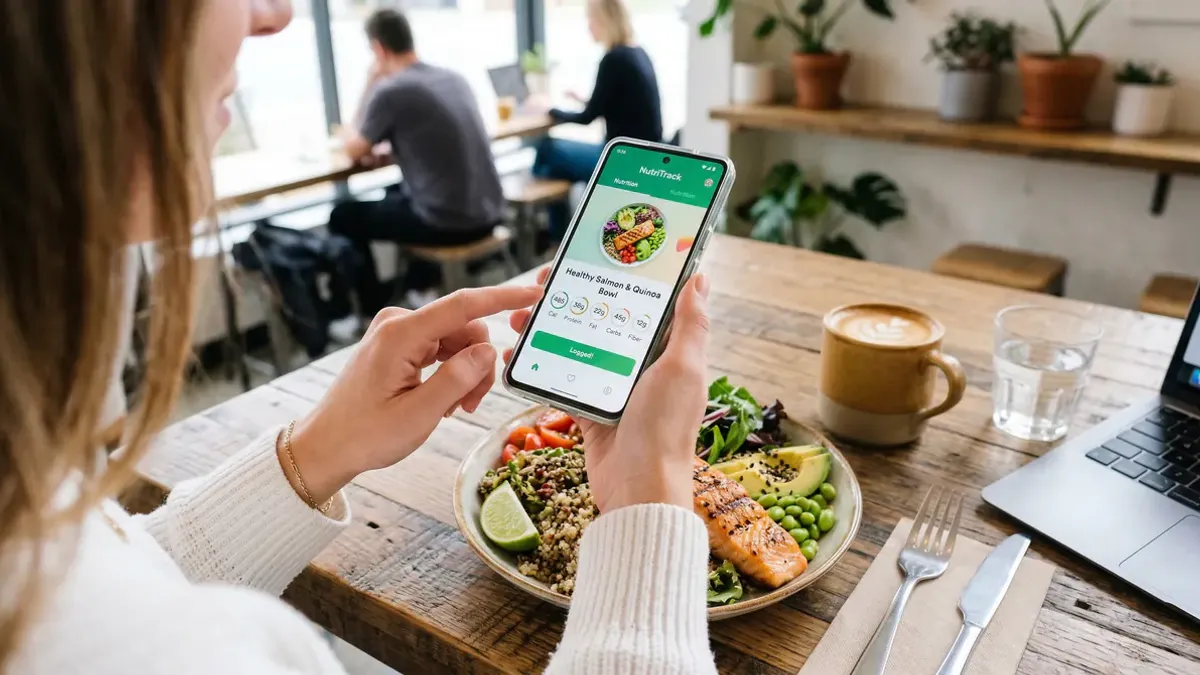
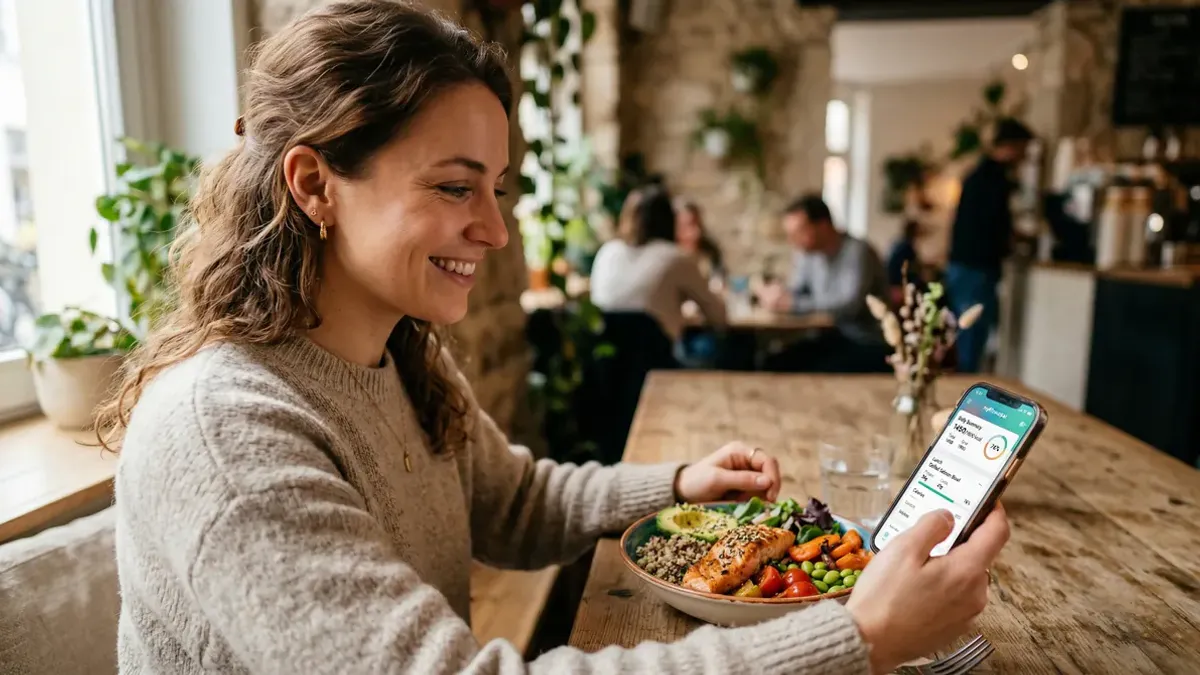
Digital nutrition app (recommended) Apps like Moveno make logging your meals radically simpler: photograph your meal and the AI automatically recognises the nutritional values. No manual entry, no barcode scanning needed. You can also search manually or scan a barcode if you prefer.
Paper food diary A notebook or printable diary works for people who prefer analogue. The downside: you have to look up nutritional values yourself, which is time-consuming.
Spreadsheet A middle ground — flexible but time-consuming, and without a built-in food database.
For most people, an app is the most sustainable option long-term.
Step 2: start with main meals
You do not need to log everything right away. Start with your three main meals. That already gives you 80% of the insight. After a week or two you can add snacks and drinks.
Perfection is the enemy of consistency. It is better to track 6 out of 7 days than to have one perfect day per week.
Step 3: learn to estimate portions
One of the most useful skills you build through food tracking is portion estimation. After 3–4 weeks of consistently weighing and logging, you can recognise an 80 g portion of pasta or 150 g of chicken by eye — without a scale.
Invest in a kitchen scale at the start (approximately €15–20). This is one of the most valuable health investments you can make.
Step 4: focus on trends, not perfection
Eating too much one day is not a problem. Patterns of overeating are. Look at your weekly overview and ask yourself:
- Are my average protein levels high enough?
- On which days do I eat the most?
- Which meals are more calorie-dense than I thought?
What should you track?
For most people it is sufficient to focus on:
- Calories — the basic energy balance
- Protein — for muscle retention, satiety and recovery
- Fibre — for digestive health and satiety
Carbohydrates and fat are worth tracking if you want more detail, but for beginners, calories and protein are the most valuable metrics.
Micronutrients (vitamins, minerals) are valuable for specific conditions or diets but are too complex for daily use.
How long should you track?
This depends on your goal:
- If you want to lose weight: track until you reach your desired weight, then check periodically
- If you want to build muscle: track until your macro targets have become a habit
- If you want more awareness: 4–8 weeks are enough to gain lasting insights
Many people stop actively tracking once they have a good feel for portions and macros. That is completely normal — and a sign of success.
Common mistakes when tracking food
Weighing everything afterwards. Weigh during cooking, not after. Cooked rice weighs differently from uncooked.
Forgetting sauces and oil. A splash of olive oil for frying is easily 100–150 kcal. Include it.
Skipping logging on bad days. It is tempting not to log a day when you have eaten 'badly'. Do it anyway — those are the days you learn the most.
Only counting, not interpreting. Review your data regularly. Numbers alone give no insight — analysis does.
Food tracking and mental health
A note of caution: for some people, food tracking may lead to an unhealthy obsession with eating. If you notice that tracking causes stress, or if you have a history of eating disorders, it is wise to discuss this with a professional first.
Tracking is a tool, not a goal. Use it as long as it helps you, and stop if it causes stress.
Tracking your nutrition with Moveno
Moveno makes tracking your food as easy as possible: photograph your meal and the AI instantly recognises the nutritional values — no manual entry required. The app also works with barcode scanning and text search for products you cannot photograph.
Want more insight into your nutrition? Check out our articles on calculating your calorie deficit and a free meal plan as a starting point.
Key takeaways
Food tracking is one of the most effective strategies for mindful eating and weight management. If you are just starting out, our beginner's guide to calorie tracking gives you the foundations before you dive in. Start simple: use an app and track your three main meals. Add snacks and drinks after a week. Focus on trends, not perfection. After 4–8 weeks you will have lasting insight into your eating pattern — even if you stop actively tracking later.
Sources
- Hollis JF et al. (2008). Weight loss during the intensive intervention phase of the weight-loss maintenance trial. American Journal of Preventive Medicine. https://www.ncbi.nlm.nih.gov/pmc/articles/PMC2515566/
- Burke LE et al. (2011). Self-monitoring in weight loss: a systematic review of the literature. Journal of the American Dietetic Association. https://pubmed.ncbi.nlm.nih.gov/21185970/
- Dutch Nutrition Centre (Voedingscentrum). Eat mindfully with a food diary. https://www.voedingscentrum.nl