
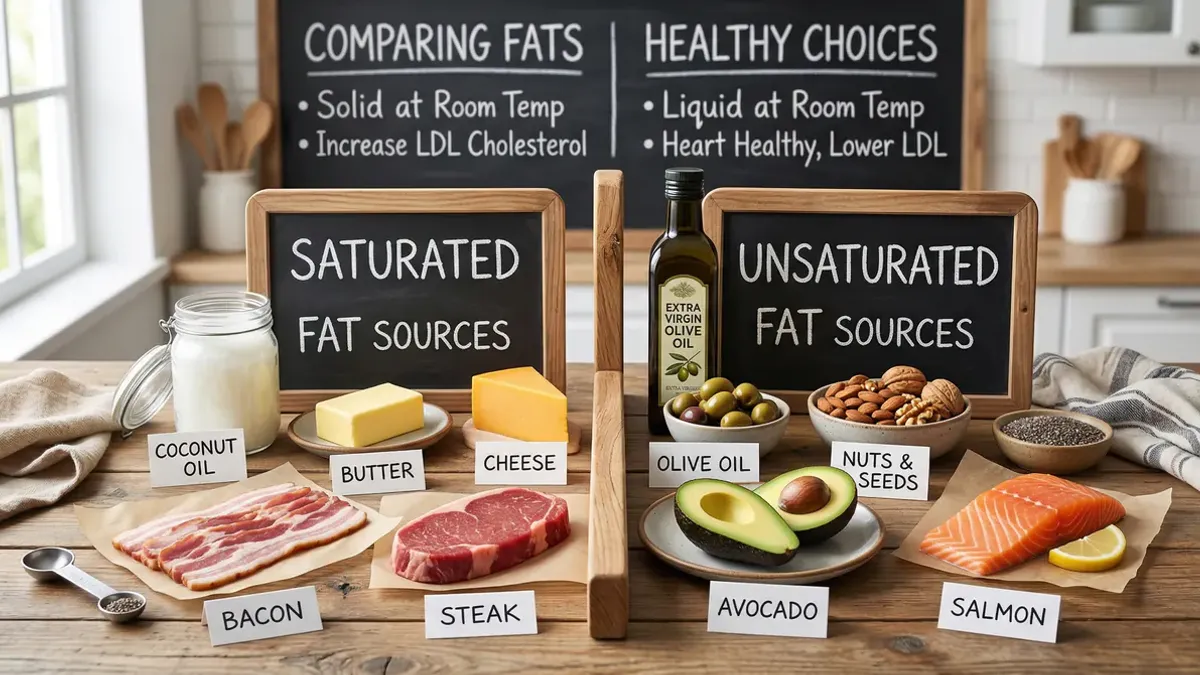
"Avoid saturated fat" — you've seen this message on food packaging for decades. But the science has become considerably more nuanced since that advice first emerged. Not all saturated fats behave the same way, and the link to heart disease is more complex than a single nutrient recommendation can capture.
Key takeaways
- Saturated fats raise LDL cholesterol — a risk factor for cardiovascular disease through arterial plaque buildup.
- The Dutch Health Council recommends keeping saturated fat below 10 percent of daily calorie intake.
- Replacing matters more than reducing: swap saturated fats for unsaturated fats (olive oil, nuts, avocado) — not for sugar or refined carbohydrates.
- Not all sources are equal: butter, coconut oil and red meat are high; dairy has a more nuanced effect than often assumed.
- Your overall dietary pattern determines cardiovascular risk far more than any single ingredient.
What are saturated fats?
Fats are built from fatty acid chains. In saturated fats, those chains are fully "saturated" with hydrogen atoms — hence the name. They are solid at room temperature (think butter and coconut oil) and found predominantly in animal products.
Common saturated fat sources:
- Red meat — beef mince, bacon, lamb
- Dairy products — butter, cheese, whole milk, cream
- Coconut oil and palm oil — widely used in food manufacturing and popular in health food circles
- Baked goods and biscuits — often made with hardened vegetable fats
What do saturated fats do to your cholesterol?
Saturated fatty acids raise LDL cholesterol in your blood. LDL — often called "bad cholesterol" — is a risk factor for developing cardiovascular disease through atherosclerosis.
The important nuance: the Dutch Health Council concluded, based on a large body of research, that LDL cholesterol falls when you replace saturated fatty acids with unsaturated ones. This also lowers heart disease risk. The Voedingscentrum therefore recommends replacing butter with soft margarine, liquid cooking fat, or vegetable oils with low saturated fat content.
However, some saturated fats — particularly those in dairy — have a less clear-cut effect on cardiovascular risk than long assumed. Research into overall dietary patterns consistently shows that no single nutrient is the whole story.
How much saturated fat per day?
The Dutch Health Council and Voedingscentrum recommend: no more than 10 percent of your daily calorie intake from saturated fats. For someone eating 2,000 calories per day, that's around 22 grams of saturated fat.
For context: one tablespoon of butter already contains about 7 grams of saturated fat. A 30-gram portion of cheddar adds around 6 grams. You reach the limit faster than most people realise.
Replacing: this is where it actually matters
Here is the most common mistake: people reduce saturated fat but replace it with sugar, white bread, or other refined carbohydrates. That doesn't help — and may actively worsen blood sugar and triglyceride levels.
The right replacement is unsaturated fat:
- Olive oil instead of butter for cooking and spreading
- Nuts and nut butter as a snack instead of cheese or processed meat
- Avocado as a source of monounsaturated fats — see our avocado nutrition guide
- Fatty fish like salmon and mackerel — rich in polyunsaturated omega-3 fatty acids
Want to understand omega-3 in more depth? Read our omega-3 fatty acids guide.
Are all saturated fats equally harmful?
No. Emerging research increasingly distinguishes between different types of saturated fatty acids. Lauric acid (in coconut oil) raises LDL but also raises HDL. Stearic acid (in dark chocolate) has a neutral effect on cholesterol levels.
Food is also more than the sum of its fatty acids. Full-fat Greek yoghurt and nuts contain protein, minerals and fibre that influence the overall health effect. That's not an argument for eating unlimited saturated fat — it's an argument for looking at the whole picture rather than one number.
Don't overlook the most harmful fats
If you're concerned about dietary fat, trans fats deserve priority attention. They raise LDL and lower HDL simultaneously — something saturated fats do not do. Fortunately, trans fats are now legally limited in the EU.
Fats in the context of your overall diet
Being mindful of fats is one part of a healthy eating pattern. To understand the bigger picture, read our beginner's guide to calorie tracking. Want to lose weight purposefully too? Knowing how to calculate your calorie deficit is helpful.
Make smarter fat choices starting today
You don't need to eliminate butter entirely. But making deliberate choices — more olive oil, less red meat, fatty fish more often — creates a measurable difference over time.
Moveno shows you exactly how much saturated fat you're getting per meal, so you're never guessing. Take a photo and your nutrition breakdown is there instantly.
Sources
- Voedingscentrum — Saturated fat — Dutch guidelines on saturated fat and health recommendations
- Voedingscentrum — Research confirms: replace saturated with unsaturated fat — scientific basis for the replacement advice
- Dutch Health Council — Dietary Guidelines for people with cardiovascular disease — scientific basis for the 10-percent guideline