Avocado has gone from an exotic fruit to a regular fixture at the Dutch breakfast table in just a few years. On toast, in a salad, or as the base for guacamole — avocados are everywhere. But for anyone watching their diet, the question quickly arises: avocados contain a lot of fat and calories, right? And is that fat actually healthy?
Key takeaways
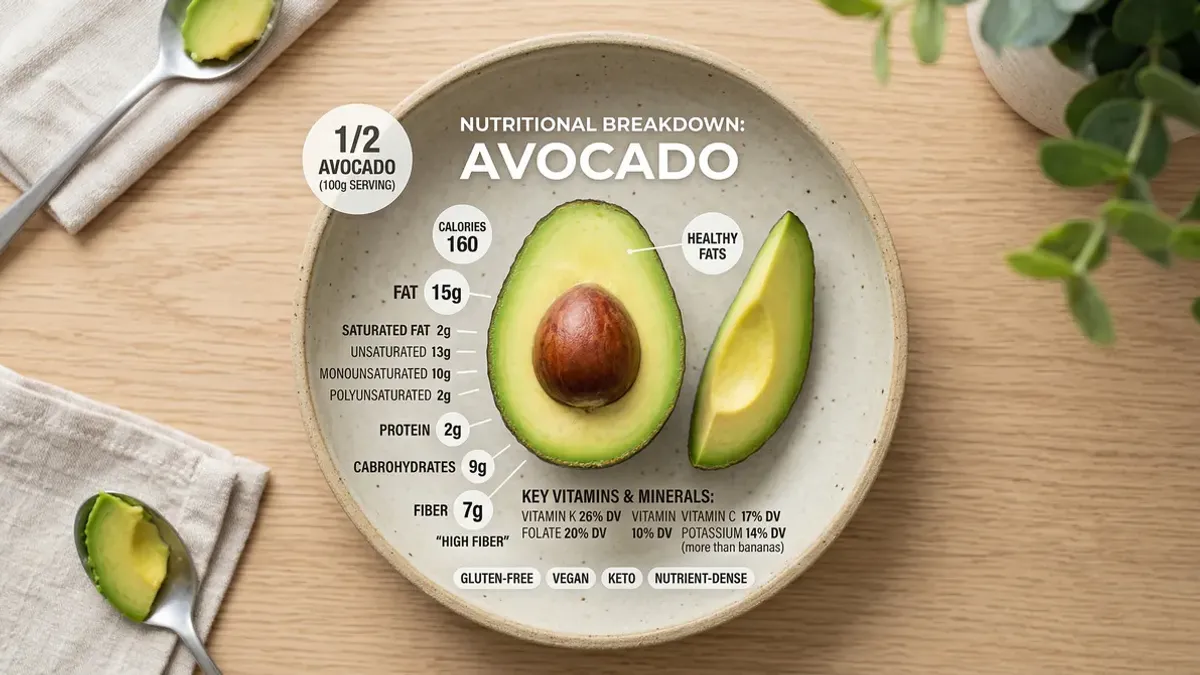
- Calories. 100g of avocado contains roughly 160 kcal — more than most vegetables, but comparable to a handful of nuts
- Healthy fats. Avocado contains about 15g of fat per 100g, of which the vast majority consists of monounsaturated fatty acids (oleic acid) — the same type found in olive oil
- Low in carbohydrates, high in fiber. Per 100g, avocado contains only 2g net carbohydrates (9g total minus 7g fiber)
- Rich in potassium and vitamin E. Half an avocado provides approximately 350 mg potassium and 20–25% of the recommended daily intake of vitamin E
- Portion control is key. A whole avocado (average 150g flesh) provides roughly 240 kcal
How many calories are in an avocado?
Based on NEVO data (Dutch Food Composition Database):
| Portion | Flesh weight | Calories |
|---|---|---|
| Half avocado (small) | ~60g | ~96 kcal |
| Half avocado (average) | ~75g | ~120 kcal |
| Whole avocado (average) | ~150g | ~240 kcal |
| Per 100g | 100g | ~160 kcal |
The weight of an avocado varies considerably: small Hass avocados weigh roughly 130–150g raw (including pit and skin), larger ones 200–250g. The flesh typically represents 60–70% of the total weight.
Complete nutritional values per 100g flesh
| Nutrient | Per 100g |
|---|---|
| Energy | ~160 kcal |
| Fat | 15g |
| Of which saturated | 2.1g |
| Of which monounsaturated | 9.8g |
| Carbohydrates | 9g |
| Of which fiber | 7g |
| Net carbohydrates | 2g |
| Protein | 2g |
| Potassium | ~485 mg |
| Vitamin E | ~2.1 mg |
| Vitamin K | ~21 µg |
| Folate | ~81 µg |
Avocado is one of the few fruits with a substantial fat content. The good news: that fat is predominantly oleic acid (omega-9), a monounsaturated fatty acid associated with favourable effects on LDL cholesterol.
Healthy fats in avocado: what does that mean?
The fat in avocado is similar to the fat in olive oil and nuts: monounsaturated. Monounsaturated fatty acids may help maintain a healthy cholesterol profile when they replace saturated fats. This is an association based on dietary patterns, however — avocado is not a medicine.
Avocado also contains small amounts of omega-3 fatty acids (alpha-linolenic acid), though in much smaller quantities than fatty fish. Read more about healthy fats and omega-3 for the full context.
Avocado vs. other fatty foods
| Food (per 100g) | Calories | Fat | Fiber |
|---|---|---|---|
| Avocado | ~160 kcal | 15g | 7g |
| Walnuts | ~654 kcal | 65g | 7g |
| Almonds | ~579 kcal | 50g | 13g |
| Olive oil | ~884 kcal | 100g | 0g |
| Salmon (raw) | ~179 kcal | 12g | 0g |
Compared to nuts and oils, avocado is relatively low in calories per 100g, with the added benefit of high fiber content. Compared to vegetables and most fruit, avocado is more calorie-dense. It occupies a unique middle ground in the food landscape.
See also the nutritional value of salmon for a comparison with another healthy fat source.
Fiber in avocado: more than you think
With 7g of fiber per 100g, avocado is one of the richest fiber sources among fruits. Half an avocado (75g) already provides over 5g of fiber — more than a slice of whole wheat bread. Fiber may support digestion, contributes to feelings of fullness, and is beneficial for gut health. For more fiber-rich options, see our overview of fiber-rich foods.
Avocado toast: how many calories?
A popular combination deserves special attention:
| Ingredient | Calories |
|---|---|
| 2 slices whole wheat bread (70g) | ~164 kcal |
| Half avocado (75g) | ~120 kcal |
| Lemon, pepper, salt | ~5 kcal |
| Total | ~289 kcal |
Avocado toast is therefore a nutritious meal at roughly 290 kcal, but not a low-calorie breakfast. Add a fried egg (+90 kcal) and you have approximately 380 kcal for a filling and nutrient-rich start to the day.
Practical tips for avocado in your eating pattern
Keep portions conscious
Half an avocado (75g flesh) is a realistic portion for most meals. A whole avocado every single day adds around 240 kcal on top of the rest of your meal.
Choose ripe avocados by feel
A ripe avocado yields slightly under gentle pressure. A hard avocado can be left at room temperature for 2–3 days. Ripe avocados should be stored in the refrigerator.
Preserve cut avocado with lemon
Avocado oxidises quickly. Coat the flesh with lemon juice and store in an airtight container in the refrigerator, ideally with the pit included.
Combine with protein and fiber
Avocado is rich in fat and fiber but low in protein. Combine with egg, legumes, or quark for a more balanced meal that also keeps you satisfied longer.
Frequently asked questions
Is avocado good for weight loss? Avocado can be part of a weight loss plan, but it is calorie-dense. The healthy fats and fiber may contribute to feelings of fullness, which can help reduce overall intake. Total calorie intake is always what matters most — start by calculating your calorie deficit to lose weight effectively.
How much avocado can I eat per day? Most nutritionists suggest half an avocado per day as a realistic amount for most people, depending on total fat intake.
Are all calories in avocado from fat? About 85% of the calories in avocado come from fat. But the type matters: predominantly monounsaturated, not saturated or trans fat.
Can I eat avocado on a low-carb diet? Yes, avocado is excellent for low-carb and ketogenic diets. With only 2g net carbohydrates per 100g, it is one of the most keto-friendly fruits available.
Avocado: versatile, nutritious, and worth it
Avocado is not a miracle food, but it is a genuinely remarkable one. The combination of healthy fats, high fiber content, potassium, and vitamin E makes it a valuable addition to a varied eating pattern. Keep portion size in mind — and it fits into almost any nutrition plan.
Want to track how many calories you consume each day? With Moveno, you photograph your meal and instantly see all nutritional values. No tables to look up, no manual entry. Discover how simple calorie tracking can be.
Sources
- Dutch Food Composition Database (NEVO): nevo-online.rivm.nl
- Voedingscentrum, Avocado: voedingscentrum.nl/encyclopedie/avocado
- Harvard T.H. Chan School of Public Health – Avocados: hsph.harvard.edu/nutritionsource/food-features/avocados