If you want to know how many calories are in a potato, or how much iron is in spinach according to Dutch standards, you will eventually encounter the NEVO table. It is the official Dutch food composition database — maintained by the RIVM (the Dutch national institute for public health) and used by dietitians, researchers, policymakers and increasingly by apps like Moveno.
Key takeaways
- The NEVO table (Nederlands Voedingsstoffenbestand) is the official Dutch food composition database, maintained by the RIVM.
- The most recent version (NEVO-online 2025/9.0) contains nutritional data for 2,328 food products covering energy and approximately 130 nutrients.
- NEVO is publicly accessible at nevo-online.rivm.nl and available as a downloadable dataset.
- Each data point has a documented source — laboratory analysis, calculation or published scientific literature.
- Moveno uses the NEVO table as its primary data source for Dutch food products.
What is the NEVO table?
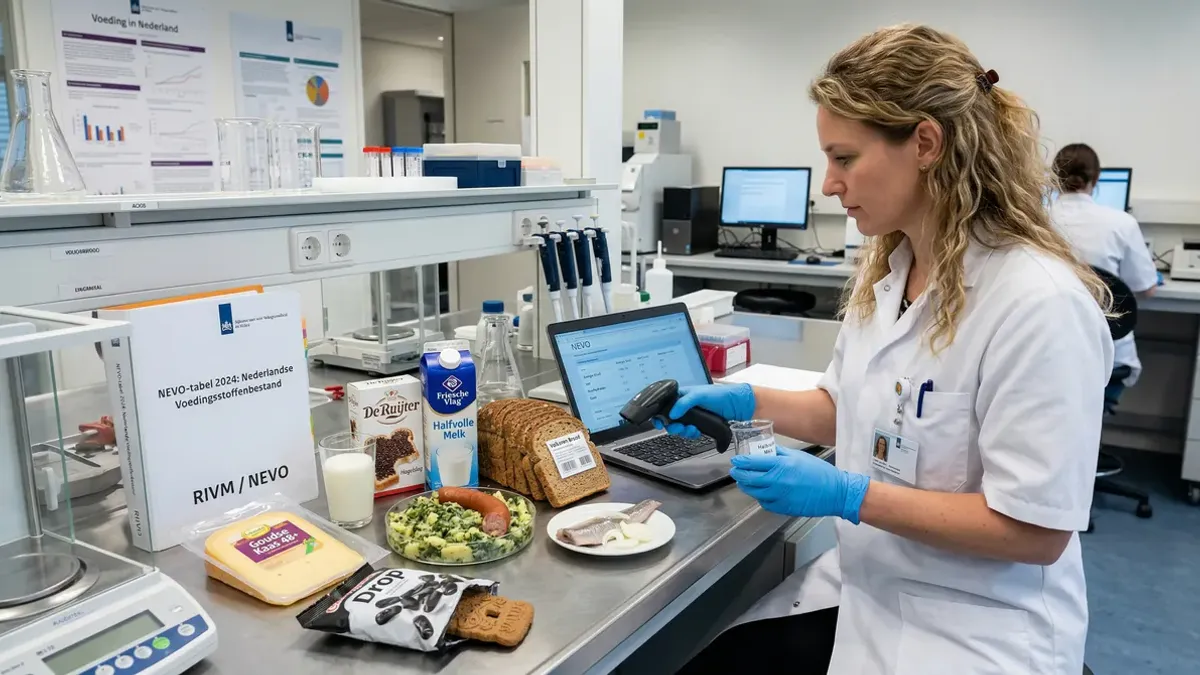
NEVO stands for Nederlands Voedingsstoffenbestand — the Dutch Food Composition Database. It is a scientific database containing the chemical composition of foods consumed in the Netherlands. Managed by the RIVM, it has been the reference standard for Dutch nutrition science for decades.
For each product, the NEVO table provides values for energy (kilojoules and kilocalories), macronutrients (protein, carbohydrates, fats, fibre), micronutrients (vitamins, minerals, trace elements) and other relevant compounds such as saturated fatty acids, sugars and sodium.
How reliable is NEVO data?
The reliability of the NEVO table is high, for one straightforward reason: every data point has a documented origin. The RIVM records whether each value comes from a laboratory analysis of a Dutch product, a recipe-based calculation or a published scientific study.
This is a meaningful distinction from most commercial nutrition databases and user-generated databases, where values are often unverified. NEVO also follows European nutrient expression standards from the EFSA — for example, in how dietary fibre is measured.
The most recent edition (NEVO-online 2025/9.0, published November 2025) contains data for 2,328 products. In this edition, the grain and flour product group was revised, with 33 products re-analysed in the laboratory.
What products are included?
The NEVO table focuses on foods consumed in the Netherlands — from raw ingredients to prepared dishes and processed products. The database includes:
- Vegetables and fruit — raw, cooked and processed variants, including Dutch seasonal produce.
- Grain products — bread types, pasta, rice, muesli and breakfast cereals common in the Netherlands.
- Meat, fish and dairy — including distinctly Dutch products such as Gouda, Edam, herring and stamppot.
- Prepared dishes — nutritional values for some Dutch recipe-based preparations (such as fries or brown bean soup).
- Drinks — water, milk, tea, coffee, soft drinks and alcoholic beverages.
What NEVO does not include is the thousands of branded products you find in a supermarket. For those, supplementary databases are needed — such as Open Food Facts for European packaged products.
NEVO vs. other food databases
| Database | Country | Products | Reliability | Access |
|---|---|---|---|---|
| NEVO | Netherlands | ~2,328 | Very high (RIVM-managed) | Free, open data |
| USDA FoodData Central | USA | ~350,000 | High (USDA-managed) | Free, open data |
| Open Food Facts | International | >3 million | Variable (user-generated) | Free, open data |
For Dutch foods, NEVO is the best choice because of its country-specific analyses and high data quality. For branded and international products, supplementary sources are needed.
How do you use the NEVO table?
Via NEVO-online
The easiest access is through nevo-online.rivm.nl. You can search by product name, product group or nutrient. The website displays the full nutritional composition per 100g and per portion, including the source of each value.
As a dataset
The RIVM also offers the NEVO data as a downloadable file (Excel or CSV). This makes it possible to integrate the data into applications, research or personal calculations. The dataset is freely available via the RIVM website.
In apps and tools
A growing number of nutrition apps use NEVO as a data source for Dutch food products. Moveno has integrated the full NEVO database as its primary source for foods eaten in the Netherlands. When you look up an apple, a slice of bread or herring, you get the official RIVM values — not an estimate from an unknown user elsewhere in the world.
Why NEVO matters for daily nutrition tracking
When you track your diet, the quality of the underlying data matters. An error of 20 percent in estimating the calories in your breakfast can significantly affect your daily targets. The NEVO table minimises that risk for Dutch staple foods.
That is also why Moveno explicitly chose NEVO as its foundation — supplemented by Open Food Facts for packaged products and the USDA database for international generic products. You get the best of all sources.
Want to know which database is behind a specific product in Moveno? Every food card shows the data source — transparency about the origin is a deliberate design choice.
Sources
- RIVM — Nederlands Voedingsstoffenbestand (NEVO) — official RIVM page on NEVO, including version history
- RIVM — New edition NEVO-online available — announcement of NEVO-online 2025/9.0 with 2,328 products
- RIVM — Download dataset — freely downloadable NEVO data as Excel or CSV
- Voeding & Visie — NEVO-online — context on the content and methodology of NEVO