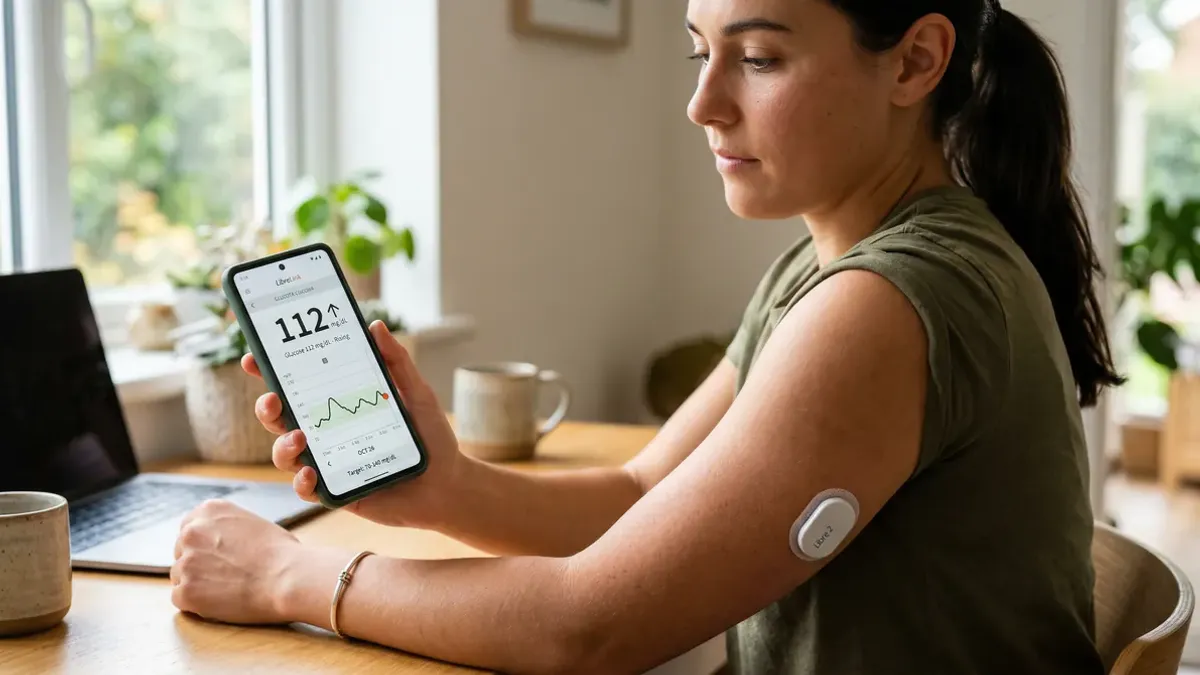
Daily finger pricks to check blood sugar — for decades, that was the only reliable option for people managing diabetes. Continuous glucose monitoring (CGM) has changed that. A small sensor worn on the arm measures blood sugar around the clock without any pricking, sending readings to your phone in real time. And increasingly, people without diabetes are discovering what this technology can teach them about their own bodies.
Key takeaways
- CGM measures glucose continuously via a small sensor worn on the skin — no finger pricks required.
- The two most widely used systems are FreeStyle Libre (Abbott) and Dexcom G7.
- Sensors measure glucose in interstitial fluid (between cells), not directly in blood — readings may lag blood glucose by 5 to 15 minutes.
- In the Netherlands, CGM is covered by basic health insurance for people with diabetes who use intensive insulin therapy (4 or more injections per day).
- Research shows that healthy individuals without diabetes can experience significant post-meal glucose spikes — CGM makes these visible.
- CGM data can inform better food choices, but does not replace medical advice or diagnosis.
How does continuous glucose monitoring work?
A CGM system has three components: a small sensor that adheres to your skin (usually the upper arm or abdomen), a transmitter that sends data wirelessly, and a receiver or smartphone app that displays readings in real time.
The sensor has a thin filament that sits just beneath the skin and measures glucose in the interstitial fluid — the fluid between cells. This is not the same as blood glucose, but the values run closely parallel. There is a small lag of around 5 to 15 minutes compared to blood glucose, but for tracking trends over time, this is not a meaningful limitation.
FreeStyle Libre vs. Dexcom: the two main systems
1. FreeStyle Libre (Abbott)
The FreeStyle Libre is the most widely used CGM system in the Netherlands. The sensor lasts 14 days and does not require calibration. The latest version, FreeStyle Libre 3, automatically sends readings to your phone without any scanning needed.
2. Dexcom G7
The Dexcom G7 transmits readings continuously and automatically to your phone or smartwatch — including overnight while you sleep. This makes it popular for people who want to monitor glucose fluctuations at all hours. The sensor lasts 10 days.
Insurance coverage in the Netherlands
According to the Dutch Healthcare Institute (Zorginstituut Nederland), CGM is covered by basic health insurance if you have diabetes and use intensive insulin therapy (four or more injections per day). This applies to both type 1 and type 2 diabetes. A medical indication from your doctor is required.
Without a diagnosis and medical indication, you pay out of pocket. A FreeStyle Libre sensor costs approximately €50 to €60 for 14 days.
Why are people without diabetes using CGM?
This is the most interesting development in recent years. Research published in peer-reviewed journals has shown that healthy individuals without diabetes can experience significant post-meal glucose spikes after certain foods — without feeling any obvious symptoms.
CGM reveals how your own body responds to specific foods. White rice, bread, pasta — one person shows a large spike, another barely registers a change. That individual variation is substantial and impossible to predict without measurement. Understanding your personal response to foods connects directly to broader blood sugar awareness and spotting hidden sugars that may be driving spikes without your knowledge.
Many CGM users report that real-time glucose data leads to more deliberate choices: more vegetables, fewer processed carbohydrates, a short walk after meals. The feedback loop is immediate and personal.
Limitations of CGM
CGM is a powerful tool, but not without limitations:
- Measurement lag. Interstitial glucose is not identical to blood glucose. During rapid changes (after intense exercise or large meals), the gap can be larger.
- Calibration. Some systems require occasional finger pricks to calibrate.
- Cost without coverage. Without medical indication, the ongoing cost is significant.
- Not a diagnostic tool. CGM does not replace a medical diagnosis. Consistently abnormal readings should be discussed with a doctor.
Building food awareness without CGM
If CGM is not accessible or not relevant for your situation, tracking what you eat is a practical alternative. Moveno lets you photograph a meal and instantly see the nutritional breakdown — including carbohydrates and sugars — so you can build awareness of your intake without any hardware.
Keeping track of calories and blood sugar
Alongside blood sugar monitoring, understanding your calorie intake is valuable. Our beginner's guide to calorie tracking shows you how to build that habit easily. Want to learn how to read labels for sugar and carbohydrate information? Read our article on reading nutrition labels.
Take control of your glucose picture
Measuring blood sugar without finger pricks is no longer science fiction — it is a practical reality for millions of people. Whether you have diabetes and want to reduce daily finger pricks, or you simply want to understand how your body responds to food, CGM offers insights that were previously unavailable. Discuss the options with your GP or diabetes nurse.
Sources
- Zorginstituut Nederland — Diabetes devices — Dutch insurance coverage rules for CGM
- Diabetes Fonds — CGM coverage — eligibility conditions for FreeStyle Libre and Dexcom reimbursement
- PMC — CGM use in people without diabetes — peer-reviewed research on CGM for non-diabetic individuals