
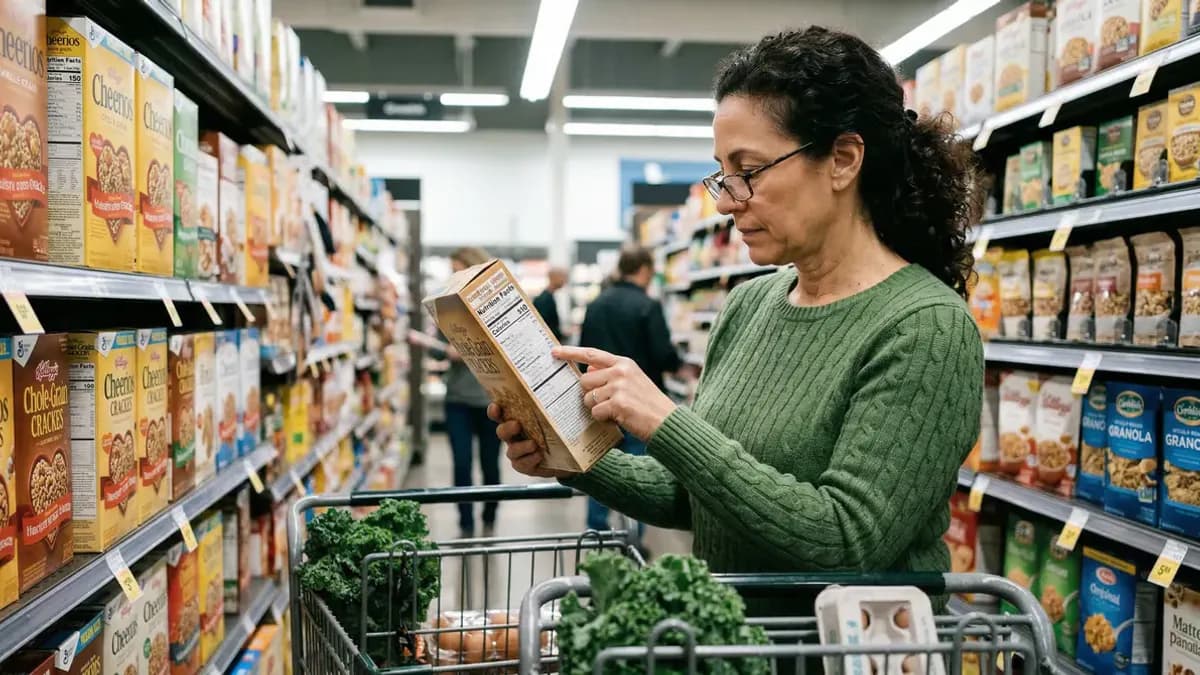
You pick up a box of cereal. The front says "reduced sugar" and "high in fibre." The back shows a table of numbers. Which ones actually matter?
Nutrition labels are designed to inform you — but also to look appealing. Once you know what to look for, you can read what matters in about ten seconds.
Key takeaways
- EU law requires energy and six nutrients on every label, always per 100g or 100ml.
- Start with the serving size — everything else makes sense only once you know the portion.
- Protein, fibre, and vitamins: more is generally better. Sugars, saturated fat, and salt: less is better.
- The ingredient list tells the real story — the first ingredient is the most abundant.
- Front-of-pack claims like "light" or "source of fibre" are regulated, but marketing language can still mislead.
What does EU law require on a label?
Under European Regulation 1169/2011, every packaged food sold in the Netherlands must include a standardised nutrition table. The mandatory components are:
- Energy (kcal and kJ)
- Fat (total and of which saturates)
- Carbohydrates (total and of which sugars)
- Protein
- Salt
These must always be declared per 100g or 100ml so you can compare products fairly. Manufacturers may also include a serving size — and that is where things get interesting.
Step 1: check the serving size
The serving size is the first thing to check. Manufacturers set this themselves, and the amounts are sometimes surprisingly small. A 200g bag of crisps might list "25g" as one serving — making the nutritional profile look far more modest than it is.
Ask yourself: how many grams is one serving, and how many servings are in the packet? Multiply the per-serving values by the number of servings you actually eat.
Step 2: calories per serving
With the serving size in hand, look at the calorie figure. The per-100g value is useful for comparing products, but per-serving tells you what you actually consume.
A 150g serving of yoghurt that contains 60 kcal per 100g gives you 90 kcal — not the 60 that might catch your eye first.
Step 3: protein, fibre, and micronutrients — more is better
Protein. Protein is satiating and supports muscle maintenance. A product with more than 10g of protein per 100g qualifies as protein-rich.
Fibre. Fibre supports digestion and contributes to a longer feeling of fullness. Look for at least 3g per 100g (source of fibre) or more than 6g per 100g (high in fibre).
Vitamins and minerals. Not always mandatory on labels, but when listed: percentages are relative to the reference daily intake (RDI). More than 15% RDI per serving is a meaningful contribution.
Step 4: sugars, saturated fat, and salt — less is better
Sugars. Labels list "of which sugars" — this includes both naturally occurring and added sugars. If sugar, syrup, or glucose-fructose syrup appears high in the ingredient list, significant sugar has been added. Less than 5g of sugar per 100g is considered low.
Saturated fat. Keep saturated fat in check: less than 1.5g per 100g is low, more than 5g per 100g is high. Over the course of a full day's eating, the overall pattern matters more than any single product.
Salt. Some labels list sodium instead of salt. Salt = sodium × 2.5. More than 1.5g of salt per 100g is high; less than 0.3g is low.
Step 5: the ingredient list — the real story
The ingredient list shows all ingredients by weight, from most to least abundant. The first ingredient is the main component of the product.
What you want to see: a recognisable list with whole grains, vegetables, fruit, or protein as the first ingredient. The shorter the list, the less processed the product.
Signals to watch for:
- Sugar, corn syrup, or fructose in the first three ingredients
- Many E-numbers (not inherently harmful, but a sign of heavy processing)
- Multiple fat types listed (hydrogenated fats, palm oil)
Front-of-pack claims: what is regulated and what to watch out for
Manufacturers cannot make health claims without EU approval. The regulation is strict. However:
- "Light" or "lite": contains at least 30% less fat, sugar, or calories than the original — but may still contain significant amounts.
- "Source of fibre": at least 3g fibre per 100g. Correctly used.
- "Sugar-free": maximum 0.5g sugar per 100g. May still contain other sweeteners.
- "Natural" or "pure": not legally defined — a marketing term.
Reading the ingredient list and nutrition table tells you more than the front of the pack ever will.
Reading labels with an app
Want to speed this up? Moveno scans barcodes and shows nutrition values instantly, cross-referenced with the official NEVO database. No label-hunting, no mental arithmetic — just scan and see. For more on tracking your overall diet, read our guide on tracking your nutrition.
Make it a habit
You do not need to read every label in full. Pick the three values most relevant to your goals — serving size, whatever nutrient you are watching (calories, sugar, or salt), and the first ingredient. That covers 80% of meaningful decisions in the supermarket aisle. Want to put those label-reading skills to use and track your daily nutrition? Read our beginner's guide to calorie tracking and use our calorie deficit calculator to set a personalised daily calorie goal.
Sources
- Voedingscentrum — Etiketten lezen — overview of mandatory label elements and how to interpret them
- Voedingscentrum — Wet Voedselinformatie — EU Regulation 1169/2011, mandatory per-100g declarations
- NVWA — Food label regulations — enforcement of labelling rules in the Netherlands