
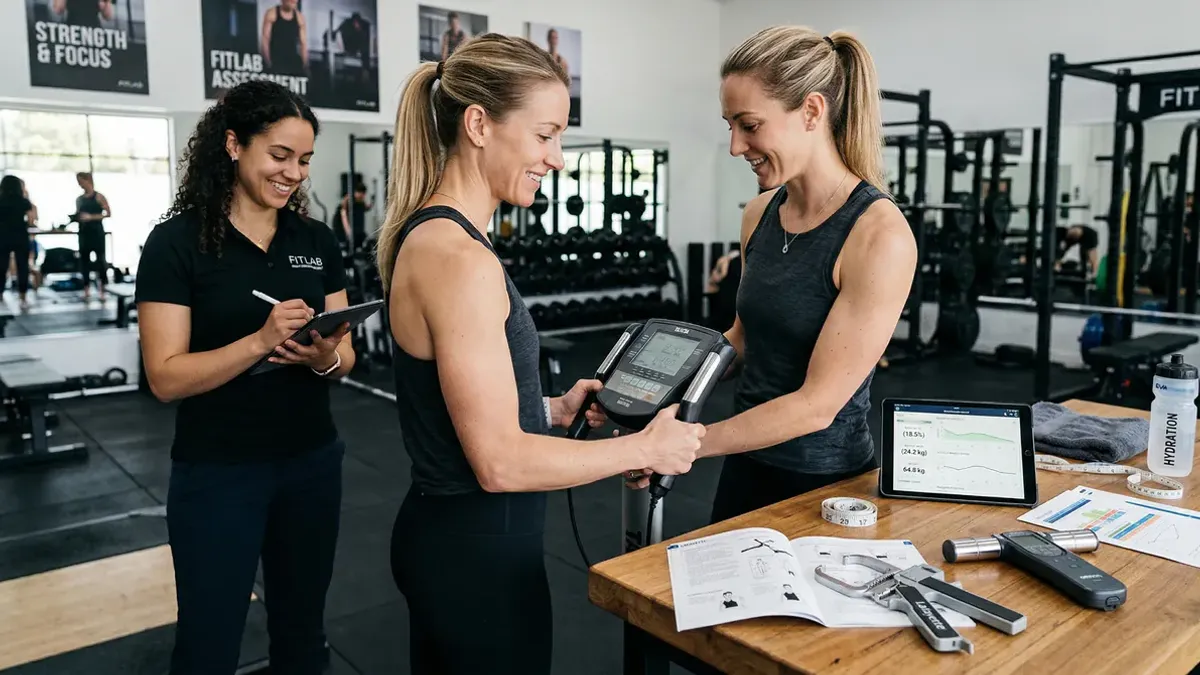
Weight doesn't tell the whole story. Two people with exactly the same weight can look and feel completely different — simply because the ratio of fat mass to muscle mass differs. Body fat percentage gives a far more precise picture of body composition than the scale alone.
But how do you measure it, and what do the results mean?
Key takeaways
- Body fat percentage measures the ratio of fat mass to total body weight — a better health indicator than weight alone.
- The four common measurement methods vary widely in accuracy and cost: caliper, bioelectrical impedance, circumference formula, and DEXA scan.
- The DEXA scan is the most accurate method, with an average deviation of around 2 percent.
- Healthy body fat ranges differ by sex: women naturally need a higher body fat percentage than men.
- Essential fat (the minimum for organ function) is 3 to 5 percent in men, 10 to 13 percent in women.
- BMI gives a weight classification but reveals nothing about body composition — body fat percentage does.
Why body fat percentage tells you more than weight
The scale measures your total mass: muscle, bone, organs, water and fat. Two people can weigh identically, but one might have 30 percent fat mass while the other has 15 percent. That variation has significant consequences for health, endurance and metabolism.
Fat mass serves two functions: essential fat (necessary for organ function, hormonal balance and brain function) and storage fat (the fat beneath the skin and around the organs). Too little body fat is just as problematic as too much.
Method 1: skinfold measurement with calipers
Calipers measure the thickness of skinfolds at multiple points on the body — commonly four or seven measurement sites. Those values are entered into a formula to estimate body fat percentage.
Advantages: inexpensive, can be done at home, no specialized equipment needed.
Disadvantages: accuracy depends heavily on technique and the skill of the person measuring. Variations of 3 to 5 percent between measurements are common.
Best for: home use as a relative measure — tracking progress over time rather than determining an absolute value.
Method 2: bioelectrical impedance analysis (BIA)
Smart scales and handheld devices send a weak electrical current through the body. Fat tissue conducts electricity poorly; muscle tissue conducts it well. Based on the resistance, the device estimates body composition.
Advantages: fast, easy, widely available as a consumer device.
Disadvantages: accuracy is strongly influenced by hydration. Measurements taken after exercise, after alcohol consumption or when dehydrated can deviate 3 to 10 percent from actual values. Average deviations are around 5 percent, with outliers up to 25 percent.
Best for: trend measurement over time, as long as you always measure under the same conditions (morning, fasted, after using the toilet).
Method 3: circumference formula
The US Navy method uses measurements of the waist, neck and (for women) hips to estimate body fat percentage. The formula can be calculated for free and only requires a tape measure.
Advantages: no equipment needed, free, easy to repeat.
Disadvantages: less accurate than calipers or BIA, and sensitive to measurement errors around the waist.
Best for: a quick general indication, particularly for visceral fat (abdominal fat).
Method 4: DEXA scan
The DEXA scan (Dual-Energy X-ray Absorptiometry) is the gold standard for body composition measurement. It uses two X-ray beams at different energy levels to accurately measure fat mass, muscle mass and bone density.
Advantages: average deviation around 2 percent, detailed regional analysis (where exactly is the fat distributed?), bone density also visible.
Disadvantages: not available for home use, costs roughly €50 to €150 per scan, requires an appointment at a sports lab, physiotherapy clinic or hospital.
Best for: anyone who wants an accurate baseline measurement for a serious training programme, or who has medical reasons to understand their body composition.
Healthy body fat ranges: what are the standards?
Body fat norms depend on sex and, to a lesser extent, age. Women naturally need a higher body fat percentage than men, in part for hormonal balance and potential pregnancy.
Men:
- Essential fat: 3 to 5 percent
- Athletic: 6 to 13 percent
- Fit/healthy: 14 to 17 percent
- Average: 18 to 24 percent
- Obese range: above 25 percent
Women:
- Essential fat: 10 to 13 percent
- Athletic: 14 to 20 percent
- Fit/healthy: 21 to 24 percent
- Average: 25 to 31 percent
- Obese range: above 32 percent
A body fat percentage well below the athletic range is not without risk — insufficient body fat can lead to hormonal disruption, reduced bone density and other health problems.
Body fat vs. BMI: which is more useful?
Body Mass Index (BMI) divides your weight by the square of your height and provides a weight classification. But BMI makes no distinction between fat and muscle: a well-muscled athlete can have a high BMI and still be healthy, while someone with a normal BMI can have an unhealthily high body fat percentage.
If you want to genuinely understand your body composition, body fat percentage is a more meaningful number than BMI. Read more in our article on calculating a healthy weight: it's more than just BMI.
Reducing body fat: nutrition and movement
Lowering your body fat percentage requires a combination of diet and activity. Read how to calculate your calorie deficit for a targeted weight-loss plan. For the role of walking in fat burning, also read about walking to lose weight. Our beginner's guide to calorie tracking helps you build the nutritional awareness to support your goals.
Start with a baseline measurement
Whichever method you choose, consistency matters more than absolute accuracy. Pick one method, measure under the same conditions every time (same time of day, same hydration level) and compare results over time.
With Moveno, you track your food intake and weight in one app. Combine that with a periodic body fat measurement and you get a complete picture of what's actually changing in your body.
Sources
- LNGVTY Health — Body fat percentage measurement — overview of measurement methods and healthy body fat norms
- Ruggengraat — Body fat measurement: 5 methods compared — accuracy comparison per measurement method