Tracking calories tells you how much you're eating. But if you want real control over your results — whether that's losing fat, building muscle, or just feeling more energised — calculating your macros is the next step. Knowing how many grams of protein, fat, and carbohydrates you eat each day lets you dial your nutrition into what your body actually needs.
Key takeaways
- Macros are the three major nutrients: protein (4 kcal/g), carbohydrates (4 kcal/g), and fat (9 kcal/g)
- Start with your total daily energy expenditure (TDEE) — then split it across macros
- For weight loss, protein is the priority to preserve muscle; for muscle building, carbohydrates take centre stage as fuel
- Guidelines are starting points, not rules — adjust after two to three weeks based on how you feel and perform
- Imperfect tracking is far better than no tracking at all
What are macros and why do they matter?
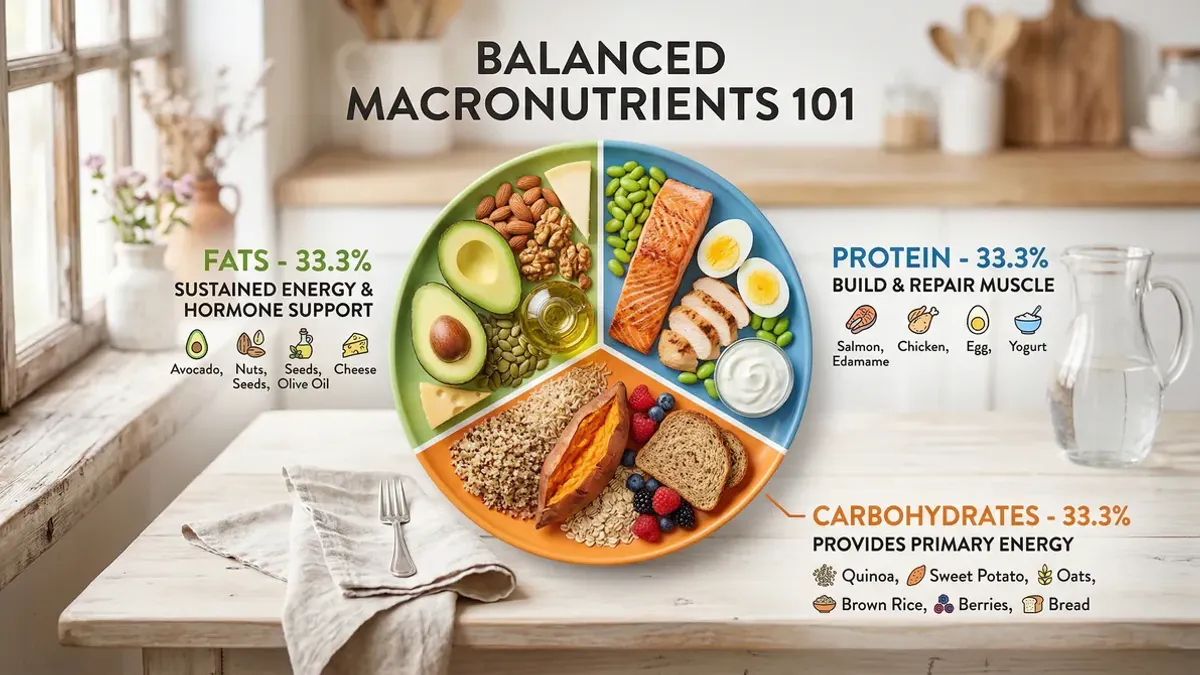
Macronutrients — macros for short — are the three nutrients that all your calories come from. Protein and carbohydrates each provide 4 kilocalories per gram; fat provides 9 kilocalories per gram. Fibre and alcohol aren't classified as macros, but they do contribute to your total calorie intake.
When you only track calories, you know how much energy you're consuming — but not where it comes from. 1,800 calories from white bread and soft drinks produces very different results from 1,800 calories built around lean protein, vegetables, whole grains, and healthy fats.
How do you calculate your calorie needs?
Before splitting your macros, you need your Total Daily Energy Expenditure (TDEE). This has two components:
Basal metabolic rate. The energy your body uses at rest — breathing, organ function, cell renewal. Roughly 60 to 70 percent of total expenditure.
Activity multiplier. The more active you are, the more calories you burn. A sedentary person multiplies their BMR by around 1.4; a very active person by 2.0.
Once you have your TDEE, you can decide on a target — eat at maintenance to stay the same weight, below it to lose fat, or above it to gain muscle.
How to split calories across macros
With your TDEE established, you can divide it across protein, carbohydrates, and fat. The right split depends on your goal.
Step 1: Set your protein target
Protein is the anchor of any macro split. It protects muscle during a calorie deficit, keeps you fuller for longer, and has the highest thermic effect — meaning your body burns more energy digesting it than fat or carbohydrates.
According to EFSA, the population reference intake for healthy adults is 0.83 g of protein per kg of body weight per day. For active individuals or those in a calorie deficit, this goes up:
- Maintenance. 0.83–1.2 g per kg
- Weight loss. 1.2–1.6 g per kg to preserve lean mass
- Muscle building. 1.6–2.0 g per kg (the range supported by sports nutrition research)
Step 2: Set a fat minimum
Fat is essential for hormone production, vitamin absorption, and cell structure. A floor of 0.8 g per kg of body weight is a commonly used minimum. Roughly 20 to 35 percent of total calories from fat is a well-supported range.
Step 3: Fill the remainder with carbohydrates
Carbohydrates are your body's primary fuel — especially for the brain and high-intensity exercise. After protein and fat, the remaining calories go to carbs.
Example calculation at 2,000 kcal
Say your TDEE is 2,000 calories and your goal is fat loss. You weigh 75 kg.
- Protein. 1.6 g × 75 kg = 120 g → 480 kcal
- Fat. 0.8 g × 75 kg = 60 g → 540 kcal
- Carbohydrates. Remaining: 2,000 - 480 - 540 = 980 kcal → 245 g
That gives a split of roughly 24% protein, 27% fat, and 49% carbohydrates. Not a perfect formula — but a solid starting point.
Macro splits by goal
| Goal | Protein | Fat | Carbohydrates |
|---|---|---|---|
| Fat loss | 1.2–1.6 g/kg | 0.8–1.0 g/kg | remainder |
| Maintenance | 0.83–1.2 g/kg | 0.8–1.0 g/kg | remainder |
| Muscle gain | 1.6–2.0 g/kg | 0.8–1.2 g/kg | remainder (priority) |
For muscle building, carbohydrates earn extra priority: they're the primary fuel for resistance training. An insufficient carbohydrate intake can accelerate muscle protein breakdown.
How to track macros in practice
You don't need to weigh every gram of every meal. But two to three weeks of active tracking — using an app that recognises the nutritional composition of your food — gives you enough data to spot your patterns and make informed adjustments.
With Moveno, you take a photo of your meal and get an instant breakdown of protein, carbohydrates, and fat. No manual entry, no barcode scanning. If you're curious about how the technology behind this works, read about how AI calorie tracking works.
When should you adjust your macros?
A macro split is a starting point, not a permanent contract. Give any change two to three weeks before drawing conclusions — your body needs time to adapt.
Signs that an adjustment may be worth trying:
- Poor recovery from workouts (possibly too little protein or carbohydrates)
- Low energy levels during the day (possibly too few carbohydrates or fats)
- Body weight not moving in the right direction after three weeks (check total calories first)
Start tracking your macros today
Calculating macros is simpler than it sounds. Find your TDEE, set a protein target based on your body weight and goal, establish a fat floor, and fill the rest with carbohydrates. Two to three weeks of tracking gives you the data you need to start making smarter decisions.
Download Moveno for free and start tracking your nutrition — including a daily breakdown of your macro split.
Sources
- Voedingscentrum — Eiwitten (Protein) — recommended daily protein intake and function
- EFSA — Population Reference Intake for protein — 0.83 g/kg/day reference for healthy adults
- PubMed — Protein intake to support muscle mass and function — meta-analysis of protein recommendations for muscle gain and fat loss
- Voedingscentrum — Hoeveel koolhydraten per dag? — recommended carbohydrate intake (40–70% of calories)
- Voedingscentrum — Energie (calorieën) — caloric values of macronutrients and TDEE calculation