
Bananas appear on many people's "avoid" list when watching their carbohydrate intake. But is that reputation justified? A banana does contain more carbohydrates than most berries, but the context — fibre content, ripeness, portion size and overall nutritional value — paints a far more nuanced picture.
Key takeaways
A medium banana (around 120 g peeled weight) contains approximately 27 grams of carbohydrates, of which 14 grams are sugars and 3 grams are fibre. Green bananas contain more resistant starch, which is beneficial for gut health. Ripe bananas contain more sugars and have a higher glycaemic index. For most people, one banana per day is a perfectly reasonable choice within a balanced diet.
How many carbohydrates does a banana contain?
The exact carbohydrate content of a banana depends on its size and ripeness. Here are the values for a peeled banana (without skin):
| Size | Weight (peeled) | Carbohydrates | Sugars | Fibre | Calories |
|---|---|---|---|---|---|
| Small | 80 g | 18 g | 10 g | 2 g | 72 kcal |
| Medium | 120 g | 27 g | 14 g | 3 g | 107 kcal |
| Large | 160 g | 36 g | 19 g | 4 g | 143 kcal |
A standard supermarket banana typically falls in the medium category. Expect around 27 grams of carbohydrates per banana.
What types of carbohydrates does a banana contain?
The carbohydrates in a banana are not all the same. They consist of three components:
Sugars (±14 g in a medium ripe banana) Mainly glucose, fructose and sucrose. Ripe bananas contain more sugars than green ones because starch converts to sugar during the ripening process.
Starch (±7 g in a medium ripe banana) In ripe bananas, most starch has already been converted to sugar. In a green or half-ripe banana, the starch component contains more resistant starch.
Fibre (±3 g in a medium banana) Bananas contain both soluble fibre (pectin) and insoluble fibre. Pectin may help regulate blood sugar and slows digestion.
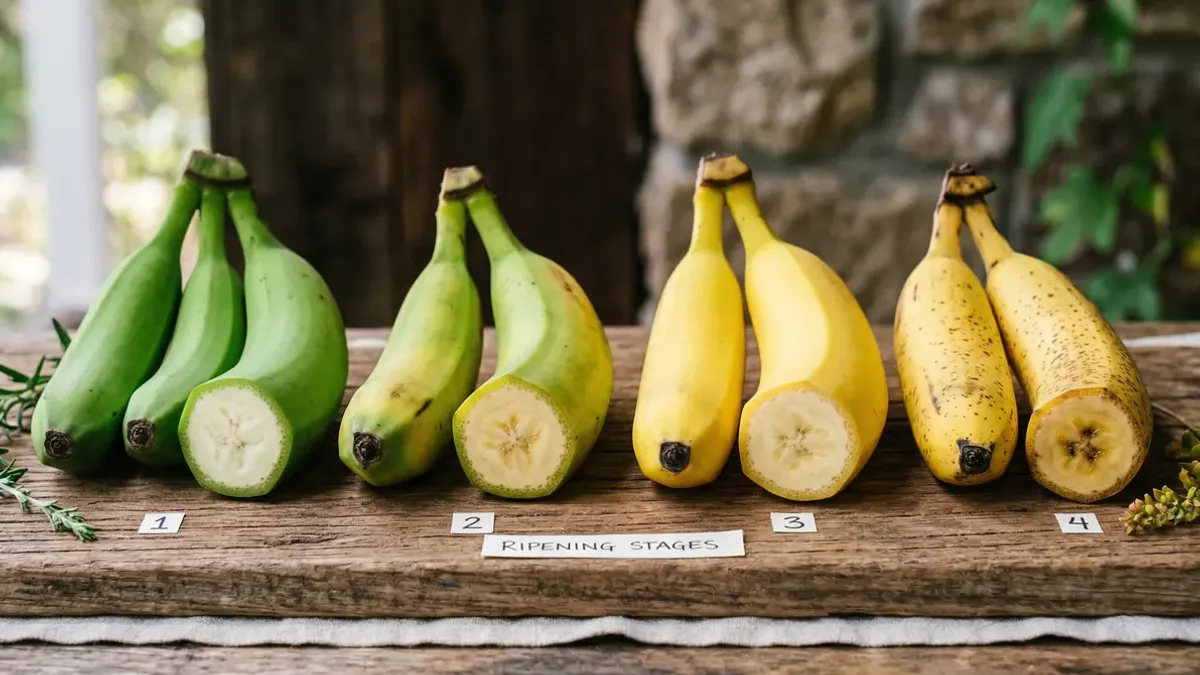
Green vs. ripe: the difference in carbohydrate composition
One of the most interesting properties of bananas is how their composition changes as they ripen:
Green (unripe) banana
- High in resistant starch: up to 60–80% of carbohydrates are resistant starch in fully unripe bananas
- Resistant starch acts as a prebiotic: it feeds beneficial gut bacteria
- Lower glycaemic index: blood sugar rises more slowly
- Less sweet, firmer texture
Ripe (yellow/spotted) banana
- Resistant starch largely converted to sugars (glucose, fructose, sucrose)
- Higher glycaemic index: blood sugar rises faster
- Sweeter and softer
- More immediately available energy
Research published in PMC (2021) shows that the ratio of resistant starch to sugars changes dramatically during ripening. For gut health, green bananas are particularly interesting as a prebiotic source.
Are bananas suitable on a low-carbohydrate diet?
This depends on how strictly you are limiting carbohydrates:
- Regular healthy eating (200–300 g carbs/day): A banana fits in easily.
- Lightly low-carb (100–150 g/day): Half a banana or a smaller banana is a good choice. Combine with protein-rich food to moderate the blood sugar rise.
- Strictly low-carb (<100 g/day): A whole banana uses about 27% of your daily budget. Consider berries instead (strawberries: 8 g/100g, raspberries: 12 g/100g).
- Ketogenic (<50 g net carbs/day): A banana barely fits. At 24 grams of net carbohydrates (27g − 3g fibre), it nearly exhausts your daily budget.
Nutritional value of a banana: more than carbohydrates
A banana is not just a carbohydrate source. Per medium banana you also get:
- Potassium: About 422 mg — supports healthy blood pressure and heart function. The Harvard T.H. Chan School of Public Health highlights bananas as an excellent potassium-rich food source.
- Vitamin B6: Around 0.4 mg — important for neurotransmitter production and haemoglobin synthesis
- Magnesium: About 32 mg — supports muscle function and energy metabolism
- Vitamin C: Around 10 mg — antioxidant, supports the immune system
- Manganese: 0.3 mg — involved in bone formation and antioxidant processes
The glycaemic index (GI) of a ripe banana is around 51, which is moderate. The fibre content dampens the blood sugar rise further — especially when you combine the banana with protein or fat (think peanut butter, nuts or yoghurt).
Bananas in your diet: practical ideas
As an energy boost before exercise: The combination of fast-release sugars and some starch makes a banana an excellent pre-workout snack, eaten 30–60 minutes before training.
In a smoothie: Frozen banana gives a smooth, creamy texture without needing dairy. Combine with Greek yoghurt for extra protein.
As a base for protein pancakes: A ripe banana and two eggs form the foundation of a healthy, lower-carb pancake recipe. Read more in our article on high-protein breakfasts.
As a natural sweetener: In recipes for banana bread or muffins, a ripe banana can partially replace sugar.
Want to track how many carbohydrates a banana contributes to your daily intake? Moveno lets you photograph your meal and see the nutritional values instantly.
Frequently asked questions
How many carbohydrates does 100 grams of banana contain? A peeled banana contains around 23 grams of carbohydrates per 100 grams. For a medium banana of 120 grams peeled weight, that amounts to roughly 27 grams.
Is a banana unhealthy due to its sugar content? No, not in the context of a normal eating pattern. The sugars in a banana come packaged with fibre, vitamins, minerals and water. Research shows that eating fruit is not associated with weight gain as part of a balanced diet.
When is a banana most nutritious? Green bananas contain more resistant starch and are better for gut health. Ripe bananas are sweeter, more digestible and provide faster-available energy. Both have benefits — it depends on your goal.