
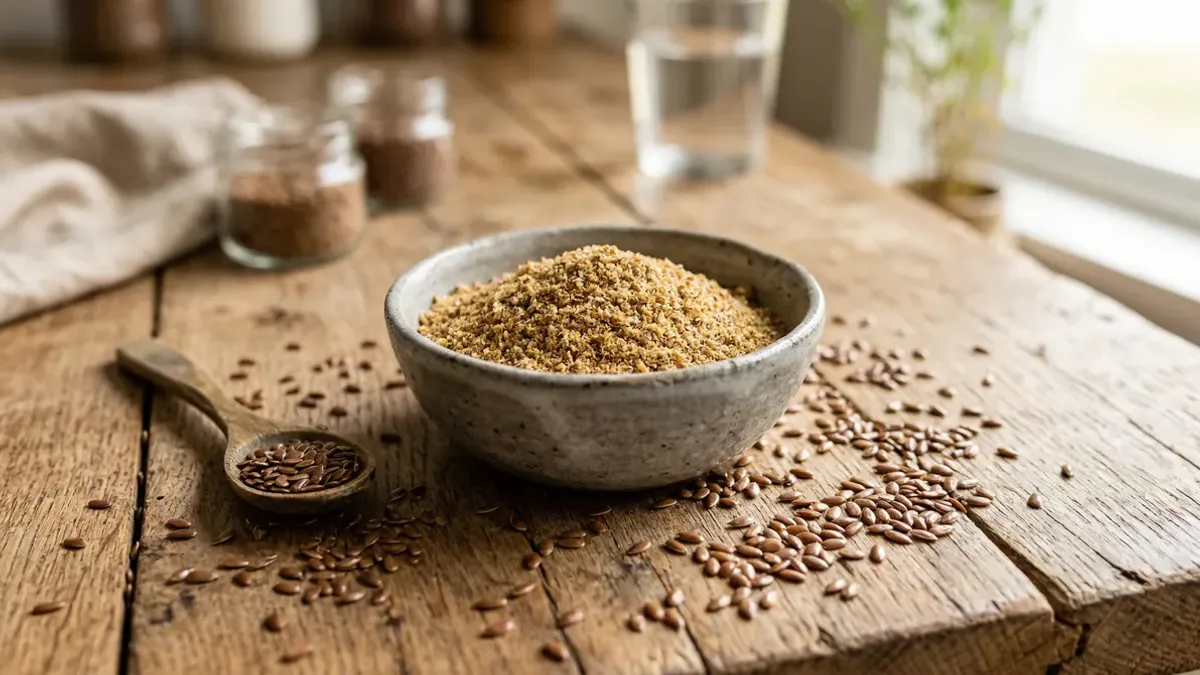
A tablespoon of flaxseed weighs seven grams, costs almost nothing, and delivers more omega-3 than most people get in an average day. The catch: whole flaxseeds pass through your digestive system largely intact. What you do with them determines whether you actually benefit.
Key takeaways
- Flaxseed is the richest plant source of alpha-linolenic acid (ALA), the plant-based omega-3 fatty acid.
- Per tablespoon (7g): 2.2g fat, 2.4g fiber, and 1.3g protein.
- Always grind flaxseed before eating — whole seeds pass through undigested and deliver almost no ALA.
- Store ground flaxseed in the freezer or fridge to prevent oxidation.
- The Voedingscentrum recommends a maximum of 28g (2–3 tablespoons) of flaxseed per day due to cyanogenic glycosides in larger quantities.
What is ALA and why does it matter?
ALA — alpha-linolenic acid — is a polyunsaturated fatty acid your body cannot produce on its own. It belongs to the omega-3 family, alongside EPA and DHA found primarily in oily fish. ALA is the plant-based representative.
Your body can partially convert ALA to EPA and DHA, but that conversion is inefficient. ALA itself is still an essential fatty acid: it's needed for cell membrane structure and normal brain function. According to the Dutch Health Council (Gezondheidsraad), adults should get at least 1% of their daily energy from ALA — for someone needing 2,000 kcal, that's roughly 2g per day.
Flaxseed is the richest known plant source of ALA, which is why it's popular among vegetarians and vegans who don't eat oily fish. Want to compare it to salmon as an animal omega-3 source? Those are fundamentally different fatty acid types (EPA/DHA vs. ALA).
Why you need to grind flaxseed
This is the most practical takeaway: whole flaxseeds pass through your digestive tract essentially intact. The hard seed coat protects the contents from digestion. The fibre, lignans, and ALA inside simply aren't available.
Ground flaxseed (also called milled flaxseed or flaxseed meal) makes all of that available for digestion.
Grind fresh in a coffee grinder, or buy pre-ground. Ground flaxseed is more vulnerable: the fatty acids oxidise quickly when exposed to air and light. Always store it in an airtight container in the freezer or fridge, and use within a few weeks.
Nutritional values per tablespoon
Per tablespoon (7g) whole flaxseed (source: Voedingscentrum/NEVO):
- Calories. 33 kcal
- Fat. 2.2g total fat (primarily ALA)
- Fiber. 2.4g — a meaningful contribution towards the recommended 30g per day
- Protein. 1.3g
- Carbohydrates. 0.9g
Two to three tablespoons of ground flaxseed stirred into your oats or yoghurt is an easy way to move closer to your daily fibre target.
Flaxseed and gut health: what the fiber does
Flaxseed contains both soluble and insoluble fibre. The soluble fibre forms a gel-like substance in the gut and may contribute to more stable post-meal blood sugar. The insoluble fibre supports healthy bowel movement.
If you're not used to a high-fibre diet, increase flaxseed intake gradually and drink enough water — a sudden jump in fibre intake can cause bloating.
Lignans: what are they?
Flaxseed is also the richest known dietary source of lignans — plant polyphenols with weak oestrogenic activity. Whether and to what extent lignans influence health outcomes in humans is an active area of research. The science is promising, but not yet conclusive enough for specific health claims.
How to use flaxseed in practice
Four easy daily applications:
- In yoghurt or quark. Stir one tablespoon of ground flaxseed in — you'll barely taste it.
- In smoothies. Unobtrusive, adds a little texture.
- In porridge. Pairs well with oats and keeps you fuller for longer.
- As an egg substitute in baking. One tablespoon ground flaxseed plus three tablespoons water, left for five minutes, creates a gel that can replace one egg.
How much flaxseed per day is reasonable?
The Voedingscentrum recommends a maximum of 28g (2–3 tablespoons) of flaxseed per day. Flaxseed contains cyanogenic glycosides which can theoretically be harmful in very large quantities (above ~60g per day). At normal amounts, there's no cause for concern.
Start with one tablespoon daily and build up gradually if you're not used to high-fibre foods. Drink plenty of water.
Small seed, consistent habit
Flaxseed is one of the easiest dietary adjustments you can make: affordable, widely available, and simple to add to existing meals. The key? Grind it, and use it consistently.
Want to track whether you're hitting your daily fibre and omega-3 targets? With Moveno, you photograph your meal and instantly see the nutritional breakdown, including fibre and fats.
Sources
- Voedingscentrum — Flaxseed nutritional values — nutritional values per 7g flaxseed
- Voedingscentrum — Ground flaxseed safety — maximum daily amounts and cyanogenic glycosides
- Voedingscentrum — Omega-3 — ALA explained and daily recommendations
- RIVM — Dutch Food Composition Database (NEVO) — reference database for nutritional values