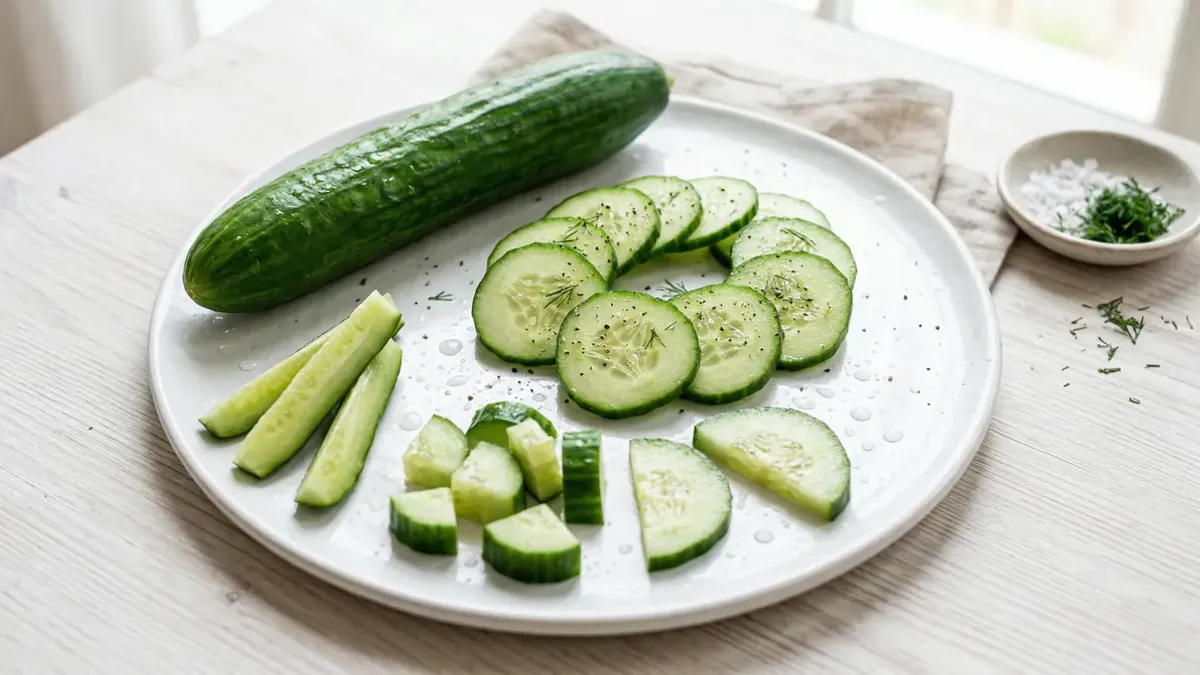
Half a cucumber with lunch, slices in a salad, or a small bowl as a mid-afternoon snack. Cucumber shows up everywhere. If you are watching your intake, the natural question is: how many calories are in there? The short answer: almost none.
Key takeaways
- 13 kcal per 100 grams. A whole cucumber with skin (115g) contains just 15 kcal, or about 13 kcal per 100g.
- 96 percent water. That makes cucumber one of the most water-rich vegetables available.
- Skin matters. The skin holds most of the fibre and vitamin K. Calorie-wise, peeling makes almost no difference.
- Barely any carbs. At 1.3g of carbohydrates per 100g (with skin), cucumber fits any eating pattern.
- Source of vitamin K. Most of it sits in the skin.
How many calories does a cucumber have?
According to the Voedingscentrum (Dutch Nutrition Centre), a whole cucumber with skin weighing 115 grams contains just 15 kcal. Per 100 grams, that works out to roughly 13 kcal. This places cucumber among the absolute lowest-calorie vegetables you can eat.
For comparison, a tomato has about 22 kcal per 100g, broccoli around 28 kcal, and a carrot roughly 35 kcal. Cucumber wins by a clear margin when it comes to lowest calorie density.
What is the full nutritional profile?
Per 100 grams of cucumber with skin:
| Nutrient | Per 100g |
|---|---|
| Energy | 13 kcal |
| Fat | 0.4g |
| Saturated fat | 0.1g |
| Carbohydrates | 1.3g |
| Sugars | 1.3g |
| Fibre | 0.6g |
| Protein | 0.7g |
| Salt | 0.01g |
Source: Voedingscentrum (Dutch Nutrition Centre)
The standout characteristic is the water content. Cucumber is approximately 96 percent water, making it an excellent hydration food, especially during warmer months.
Does peeling affect the calories?
Slightly. The Voedingscentrum provides different values for cucumber with and without skin.
With skin. 15 kcal per 115g cucumber (about 13 kcal per 100g). Contains 0.6g fibre per 100g.
Without skin. About 15 kcal per 100g. Only 0.3g fibre per 100g.
The calorie difference is small, but the skin holds most of the fibre and vitamin K. Eat your cucumber unpeeled when you can.
How many calories per serving?
In practice, you eat cucumber in specific portions. Here is a breakdown of common serving sizes:
| Serving | Weight | Calories |
|---|---|---|
| 5 slices | 30g | 4 kcal |
| Small side portion | 50g | 6 kcal |
| Half a cucumber | 58g | 8 kcal |
| Whole cucumber | 115g | 15 kcal |
| Snack bowl | 150g | 20 kcal |
Even a whole cucumber delivers just 15 kcal. That is less than a single slice of cheese or half a glass of milk.
Can cucumber support weight loss?
Absolutely. At just 13 kcal per 100g, cucumber is one of the most calorie-friendly foods in existence. The high water content also adds volume to your plate without adding energy.
Here are three ways cucumber can help when you are working toward a calorie deficit:
1. Volume eating without the calories
Add cucumber to salads, wraps, or alongside a hot meal. A generous 200g serving adds only 26 kcal but makes your plate look and feel much fuller.
2. Swap for calorie-dense snacks
A bowl of cucumber with a small amount of hummus is a smart replacement for crisps or crackers. The cucumber itself adds virtually nothing to your calorie total.
3. Hydration boost
On days when you struggle to drink enough water, cucumber can contribute to your fluid intake. It is not a replacement for drinking water, but it helps.
Want to understand your daily calorie needs better? Read our guide on how many calories you need per day.
Cucumber in everyday meals
Cucumber is a staple ingredient across many cuisines. A few common uses and what they contribute calorically:
On a sandwich. Two slices of cucumber on bread add just 4 kcal. The bread itself (80 to 100 kcal) and the spread determine the real calorie count.
Cucumber salad. A 100g portion of cucumber with a splash of vinegar and some dill comes to under 20 kcal. Add mayonnaise and that number rises quickly.
Greek salad. Cucumber is the low-calorie hero here. The feta and olive oil carry most of the energy.
Pickles. Technically small cucumbers. Pickling barely changes the calorie count (about 12 kcal per 100g), though the sodium content may increase depending on the brine.
Frequently asked questions about cucumber calories
Is cucumber a vegetable or a fruit? Like the tomato, cucumber is botanically a fruit because it develops from the flower and contains seeds. In nutrition science and in the grocery store, it is treated as a vegetable.
Can you eat too much cucumber? Practically speaking, no. Cucumber is so low in calories and macronutrients per gram that you would need to eat enormous quantities before it became an issue. Variety in your vegetable intake is still recommended.
Do you lose nutrients by peeling cucumber? Yes. The skin contains most of the fibre and vitamin K. If you peel the cucumber, you lose a portion of those. Eat it unpeeled when possible.
Does cucumber help with bloating? Cucumber is water-rich and contains potassium, which may contribute to a healthy fluid balance. It is not a miracle cure, but it fits well in a balanced diet. If bloating is a recurring concern, consider tracking your meals to identify patterns and potential triggers.
How does cucumber compare to other low-calorie vegetables? Cucumber (13 kcal per 100g) is among the lowest. Celery sits at around 14 kcal, lettuce at 15 kcal, and tomato at 22 kcal. All are excellent choices for adding volume to meals.
Start tracking what you eat
At 13 kcal per 100g, cucumber may well be the lowest-calorie vegetable in the supermarket. It is versatile enough to add to nearly any meal without affecting your calorie total.
Curious how your overall eating pattern looks? Moveno recognises your meals from a photo and shows the full nutrition breakdown instantly, from the cucumber slices to everything else on your plate.