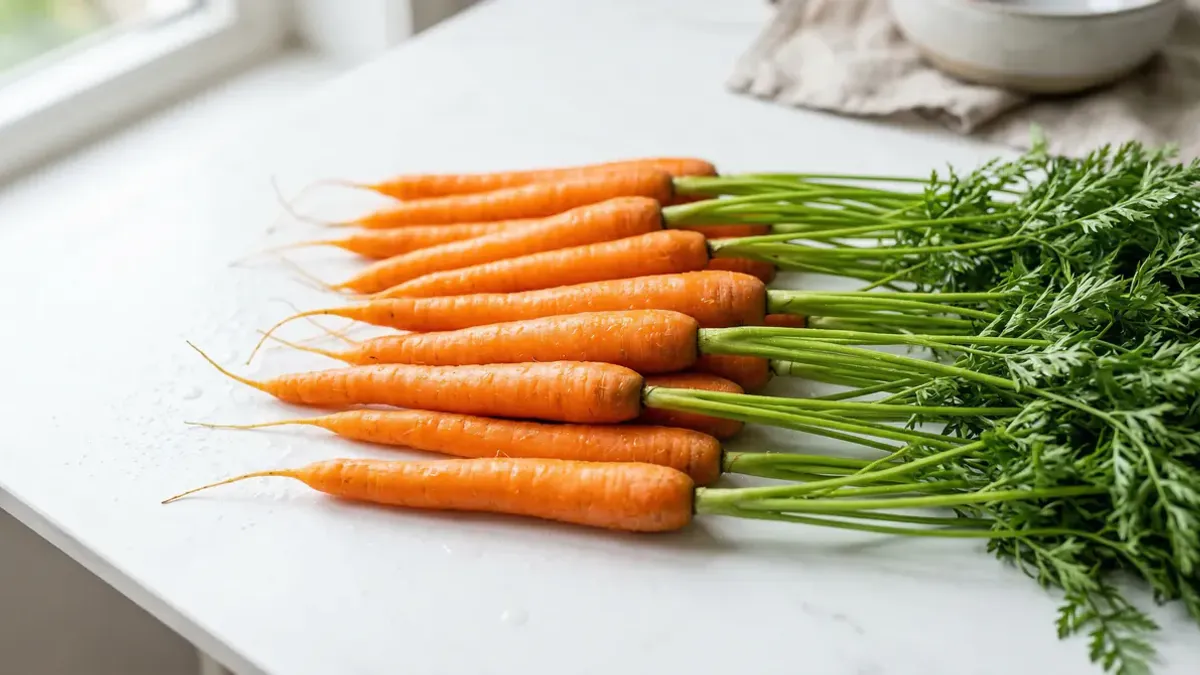
Carrots are so ordinary that you barely think about them. They sit in the bottom of the fridge, go into every stew and serve as the default healthy snack. But did you know that this everyday vegetable is one of the best natural sources of beta-carotene? And that how you cook carrots determines how much of that beta-carotene your body actually absorbs? It is time to take a closer look at what might be the most underestimated vegetable in your kitchen.
Key takeaways
- Very low in calories. 100 grams of carrots contains just 30 calories. A single small carrot (20 grams) has only 6 calories.
- Beta-carotene champion. Carrots provide roughly 6,400 micrograms of beta-carotene per 100 grams, a precursor your body converts into vitamin A.
- Cooking improves absorption. Lightly cooked carrots release more beta-carotene than raw ones because heat breaks open the cell walls.
- Fat helps. Beta-carotene is fat-soluble. A drizzle of olive oil or a small knob of butter with your carrots significantly improves absorption.
- Extremely versatile. From stews to snacking, soups to salads. Carrots fit into practically every meal.
How many calories are in carrots?
According to the Dutch Nutrition Centre (Voedingscentrum), 100 grams of carrots contains just 30 calories. A single small carrot weighing about 20 grams has only 6 calories. That makes carrots one of the lowest-calorie vegetables available at the supermarket.
In practical terms, a typical dinner serving of carrots is 100 to 150 grams. That works out to 30 to 45 calories, less than half of what a slice of bread contains. You can comfortably heap carrots onto your plate without worrying about your calorie budget.
| Nutrient | Per carrot (~20 g) | Per 100 grams |
|---|---|---|
| Energy | 6 kcal | 30 kcal |
| Fat | 0.1 g | 0.5 g |
| Carbohydrates | 1.0 g | 5.0 g |
| Sugars | 1.0 g | 5.0 g |
| Fibre | 0.5 g | 2.5 g |
| Protein | 0.2 g | 1.0 g |
Source: Voedingscentrum (Dutch Nutrition Centre), based on NEVO food composition data.
Wondering how carrots fit into your daily calorie target? Check our article on how many calories you need per day.
Why are carrots so nutritious?
The orange colour already gives it away: carrots are packed with beta-carotene. This is a provitamin that your body converts into vitamin A. And carrots are by far the most common everyday source of this nutrient.
1. Beta-carotene and vitamin A
100 grams of carrots delivers approximately 6,400 micrograms of beta-carotene, equivalent to about 1,067 micrograms of vitamin A (retinol activity equivalents). That is over one and a half times the average recommended daily intake.
Vitamin A is essential for:
- Vision. It plays a direct role in how your retina functions, particularly in low-light conditions.
- Skin. Vitamin A contributes to the production and repair of skin cells.
- Immune function. It supports the proper working of your immune system.
2. Fibre
At 2.5 grams of fibre per 100 grams, carrots contribute to healthy digestion. That is less than broccoli (3.2 grams) but still a meaningful amount. Most people do not consume enough fibre in their daily diet. Learn more in our guide to daily fibre intake.
3. Low calories, high volume
The combination of fibre and a high water content (carrots are roughly 88 percent water) makes them remarkably filling relative to their calorie count. This makes them ideal as a snack or as bulk in a main meal.
Does it matter how you prepare carrots?
Yes, and this is where it gets interesting. The preparation method directly affects how much beta-carotene your body absorbs.
Step 1: Cooking improves absorption
Lightly cooked carrots release more beta-carotene than raw ones. Heat breaks open the cell walls, freeing the beta-carotene and making it more bioavailable. According to the Dutch Nutrition Centre, your body can absorb certain vitamins more easily from cut and cooked vegetables.
This is unusual because most vegetables lose nutrients during cooking. For carrots and beta-carotene, the opposite is true.
Step 2: Add a small amount of fat
Beta-carotene is fat-soluble. That means you need fat to absorb it effectively. A drizzle of olive oil, a small knob of butter, or a dressing with oil alongside your carrots makes a measurable difference in absorption.
Step 3: Cut or grate them
The smaller you cut your carrots, the more beta-carotene is released. Grated carrots deliver more available nutrients than whole or roughly chopped pieces.
In summary: the optimal preparation for maximum beta-carotene absorption is lightly cooked, chopped carrots with a small amount of oil. But raw carrots are perfectly fine too, especially as a snack.
Can carrots help with weight management?
At just 30 calories per 100 grams, carrots are an excellent choice when you are watching your calorie intake. Like broccoli, they work well for volumetric eating: consuming a high volume of food for very few calories.
Practical ways to use carrots for this purpose:
- As a snack. Carrot sticks with hummus are a classic. A portion of 100 grams of carrots with one tablespoon of hummus comes to roughly 60 calories.
- As a volume extender. Grate carrots into your bolognese sauce, chilli or curry. You increase the volume without adding significant calories.
- As a swap. Use thin carrot strips instead of crisps on a snack platter. The calorie difference is hundreds.
For more strategies on using low-calorie vegetables for weight management, read our complete guide to calorie counting.
What are the best ways to eat carrots?
Carrots are a staple in kitchens across Europe. They are available year-round, affordable and endlessly adaptable.
- In stews. Carrots are a standard ingredient in traditional stews and hearty soups.
- Roasted. Whole carrots roasted with honey, thyme and a drizzle of olive oil. The sugars caramelise and the oil improves beta-carotene absorption.
- Grated in salads. Raw grated carrot with a mustard-honey dressing makes a fresh side dish.
- As soup. Pureed with ginger and coconut milk for a warming bowl.
- In baking. Carrot cake with cinnamon and nuts is a classic that uses the natural sweetness of the vegetable.
- Raw. Carrot sticks with hummus, tzatziki or a yoghurt-based dip.
Carrots are available year-round, but locally grown carrots are at their peak from June through November in northern Europe. Explore more options in our seasonal vegetable guide.
How do carrots compare to other low-calorie vegetables?
To put carrots in perspective against other popular low-calorie vegetables:
| Vegetable | Kcal/100 g | Beta-carotene | Fibre/100 g |
|---|---|---|---|
| Carrots | 30 | Very high (6,400 mcg) | 2.5 g |
| Broccoli | 28 | Low | 3.2 g |
| Cucumber | 12 | Very low | 0.5 g |
| Tomato | 18 | Moderate (lycopene) | 1.0 g |
| Courgette | 17 | Low | 1.0 g |
Carrots are not the absolute lowest in calories, but they more than compensate with their unique beta-carotene content. No other commonly eaten vegetable comes close to the amount of provitamin A that carrots deliver.
How many carrots should you eat?
Health guidelines recommend at least 250 grams of vegetables per day. Carrots do not need to be your only vegetable, but they make an excellent addition. A serving of 100 to 150 grams with dinner, supplemented by carrot sticks as a snack, moves you toward that target.
Can you eat too much beta-carotene? In theory, excessive intake can cause an orange discolouration of the skin (carotenodermia), but this only occurs at very high intakes over an extended period. At normal consumption levels, there is no reason for concern.
Give the humble carrot the credit it deserves
The carrot may not be the most exciting vegetable, but it is one of the most nutritious. Extremely low in calories, an unmatched source of beta-carotene, and versatile enough to work in almost any dish. It is the vegetable you already have on hand and could benefit from eating more of.
With Moveno, you snap a photo of your meal and instantly see what is in it. You discover just how nutritious that everyday carrot really is and build a better understanding of your eating habits, one meal at a time.