
Vitamin K2 rarely gets the attention it deserves — yet it plays a unique and irreplaceable role in your body's calcium regulation. Rather than simply ensuring calcium enters the body, K2 directs it to the right places and keeps it away from where it can do harm.
Key takeaways
Vitamin K2 activates two proteins that regulate calcium: osteocalcin (builds calcium into bones) and Matrix GLA Protein (removes calcium from artery walls). Without adequate K2, calcium may accumulate in the arteries instead of the bones. The best sources are natto, Gouda cheese, eggs, and butter from grass-fed cows.
What exactly is vitamin K2?
Vitamin K is a fat-soluble vitamin with two main forms: K1 (phylloquinone) and K2 (menaquinone). K1 is found primarily in green leafy vegetables and plays a key role in blood clotting. K2 is found in fermented foods and animal products, and is responsible for activating calcium-regulating proteins in tissues beyond the liver.
K2 has multiple subtypes. MK-4 (short-chain, found in animal products) and MK-7 (long-chain, found in natto and some cheeses) are the most important. MK-7 has a longer half-life in the blood and is therefore the preferred form for supplementation.
The two key proteins of K2
Osteocalcin — calcium into your bones
Osteocalcin is a protein produced by osteoblasts (bone cells). In its inactive form, it cannot bind calcium. Vitamin K2 activates osteocalcin through carboxylation, enabling it to incorporate calcium into the bone matrix. Without adequate K2, osteocalcin remains largely inactive regardless of how much calcium you consume.
Matrix GLA Protein (MGP) — calcium out of your arteries
MGP is the most potent known inhibitor of vascular calcification. Like osteocalcin, MGP must be activated by vitamin K2. Inactive MGP (ucMGP — uncarboxylated MGP) accumulates when K2 status is low. High ucMGP levels are strongly associated with arterial calcification and elevated cardiovascular risk.
Vitamin K2 and bone health
Multiple observational studies show a link between higher vitamin K2 intake and better bone density, particularly in postmenopausal women. In Japan, where natto is a daily staple and MK-7 intake is exceptionally high, hip fracture incidence is considerably lower than in western countries with similar calcium consumption.
A 2006 meta-analysis in the Archives of Internal Medicine found that vitamin K2 supplementation may reduce vertebral fracture risk by 60% and hip fracture risk by 77% in osteoporosis patients.
Vitamin K2 and cardiovascular health
The Rotterdam Study — a large prospective cohort study in the Netherlands — found that participants with the highest vitamin K2 intake (particularly MK-7 and MK-8/9 from cheese) had a 41% lower risk of cardiovascular mortality and 52% less aortic calcification. Notably, K1 intake showed no comparable effect.
This supports the idea that K2 — not K1 — is the primary vitamin for extrahepatic tissues such as bones and blood vessels.
Best dietary sources of vitamin K2
| Food | K2 content (MK-7 or total menaquinone) |
|---|---|
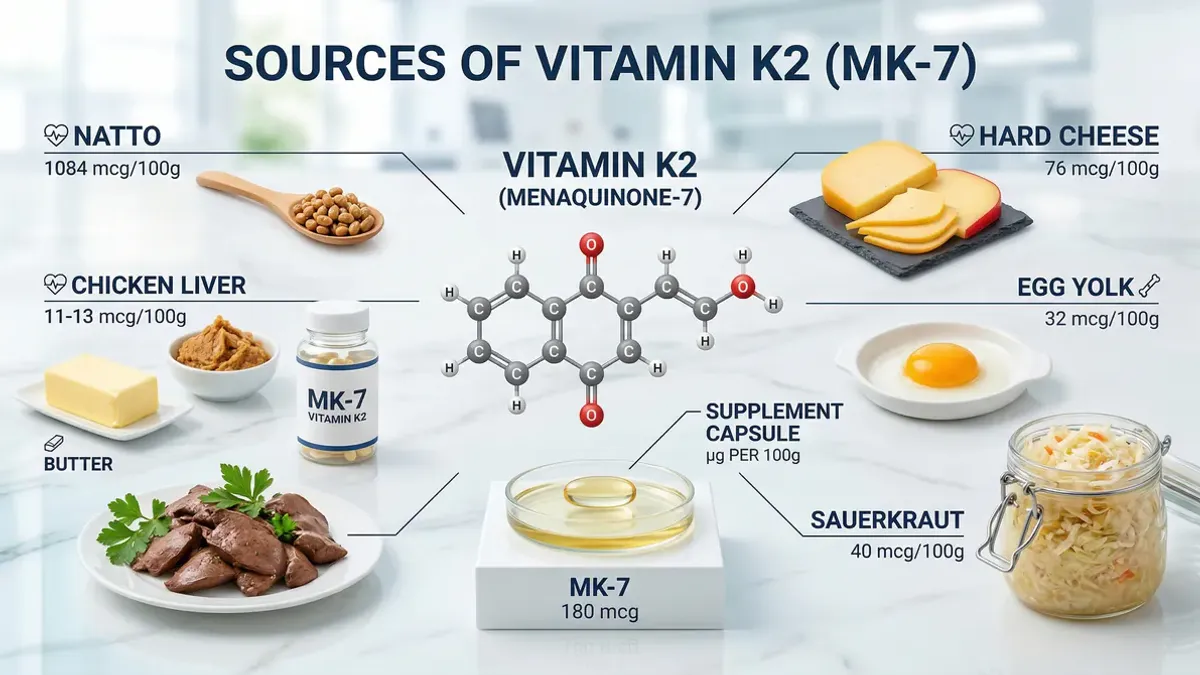
| Natto (fermented soybeans) | 939 mcg per 100g |
| Gouda cheese | 75 mcg per 100g |
| Brie | 56 mcg per 100g |
| Eggs | 32 mcg per 100g |
| Butter (grass-fed) | 15 mcg per 100g |
| Chicken liver | 14 mcg per 100g |
Natto is by far the richest source — but it is an acquired taste. Cheese, particularly aged Gouda and other long-ripened varieties, is the most practical main source of K2 for most people.
Deficiency: who is at risk?
Vitamin K2 deficiency is difficult to diagnose as it is not routinely measured. Indicators include elevated ucMGP or inactive osteocalcin. Risk groups:
- People who eat little cheese or fermented foods
- People who supplement vitamin D3 without K2 — D3 increases production of K2-dependent proteins; without K2, these proteins cannot be fully activated
- People taking anticoagulants (VKAs such as warfarin) — K2 supplementation may affect INR; always consult a doctor
- Older adults — lower dietary intake and possibly reduced conversion
Supplementing: how much and which form?
The optimal dose of vitamin K2 is still being studied. Common supplementation recommendations are 100–200 mcg MK-7 per day. As a fat-soluble vitamin, K2 is best absorbed with a fat-containing meal.
If you take vitamin D3, combining it with K2 (MK-7) is particularly beneficial: D3 increases calcium absorption, K2 ensures that calcium ends up in the right place. See our article on vitamin D3 for more background on this synergy. And if you are unsure whether you have a vitamin D deficiency, the vitamin D deficiency symptoms article covers the key warning signs.
Want to track whether you are getting enough K2 through food? With Moveno you can easily monitor your daily nutritional intake.
Vitamin K2 and your overall diet
Optimising vitamin K2 is most effective as part of a healthy, balanced diet. To get the full picture of what you eat, read our beginner's guide to calorie tracking. And if you are also working on your weight, our calorie deficit calculator guide will help you set the right daily energy target.
Sources
- Geleijnse JM et al. (2004). Dietary intake of menaquinone is associated with a reduced risk of coronary heart disease: the Rotterdam Study. Journal of Nutrition, 134(11):3100–3105. doi.org/10.1093/jn/134.11.3100
- Vermeer C. (2012). Vitamin K: the effect on health beyond coagulation — an overview. Food & Nutrition Research, 56. doi.org/10.3402/fnr.v56i0.5329
- Iwamoto J et al. (2006). Bone mineral density — vitamin K2 systematic review. Archives of Internal Medicine. doi.org/10.1001/archinte.166.6.655
- RIVM (2023). Vitamin K in the Dutch diet. rivm.nl