
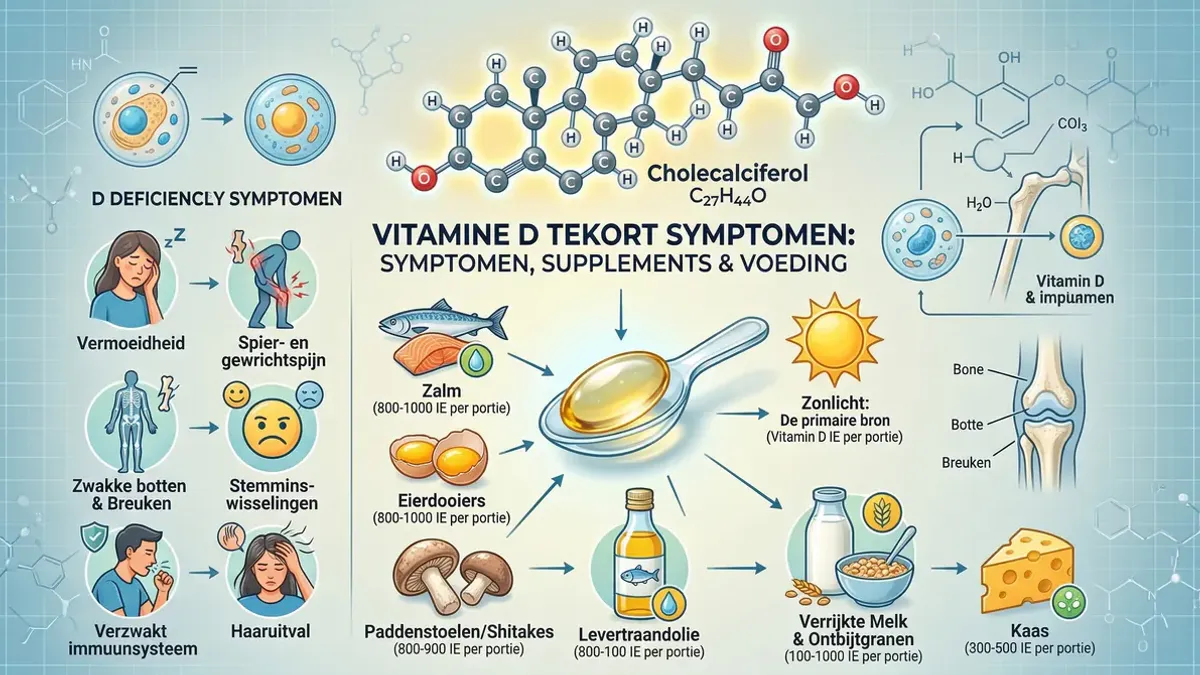
Nearly half of the Dutch population has insufficient vitamin D levels — yet the symptoms are often dismissed as stress or tiredness. Your body sends subtle signals that are easy to overlook, but recognising them early can make a real difference.
Key takeaways
Vitamin D deficiency can cause fatigue, muscle pain, low mood, and increased susceptibility to infections. If you recognise several of the symptoms below, ask your GP for a blood test.
How vitamin D works in your body
Vitamin D is technically a hormone produced by the skin when exposed to sunlight. It plays a key role in calcium absorption, immune regulation, muscle function, and even mood. The Netherlands sits at a latitude where sunlight is too weak for vitamin D synthesis between October and April — which explains why deficiency is so common here.
The recommended daily intake is 10 mcg (400 IU) for most adults, rising to 20 mcg (800 IU) for older adults and people with darker skin. A blood level of 50 nmol/L or above is considered sufficient; below 30 nmol/L indicates a true deficiency.
10 symptoms of vitamin D deficiency
1. Persistent fatigue
One of the most common yet most overlooked symptoms. If you wake up rested but feel tired throughout the day, low vitamin D may be contributing. Studies show that people with deficiency experience chronic fatigue more often than those with adequate levels.
2. Frequent infections
Vitamin D activates immune cells that fight bacteria and viruses. A deficiency may help explain why you get ill every winter or take longer to recover. Research suggests that supplementation may reduce the risk of respiratory tract infections.
3. Bone and back pain
Vitamin D is essential for calcium absorption in bones. Deficiency can lead to bone pain, particularly in the back, hips, and legs. In severe cases, this may progress to osteomalacia (softening of bones in adults) or rickets in children.
4. Low mood (especially in winter)
The brain contains vitamin D receptors. Low levels are associated with seasonal affective disorder and a persistently low mood. Whether supplementation helps with clinical depression is still being studied, but there is evidence that people with deficiency may benefit from raising their levels.
5. Slow wound healing
Wounds that take longer than usual to heal can point to a deficiency. Vitamin D plays a role in producing compounds that help skin regenerate and fight off infection.
6. Muscle pain and cramps
Unexplained muscle pain is a less commonly discussed but fairly frequent symptom. Vitamin D receptors in muscle tissue are involved in muscle function and recovery. Deficiency has been linked to muscle weakness and increased fall risk in older adults.
7. Hair loss
Significant hair loss has many causes, but vitamin D deficiency is one of them. Vitamin D may help stimulate hair follicles. Lower vitamin D levels are consistently found in people with alopecia areata.
8. Weight gain
A link has been established between low vitamin D levels and excess body weight. Vitamin D is stored in fat cells, meaning people with more body fat have proportionally less free vitamin D in the blood. It is a circular relationship: excess weight lowers available vitamin D, and deficiency may make fat storage easier.
9. Anxiety
Similar to depression, low vitamin D levels appear to be associated with heightened anxiety. The exact mechanism is not fully understood, but the brain uses vitamin D in the regulation of neurotransmitters.
10. Difficulty concentrating
Trouble focusing, forgetfulness, and brain fog are regularly reported by people with confirmed vitamin D deficiency. Many report a noticeable improvement in mental clarity after starting supplementation.
Who is most at risk?
Certain groups face a significantly higher risk:
- People with darker skin — more melanin blocks UVB rays
- Older adults — skin produces less vitamin D and kidneys convert it less efficiently
- People who spend little time outdoors — office workers, those working from home
- People who always wear sunscreen or cover their skin
- People with excess body weight — vitamin D is sequestered in fat tissue
- Vegans and vegetarians — animal products are the main dietary sources
Vitamin D from food
Food alone provides only a small fraction of your vitamin D needs. The best dietary sources are:
| Food | Vitamin D per serving |
|---|---|
| Fatty fish (salmon, mackerel, herring) | 10–25 mcg per 100g |
| Cod liver oil | 21 mcg per tablespoon |
| Eggs (yolk) | 1–2 mcg per egg |
| Fortified margarine | 1.5 mcg per 10g |
| Fortified dairy | 0.5–1 mcg per 200ml |
For most people, supplementation during autumn and winter is advisable. The Dutch Health Council recommends 10 mcg/day for adult women and 20 mcg/day for everyone over 70.
What should you do?
If you recognise several of the symptoms above, visit your GP for a 25-hydroxyvitamin D blood test. Based on the result, you can decide together whether supplementation is appropriate and at what dose.
Track your vitamin D3 intake as part of your daily nutrition. And if you supplement with D3, consider adding vitamin K2 — both vitamins work together for optimal calcium metabolism.
Want to track exactly what you eat? With Moveno you photograph your meal and instantly see all the nutritional values.
Track your nutrition to support vitamin D levels
Sunlight is the main source of vitamin D, but diet plays a supporting role. To understand your full nutritional picture, read our beginner's guide to calorie tracking. And if you are managing your weight alongside your vitamin D levels, our guide to calculating a calorie deficit will help you set realistic goals.
Sources
- Dutch Health Council (2022). Vitamin D — Assessment of dietary reference values for adults. gezondheidsraad.nl
- Holick MF. (2007). Vitamin D Deficiency. New England Journal of Medicine, 357(3):266–281. doi.org/10.1056/NEJMra070553
- RIVM (2023). Vitamin D in the Dutch diet. rivm.nl
- Martineau AR et al. (2017). Vitamin D supplementation to prevent acute respiratory tract infections. BMJ, 356:i6583. doi.org/10.1136/bmj.i6583