Potatoes have a somewhat paradoxical reputation in modern nutrition: once a staple food for generations, now often dismissed as "too many carbohydrates." But the facts tell a different story. The potato is actually one of the most nutritious and calorie-efficient carbohydrate sources you can eat — as long as you pay attention to how it is prepared.
Key takeaways
- Boiled potato. Contains only about 77 kcal per 100g — one of the most calorie-efficient carbohydrate sources available
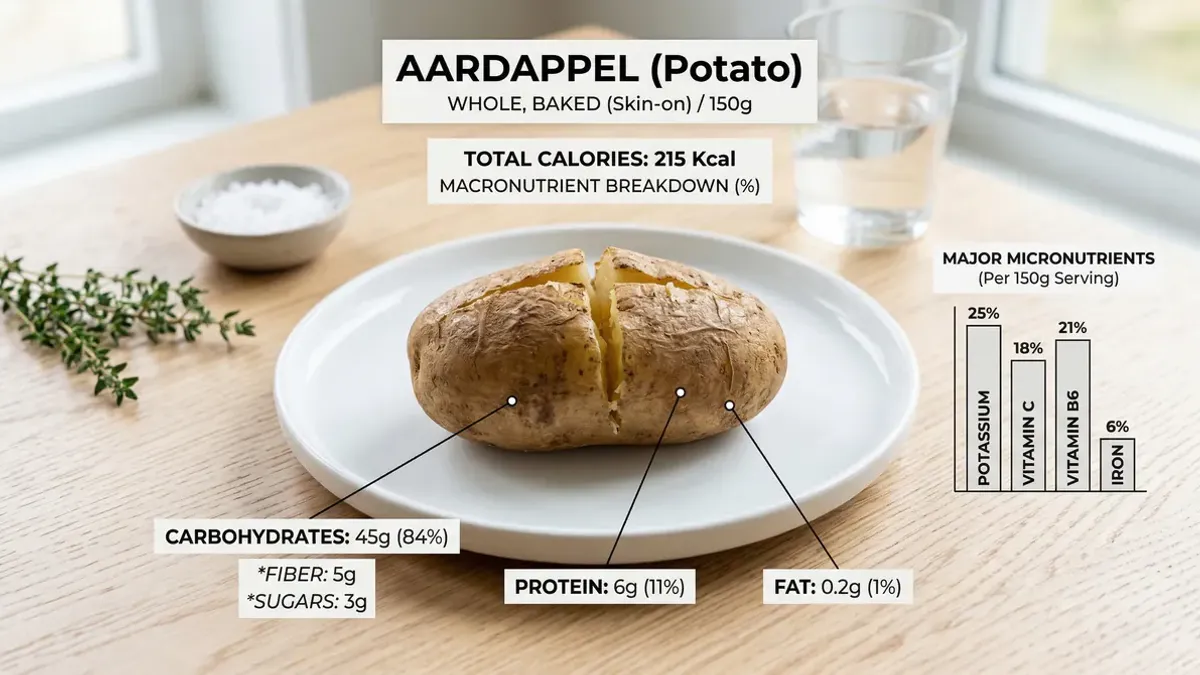
- Rich in potassium and vitamin C. A medium potato provides 20–30% of the recommended daily intake of potassium
- Preparation method determines calories. French fries contain about 320 kcal per 100g, crisps up to 550 kcal — more than seven times a boiled potato
- Keep the skin on. The skin contains more fiber and nutrients than the flesh alone
- Not inherently fattening. Potatoes are naturally low in fat and calories; butter, cream, and oil make the difference
How many calories are in a potato?
Based on NEVO data (Dutch Food Composition Database), here are the calories by preparation method:
| Preparation | Per 100g | Per potato (150g) |
|---|---|---|
| Boiled (without skin) | ~77 kcal | ~116 kcal |
| Boiled (with skin) | ~74 kcal | ~111 kcal |
| Jacket potato | ~93 kcal | ~140 kcal |
| Pan-fried in oil | ~150 kcal | ~225 kcal |
| French fries (thin) | ~320 kcal | — |
| Crisps | ~550 kcal | — |
A medium raw potato weighs approximately 150–200g. Comparing this with rice (~145 kcal per 100g cooked) and pasta (~142 kcal per 100g cooked), the boiled potato is by far the most calorie-efficient choice.
Complete nutritional values per 100g boiled
| Nutrient | Boiled potato |
|---|---|
| Energy | ~77 kcal |
| Carbohydrates | 17g |
| Of which fiber | 1.5g |
| Protein | 2g |
| Fat | 0.1g |
| Potassium | ~380 mg |
| Vitamin C | ~13 mg |
| Vitamin B6 | ~0.25 mg |
| Folate | ~16 µg |
Potassium is perhaps the most underappreciated quality of the potato. Potassium may help regulate blood pressure and is essential for muscle function. A serving of 200g boiled potato provides about 760 mg of potassium — more than a banana.
Comparison with rice, pasta, and sweet potato
How does the potato compare to other popular carbohydrate sources?
| Food (100g, prepared) | Calories | Fiber | Potassium |
|---|---|---|---|
| Boiled potato | ~77 kcal | 1.5g | ~380 mg |
| Sweet potato (boiled) | ~86 kcal | 2.5g | ~230 mg |
| White rice (cooked) | ~145 kcal | 0.4g | ~35 mg |
| Pasta (cooked) | ~142 kcal | 1.3g | ~45 mg |
The regular potato wins on calories and potassium content. The nutritional value of rice is comparable in protein but contains nearly twice as many calories per 100g cooked. Sweet potato contains more fiber and beta-carotene but slightly more calories. Want to understand the full picture of carbohydrates in your diet? Read our guide on carbohydrates explained.
Preparation method: the biggest difference
The calorie profile of a potato depends more on how it is prepared than on the variety itself.
Boiling
The most calorie-efficient option: ~77 kcal per 100g. Boiling in water or steaming preserves most nutrients. Boiling with the skin on is even better: the skin holds in vitamins and fiber.
Jacket potato
A jacket potato contains slightly more calories (~93 kcal per 100g) because moisture evaporates and the dry matter becomes more concentrated. With a healthy filling such as quark, corn, and vegetables, it is still a nutritious meal.
Pan-fried in oil
Each tablespoon of oil adds approximately 90 kcal. Roasting in the oven with a thin coating of oil is a good compromise: a crispy result for 120–150 kcal per 100g.
French fries and crisps
With fries and crisps, the potato is transformed into an entirely different product. French fries (~320 kcal/100g) and crisps (~550 kcal/100g) contain four and seven times more calories than a boiled potato, respectively.
Resistant starch: an additional benefit
Just as with rice, cooled cooked potatoes contain more resistant starch than warm potatoes. Resistant starch is not fully broken down in the small intestine and acts as a prebiotic for gut bacteria. Potato salad (made from cooled potatoes) therefore has a lower glycemic response than warm potatoes. For more on fiber and gut health, read about fiber-rich foods.
Practical tips
Choose the right variety for the purpose
- Waxy potatoes (e.g., Charlotte, Nicola): ideal for salads and stir-fries
- Floury potatoes (e.g., King Edward, Maris Piper): great for mash and baked dishes
- All-purpose varieties: versatile for side dishes
Keep the skin on
The skin contains extra fiber, potassium, and antioxidants. Wash the potato thoroughly and leave the skin intact as much as possible.
Watch the toppings
A plain potato is low in calories. But 30g of butter added to mash contributes 220 kcal, and a tablespoon of mayonnaise in potato salad adds 90 kcal. Keep toppings in mind when tracking your calorie intake.
Frequently asked questions
Are potatoes good for weight loss? Yes, boiled potatoes fit well into a weight loss plan. They are low in calories, filling due to their fiber and water content, and provide valuable nutrients. The key is calculating a calorie deficit and monitoring your total daily intake.
How many carbohydrates are in a potato? A medium boiled potato (150g) contains about 26g of carbohydrates. See also our post on carbohydrates in potatoes for the full breakdown.
Can I eat potatoes on a low-carb diet? That depends on how strict your diet is. On a ketogenic diet (fewer than 20g carbohydrates per day), a potato is difficult to fit in. With a moderate low-carb pattern (~100g carbohydrates per day), a small portion of potato works fine.
Are sweet potatoes healthier than regular potatoes? Both are nutritious. Sweet potato contains more beta-carotene (vitamin A precursor) and fiber; regular potato contains more potassium and vitamin C. Variety is the best advice.
The potato deserves its place back
The potato has been unfairly dismissed. When boiled or steamed, it is one of the most calorie-efficient and nutrient-dense carbohydrate sources in the supermarket. Preparation method is everything — not the potato itself.
Want to track how many calories are in your meals? With Moveno, you photograph your plate and instantly see the nutritional values — including that potato with vegetables. Try how simple food tracking can be.
Sources
- Dutch Food Composition Database (NEVO): nevo-online.rivm.nl
- Voedingscentrum, Potato: voedingscentrum.nl/encyclopedie/aardappel
- Harvard T.H. Chan School of Public Health – The Nutrition Source, Potatoes: hsph.harvard.edu/nutritionsource/food-features/potatoes