You choose a balanced meal — vegetables, some protein, a portion of carbs. But the scale doesn't move. Often, the issue isn't what you eat. It's how much. Portion size is one of the most underestimated factors in calorie control, and one of the easiest to improve.
You don't need to weigh every gram to regain control.
Key takeaways
- Portion size has a significant impact on total calorie intake, regardless of food quality.
- Average serving sizes have grown considerably over recent decades — and our perception has adjusted with them.
- Hand-based portion guides (palm, fist, thumb) offer practical estimates without a scale.
- The Voedingscentrum provides specific portion recommendations per food group.
- Eating from larger plates or packages consistently leads to higher intake.
- Small adjustments to portion size add up to a meaningful difference over a week.
Why portion size matters so much
A healthy meal can still be too calorie-dense if the portions are too large. Conversely, you don't need to radically change what you eat if you adjust the quantities. Portion control is one of the most direct and accessible ways to manage calorie intake without overhauling your diet.
The Dutch Nutrition Center (Voedingscentrum) provides concrete recommendations per food group. For vegetables, the guideline is 250 grams per day; for fruit, two pieces; for meat or fish, 100 grams per meal. Following those guidelines generally keeps calorie intake in check — not because counting is necessary, but because the recommendations are already built on balanced proportions.
Hand-based portion guides: your built-in measuring cup
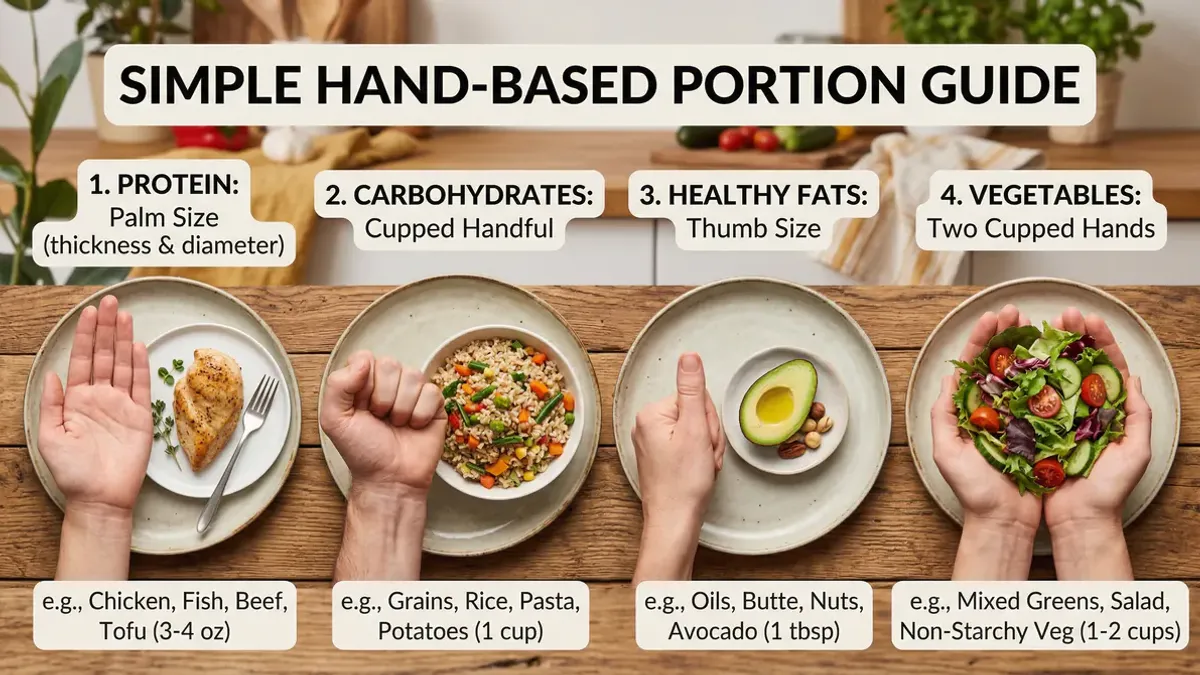
No scale available? Your hands give a surprisingly reliable indication. These are the most commonly used guidelines:
- Protein (meat, fish, tofu). A portion the size of your palm — roughly 80 to 100 grams.
- Carbohydrates (rice, pasta, bread). About a fist — cooked, that's around 150 to 200 grams.
- Vegetables. Two cupped hands — enough for 200 to 250 grams.
- Fats (oil, butter, nuts). A thumb-length as a guide for added fats.
This method isn't exact science, but it provides a practical framework you can use anywhere — at home, in a restaurant, at a friend's place.
How much have plates grown?
Research shows that portion sizes in restaurants and homes have grown significantly over the past fifty years. Larger plates demonstrably lead to larger portions: when the plate is bigger, you serve more — often without noticing.
A simple fix: use smaller plates and bowls. Not as a restriction, but as a smart environmental adjustment. Your brain perceives a full plate as a complete portion, regardless of the actual volume.
Portion control without a scale: practical steps
Step 1: Eat slowly and mindfully
Your satiety signal takes 15 to 20 minutes to reach your brain. People who eat quickly are well past their portion before they feel full. Eating more slowly — putting down your fork, chewing thoroughly — is one of the easiest ways to eat less without consciously cutting back.
Step 2: Use smaller containers
Eating straight from a bag or large package consistently leads to higher intake. Always serve a portion onto a plate or into a bowl before starting. That way you see exactly what you're eating and it's easier to stop at the right moment.
Step 3: Learn portion estimation by tracking
Tracking your food intake for a period — with an app or a food diary — quickly teaches you what 100 grams of chicken actually looks like, or how much pasta a handful really is. That experience sticks, even after you stop tracking.
If you want to learn more about tracking your food intake, read our article on keeping a food diary: why it works and how to start.
Start with one adjustment
You don't need to overhaul your entire diet to see results. Start with one thing: use a smaller plate, take one serving instead of two, or weigh your rice portion for a week. Awareness is the first step — and that step is smaller than you think.
With Moveno, you identify your meal from a photo and immediately see the nutritional values and portion size. That's how you build a reliable picture of what you eat each day.
Sources
- Voedingscentrum — Richtlijnen Schijf van Vijf — Dutch national portion recommendations per food group
- Voedingscentrum — Energy (calories) — energy balance and calorie intake explained