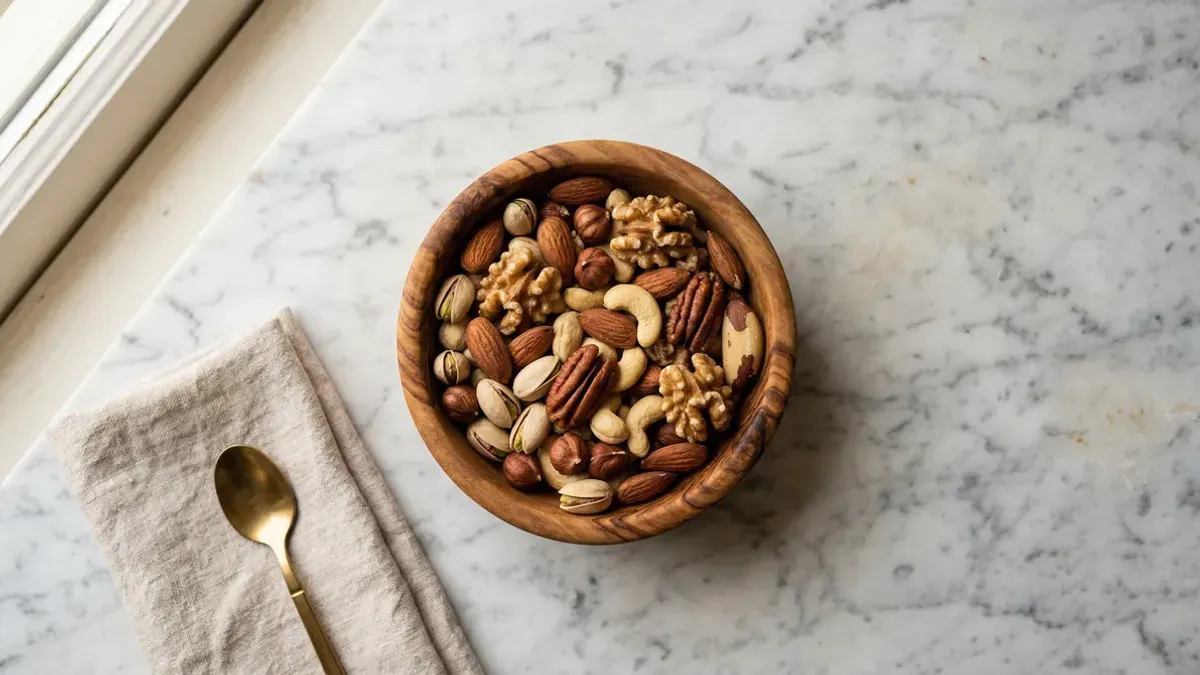
You reach for a handful of nuts, thinking it's a healthy snack. And it is — but that single handful contains 150-175 calories. Grab a second and third handful without thinking, and you've eaten 450-525 calories before you even realize it. Nut calories add up quickly because nuts taste good enough to eat mindlessly. The solution isn't avoiding nuts. It's learning how to snack on them wisely.
Key takeaways
- One handful of nuts (25 g) contains 148-176 calories. The Dutch Nutrition Centre recommends exactly this: one handful of unsalted nuts per day.
- Walnuts are the most calorie-dense (176 kcal per 25 g). Pistachios are the lightest at roughly 148 kcal per 25 g.
- Nuts are rich in healthy fats, protein and fiber. They may contribute to lower LDL cholesterol levels.
- The biggest pitfall is eating from the bag. Three handfuls instead of one delivers 450-530 kcal.
- Salted and roasted variants contain more calories. Always choose unsalted and unroasted when possible.
How many calories are in nuts?
Nuts are naturally calorie-dense because they're high in fat — mostly unsaturated fat that's beneficial for your cardiovascular system. According to the Dutch Nutrition Centre, a handful of unsalted mixed nuts (25 g) contains roughly 164 kcal, 14.9 g fat, and 4.5 g protein.
But not all nuts are equal. The differences between varieties are significant, especially when you eat them daily.
Nut calories by type: the full comparison
All values are per handful (25 g), based on data from the Dutch Nutrition Centre calorie checker for unsalted variants.
Walnuts. 176 kcal per 25 g. The most calorie-dense nut, but also an excellent source of omega-3 fatty acids.
Mixed nuts. 164 kcal per 25 g. The average across a nut mix. A useful reference point.
Almonds. 158 kcal per 25 g. Popular as a snack and in cooking. Relatively high in protein and fiber compared to other nuts.
Peanuts. 157 kcal per 25 g. Technically a legume, but nutritionally comparable to tree nuts. The most affordable option.
Cashews. 154 kcal per 25 g. Mild in flavor and slightly lower in fat than most nuts. Contains more carbohydrates, though.
Pistachios. Roughly 148 kcal per 25 g (calculated from 118 kcal per 20 g, Dutch Nutrition Centre). The shell-cracking process slows your eating pace, which may help with portion control.
The gap between the lightest and heaviest nut is nearly 30 kcal per handful. That sounds small, but over a week of daily eating, it adds up to more than 200 calories.
Why are nuts so calorie-dense?
Nuts are 50-70 percent fat by weight. That sounds like a lot, but the vast majority is unsaturated fat. According to the Dutch Nutrition Centre, one handful of unsalted nuts per day may contribute to lower LDL cholesterol and healthier blood vessels.
Beyond healthy fats, nuts provide fiber, protein, vitamin E, vitamin B1, iron, and minerals. These are nutrients many people don't get enough of. A daily handful of nuts is a smart addition to your eating pattern — as long as you watch the portion size.
Wondering how nuts fit into your daily calorie intake? Start by figuring out how many calories you need per day.
Unsalted vs. salted nuts: does it matter?
In terms of calories, the difference is minimal. Salted peanuts contain 155 kcal per 25 g according to the Dutch Nutrition Centre; unsalted peanuts contain 157 kcal. But there are two good reasons to choose unsalted.
Salt makes you eat more. Salted nuts activate your reward system more strongly, making it harder to stop at one handful. One handful easily becomes three.
Too much sodium is unhealthy. Most people already consume more salt than recommended. Salted nuts add to that surplus.
Roasted nuts are a different story. Roasting itself doesn't add calories, but manufacturers often add oil during the roasting process, which increases the fat content. Choose dry-roasted or raw if you want to keep calories in check.
How to control your nut portions
The biggest risk with nuts isn't the nut itself — it's the quantity. Eating from the bag is the fastest way to consume 400-500 calories without realizing it. These strategies help:
Pre-portion your servings. Weigh out 25 g and put it in a small container or bag. You'll know exactly what you're eating without having to think about it each time.
Choose in-shell pistachios. Cracking shells slows your eating pace. Research suggests you may eat up to 40 percent less compared to shelled nuts.
Pair nuts with something filling. A handful of nuts with a piece of fruit or a few slices of cheese makes a more complete snack that keeps you satisfied longer.
Never eat straight from the package. This is the golden rule. Once you eat from a large bag, you lose track of how much you've consumed.
Nuts vs. chips: which snack is smarter?
If you want a snack, nuts are almost always the better choice compared to chips. A bowl of chips (40 g) contains roughly 216 kcal of mostly empty calories: lots of fat and salt, minimal nutrients. A handful of nuts (25 g) contains similar calories but delivers healthy fats, protein, and fiber alongside them.
The difference isn't just in calories but also in satiety. Nuts keep you full longer thanks to their protein and fiber content. After a handful of nuts, you'll have less of an appetite than after a handful of chips.
Want to understand how nutrition labels work? That knowledge helps you evaluate which snacks align with your goals.
How nuts fit into your day
Nuts work well as part of a balanced eating pattern when you know what you're consuming. A few ideas:
As a mid-morning snack. A handful of nuts with a cup of coffee around 10 AM. Together roughly 165-195 kcal, depending on the coffee variant.
Mixed into yogurt. Add 15-20 g of chopped nuts to Greek yogurt or quark. Adds texture and keeps you fuller for longer.
With lunch. A few walnuts tossed into your salad adds healthy fats and protein without making lunch much heavier.
A practical way to keep track is by logging your meals and snacks. That way you can see exactly how nuts fit into your daily calorie needs.
Frequently asked questions
How many nuts should you eat per day? The Dutch Nutrition Centre recommends one handful (25 g) of unsalted nuts per day. This is enough to get the health benefits without excessive calories.
Are peanuts actually nuts? No, peanuts are legumes. But nutritionally and in terms of calories, they're comparable to tree nuts. The Dutch Nutrition Centre groups them in the same category.
Which nut has the fewest calories? Pistachios at roughly 148 kcal per 25 g. Cashews follow closely at 154 kcal.
Do nuts make you gain weight? Nuts are calorie-dense, but research indicates that regular nut consumption doesn't automatically lead to weight gain. The satiating effect of their protein and fiber may cause you to eat less at other times.
Sources
- Voedingscentrum — Calories in unsalted nuts (Dutch Nutrition Centre)
- Voedingscentrum — Which nuts are healthy to eat?
- Voedingscentrum — Nuts (encyclopedia)
Start snacking smarter today
Nuts are one of the best snacks you can choose — as long as you watch the quantity. With Moveno, you don't have to guess. Snap a photo of your snack and see the nutritional values instantly. That way you know exactly what a handful of nuts contributes to your day.