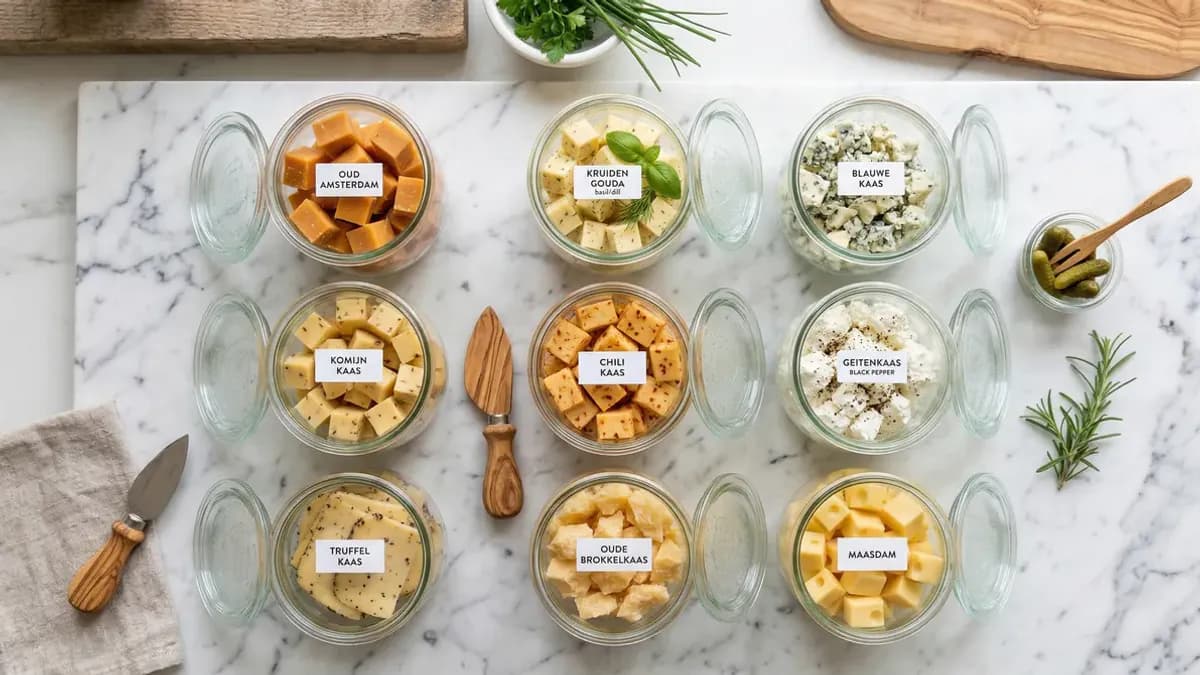
Two slices of cheese on a sandwich, a piece of Gouda with drinks, or grated cheese over pasta. Cheese is deeply embedded in European food culture. But the calorie range is wide, from 90 kcal per 100g for cottage cheese to nearly 400 kcal for hard aged varieties. Knowing which cheese you pick can make a real difference.
Key takeaways
- Standard Gouda (48+): 109 kcal per slice (30g). The most common sandwich cheese in the Netherlands.
- Reduced-fat cheese (30+): 92 kcal per slice. Saves 17 kcal compared to standard Gouda.
- Mozzarella: 63 kcal per slice (25g). At 252 kcal per 100g, a middle-range option.
- Cottage cheese: 18 kcal per portion (20g). The lightest choice with high protein.
- Fat content drives the calories. Dutch cheese uses a plus-number system (20+, 30+, 48+) indicating fat percentage in dry matter.
How many calories are in cheese?
The Voedingscentrum (Dutch Nutrition Centre) provides calorie data per standard serving. For Dutch cheese, that is a pre-cut slice of 30 grams. For soft and international cheeses, portion sizes vary.
| Cheese type | Portion | Calories | Per 100g |
|---|---|---|---|
| Gouda 48+ young | 30g slice | 109 kcal | 363 kcal |
| Gouda 48+ semi-aged | 30g slice | 111 kcal | 370 kcal |
| Gouda 48+ aged | 30g slice | 113 kcal | 377 kcal |
| Gouda 30+ aged | 30g slice | 92 kcal | 307 kcal |
| Gouda 20+ | 30g slice | 74 kcal | 247 kcal |
| Mozzarella | 25g slice | 63 kcal | 252 kcal |
| Brie | 30g | 111 kcal | 370 kcal |
| Goat cheese | 20g | 79 kcal | 395 kcal |
| Camembert | 30g | 92 kcal | 307 kcal |
| Cottage cheese | 20g | 18 kcal | 90 kcal |
Source: Voedingscentrum (Dutch Nutrition Centre)
A surprising finding: goat cheese is more calorie-dense than most hard cheeses at 395 kcal per 100g. And reduced-fat cheese (20+) has nearly half the calories of standard Gouda (48+).
What does the plus-number mean on cheese?
The number before the plus sign indicates the fat percentage in the dry matter, not in the cheese itself (since cheese also contains moisture).
48+. The standard. Contains 48 percent fat in dry matter. This is the most sold variety in the Netherlands.
30+. The lighter option. At 30 percent fat in dry matter, this variety offers noticeably fewer calories with comparable flavour.
20+. The lightest hard cheese. At just 247 kcal per 100g and an impressive 10.4g protein per 30g slice, this is the most protein-efficient option.
Taste does change: less fat means a drier, firmer texture. Some people notice a slightly rubbery consistency with 20+ cheese.
Which cheese fits your goal?
1. Weight loss or calorie reduction
Choose 20+ or 30+ cheese instead of 48+. You save 17 to 35 kcal per slice. With two sandwiches a day, each with two slices of cheese, that adds up to 490 kcal per week.
Cottage cheese is the ultimate light option. At 90 kcal per 100g and 11g protein per 100g, you can eat a generous portion for very few calories.
Learn more about smart calorie management in our calorie tracking beginners guide.
2. Muscle building or higher protein needs
Cheese is surprisingly protein-rich. A 30g slice of 48+ cheese contains 6.8g protein. The 20+ variety delivers 10.4g protein per 30g slice with fewer calories.
Cottage cheese is a favourite among athletes: 11g protein per 100g for just 90 kcal. Combine it with vegetables or spread it on a rice cake.
3. Enjoying food without overthinking it
Pick your favourite cheese and watch the portion size. One slice more or less may not matter on any single day, but over a week it adds up. Simply being aware of the numbers already helps.
Cheese on bread versus cheese in cooking
Most Dutch people eat cheese on bread, but cheese also appears frequently in cooked meals, where calories can climb quickly.
Cheese on bread. Two slices of 48+ (60g) deliver 218 kcal from cheese alone. Add the bread (80 to 100 kcal) and you are already at 300 kcal.
Grated cheese over pasta. A tablespoon of grated Gouda is about 10g and contains roughly 36 kcal. Most people sprinkle two to three tablespoons, adding 70 to 110 kcal.
Grilled cheese sandwich. Two slices of cheese plus butter on the outside. The cheese alone is 218 kcal; the butter adds another 70 to 100 kcal.
Cheese board with drinks. Three to four pieces of cheese (60 to 80g) easily deliver 220 to 300 kcal, without counting the crackers and drinks.
How does cheese compare to other dairy?
Cheese is by far the most calorie-dense dairy product. For perspective:
| Product | Calories per 100g |
|---|---|
| Skimmed milk | 35 kcal |
| Semi-skimmed milk | 45 kcal |
| Yoghurt (semi-skimmed) | 50 kcal |
| Cottage cheese | 90 kcal |
| Mozzarella | 252 kcal |
| Camembert | 307 kcal |
| Gouda 48+ young | 363 kcal |
| Goat cheese | 395 kcal |
A glass of milk (250ml semi-skimmed) has 112 kcal. That is about the same as a single slice of cheese. Yoghurt sits somewhere in between. It shows just how concentrated the calories in cheese really are.
Want a complete picture of how many calories you need daily? Check our guide on calculating your daily calorie needs.
Frequently asked questions about cheese calories
Is cheese unhealthy for weight loss? No, but portion control matters. Cheese delivers many calories per gram, but also protein and calcium. One to two slices per day fits most eating patterns. The key is being aware of what you eat and choosing deliberately.
How much cheese can you eat per day? The Voedingscentrum recommends a maximum of 40 grams of cheese per day as part of your dairy intake. That equals roughly one slice plus a small piece. This recommendation is based on saturated fat content.
Is reduced-fat cheese (30+) really lighter? Yes. Cheese labelled 30+ contains noticeably fewer calories and less fat than 48+. Per 30g slice, the difference is 17 kcal. The flavour is slightly milder, but many people barely notice the difference on a sandwich.
Does parmesan count as high-calorie cheese? Yes. Parmesan contains around 390 kcal per 100g. But you typically use small amounts (5 to 10g grated), so the actual calorie impact stays limited.
Are there fat-free cheese options? Truly fat-free cheese does not exist, but 20+ cheese comes closest to a lighter option among hard cheeses. Cottage cheese (90 kcal per 100g) is a strong alternative if you do not need the texture of traditional cheese.
Enjoy your next sandwich more consciously
Cheese is one of the most delicious but also most calorie-dense items in a typical diet. The good news: you do not have to give it up. By choosing between 48+, 30+, or 20+, or by occasionally trying cottage cheese, you can save significantly without sacrificing flavour.
Want to know exactly what is on your plate? Moveno recognises your meals from a photo and shows the full nutrition breakdown instantly, from those two slices of cheese to the rest of your lunch.