Quick answer: A nutrition label shows calories (energy), carbohydrates (fuel), protein (building blocks), fat (concentrated energy) and fibre (satiety). Calories tell you how much energy a food provides — eat more than you burn and you gain weight, eat less and you lose weight.
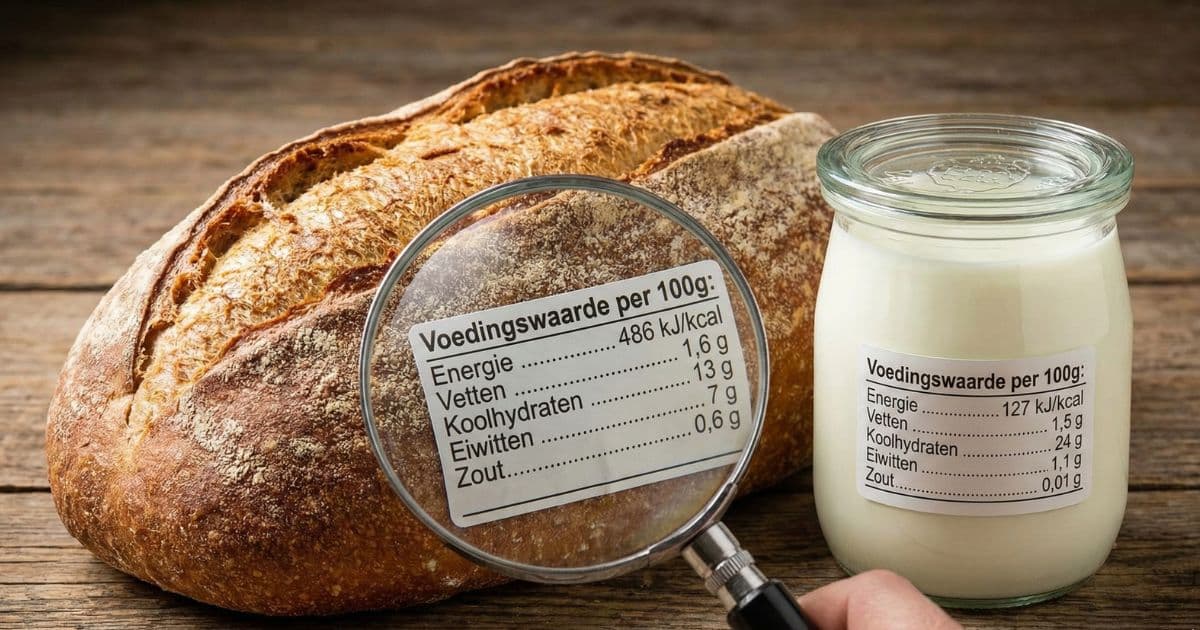
You pick up a loaf of bread at the supermarket. On the side there's a table full of numbers. Calories. Protein. Carbohydrates. Fat. Fibre. It looks scientific, maybe even intimidating. But what do those numbers actually mean?
This article explains everything on a nutrition label in plain language. Not for fitness enthusiasts, but for anyone who wants to eat a little more mindfully.
Calories: the most important number on the label
Calories are a measure of energy. Everything you eat contains calories — it's simply how much energy your body can extract from that food.
An apple, for example, contains 50 to 80 calories. If you eat 2,000 calories in a day, you're taking in 2,000 units of energy from food. This is the number most people already know: eat more calories than you burn and you gain weight. Eat fewer and you lose weight.
Here's the thing: calories are not good or bad. They're numbers. Information. They tell you how much energy is in a product, not whether that product is healthy or unhealthy.
Carbohydrates: your body's fuel
Carbohydrates are, at their core, sugars. There are two main types:
- Simple carbohydrates (sugars). These enter your bloodstream quickly, give you a fast energy boost and wear off fast. Think sugar in sweets or soft drinks.
- Complex carbohydrates (starch, fibre). These are absorbed more slowly, provide steady energy and keep you full for longer. Think wholegrain bread, rice and pasta.
Bread contains roughly 40 to 50 grams of carbohydrates per 100 grams. Two slices (about 50 grams) give you around 20 to 25 grams of carbs. That's perfectly normal — carbohydrates are your body's primary fuel source.
A portion of cooked rice (200 grams) contains about 50 to 55 grams of carbohydrates. That's a fair amount, but whether it's "too much" depends on what else you eat that day and how active you are. Carbs are not the enemy — they're fuel.
Protein: your body's building blocks
Protein is what your muscles, organs and immune system are built from. It also keeps you full for longer than carbohydrates do.
Foods high in protein:
- Chicken, meat: 20 to 25 grams per 100 grams
- Fatty fish (salmon, mackerel): 20 to 25 grams per 100 grams
- Quark (thick yoghurt): 10 grams per 100 grams
- Egg: about 7 grams per medium egg (50g) — or 8 grams for a large egg (60g)
- Nuts: 15 to 26 grams per 100 grams (almonds ~21g, peanut butter ~26g, cashews ~18g)
A 150-gram chicken breast contains about 35 grams of protein. That alone covers a large chunk of your daily needs.
Eating plant-based? Tofu, lentils and beans are solid protein sources.
The general recommendation is about 50 to 60 grams of protein per day for adults (the precise requirement is 0.8 grams per kilogram of body weight — for someone weighing 70 kg, that's about 56 grams). A single chicken breast gets you most of the way there.
Protein contains 4 calories per gram, the same as carbohydrates, but it keeps you fuller for longer. That's why many people focus on eating more protein: not because it's magic, but because you feel satisfied sooner and are less likely to overeat.
Fat: not the villain you think
Fat has earned a bad reputation. "Eating fat makes you fat" is a stubborn myth. In reality, fat is essential. Your brain needs fat. Your hormones need fat.
Foods containing fat:
- Butter: 82 grams of fat per 100 grams (almost pure fat)
- Oil: 100 percent fat
- Nuts: 50 to 60 grams of fat per 100 grams
- Fatty fish (salmon, mackerel): 10 to 20 grams of fat per 100 grams
- Lean fish (cod, tilapia): 1 to 3 grams per 100 grams
- Skimmed milk: 0.1 grams of fat per 100 ml
The crucial difference: fat contains 9 calories per gram, more than double the amount in carbohydrates and protein (4 calories per gram). Fat is calorie-dense. A single teaspoon of oil (5 grams) already delivers 45 calories.
This explains why restaurant meals are so calorie-heavy. Chefs use generous amounts of oil and butter, making food tastier but also far more calorie-dense. The same meal prepared at home without much oil: 350 calories. The same meal at a restaurant: easily 550 calories. The difference? Oil and butter.
So fat isn't bad — but it adds up fast.
Fibre: the silent hero on the label
Fibre technically falls under carbohydrates, but it behaves very differently from sugar. Your body can't really digest fibre. It passes through your digestive system without contributing many calories.
So what does fibre actually do?
- It fills your stomach, making you feel full sooner
- It supports healthy digestion
- It helps keep your blood sugar stable
A clear example: wholegrain bread contains 5 to 8 grams of fibre per 100 grams. White bread has just 1 to 2 grams. The calories are roughly the same (around 250 per 100 grams), but wholegrain bread keeps you noticeably fuller.
That's why nutrition experts recommend brown bread over white. Not because wholegrain is magic, but because the extra fibre keeps you satisfied for longer. Other fibre-rich foods include vegetables, fruit, nuts and beans.
Salt and sodium: less is better
Many nutrition labels list "salt" or "sodium". This can be confusing because they're not quite the same thing. Sodium is a component of salt — labels may show one or the other.
The recommended maximum is about 6 grams of salt per day (equivalent to roughly 2,400 mg of sodium). Most people consume more salt than they realise, which can raise blood pressure over time.
Many packaged foods contain more salt than you'd expect. Crisps are obvious, but bread, ready-made soups and fruit juices also contain surprisingly high amounts. You can't always taste it, but it's there.
Salt isn't something you need to actively "count" like calories, but it's worth being aware of — especially with packaged foods.
Sugar: the special case under carbohydrates
Sugar is listed separately on most nutrition labels, underneath carbohydrates. This number includes all sugar in the product: both natural sugar (in fruit, milk) and added sugar (in sweets, soft drinks, sauces).
Many processed foods contain more added sugar than you'd expect. Yoghurt, breakfast cereals and fruit juices are common offenders.
A clear example: a glass of apple juice contains 80 to 100 calories, almost entirely from sugar. No fibre, no lasting fullness. An apple, on the other hand, contains 50 to 80 calories from a combination of sugar and fibre. Same energy, but the apple fills you up more.
This is precisely why nutrition experts say: eat fruit rather than drink juice. Not because juice is inherently bad, but because whole fruit with its fibre gives you more satiety per calorie.
How to use this in practice
Imagine you're in the supermarket comparing two yoghurts:
| Yoghurt A | Yoghurt B | |
|---|---|---|
| Calories | 150 kcal | 180 kcal |
| Carbohydrates | 15g (of which 10g sugar) | 20g (of which 5g sugar) |
| Protein | 10g | 15g |
| Fat | 5g | 5g |
| Fibre | 0g | 2g |
Which do you pick? It depends on your goal. Yoghurt B has more calories, but also more protein, less added sugar and more fibre. Nutritionally, yoghurt B is the better choice — you get more nourishment for your calories. But if you're strictly watching calories, yoghurt A is lighter.
This shows why it's not just about calories. It's also about what your body gets from that food. But as a starting point for eating more mindfully? Calories are the simplest number to begin with.
The key takeaway
Nutrition labels look complicated, but the numbers are actually straightforward:
- Calories = energy
- Carbohydrates = fuel
- Protein = building blocks
- Fat = concentrated energy
- Fibre = feeling full without many calories
- Sugar = fast carbohydrates (watch out for added sugar)
Now that you understand this, you can make smarter choices at the supermarket. Not to obsessively count everything, but to understand what you're buying.
Want to make it even easier? At Moveno, we're building an app that lets you snap a photo of your food and instantly see the nutrition facts. No reading labels, no looking up numbers — just photograph and understand what you eat.
Curious? Join the waitlist and get early access.
Sources
- RIVM. NEVO-online: Dutch Food Composition Database. nevo-online.rivm.nl
- Voedingscentrum. Nutrients — calories, carbohydrates, proteins and fats. voedingscentrum.nl
- Dutch Health Council (Gezondheidsraad). Dietary Reference Values 2015. gezondheidsraad.nl
- Voedingscentrum. Salt and sodium. voedingscentrum.nl