
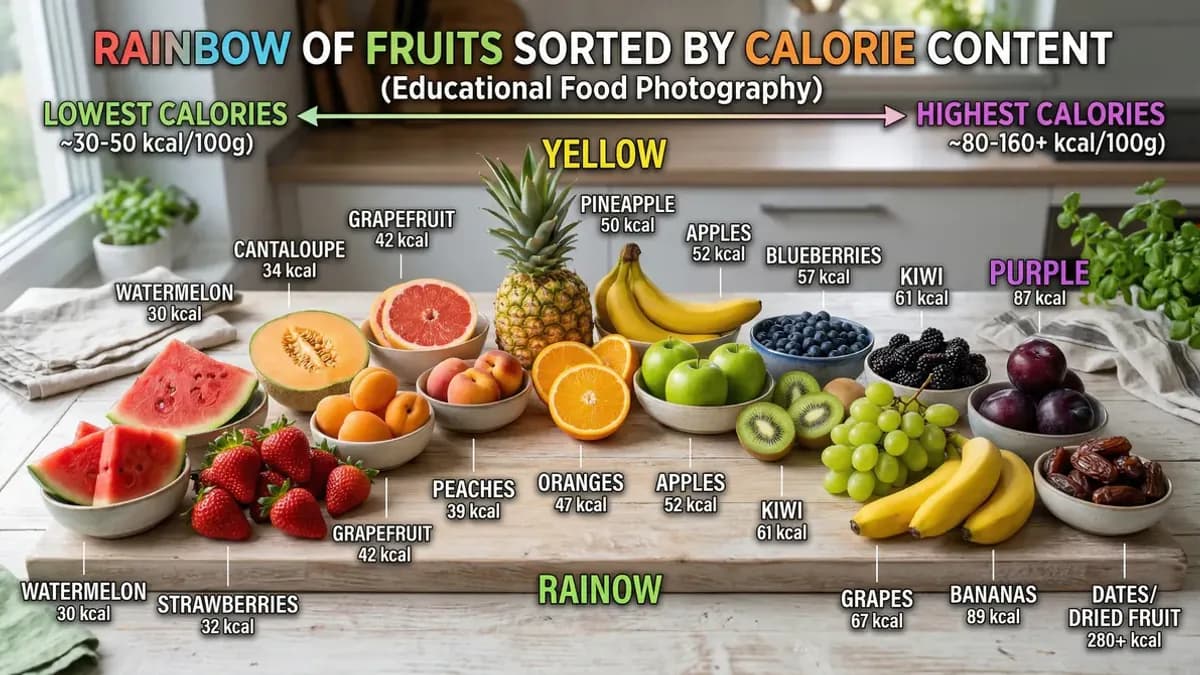
Fruit is healthy — everyone knows that. But fruit also contains sugars and calories, and the variation between types is enormous. A bowl of strawberries and a handful of dates are both fruit, but they deliver a vastly different amount of energy. For anyone wanting to understand their calorie intake, it's worth knowing what you're actually getting.
That doesn't mean avoiding or restricting fruit. It means being intentional about it.
Key takeaways
- Fruit contains on average 30 to 80 calories per 100 grams, depending on water content.
- Low-calorie fruit: strawberries (29 kcal), watermelon (30 kcal) and grapefruit (42 kcal) per 100g.
- Higher-calorie fruit: dried dates (315 kcal), avocado (160 kcal) and banana (89 kcal) per 100g.
- Dried fruit contains up to five times more calories than fresh fruit due to moisture loss.
- The Voedingscentrum recommends at least two pieces of fruit per day as part of a balanced diet.
- Fruit as a snack ideally replaces higher-calorie alternatives like biscuits or confectionery.
How do calories in fruit work?
The calories in fruit come almost entirely from carbohydrates — mainly fructose (fruit sugar) and glucose. Fruit also contains fiber, vitamins, minerals and antioxidants, which cause sugars to be absorbed more slowly than refined sugars in processed products.
Water content largely determines calorie density. Watermelon is about 92 percent water, delivering just 30 calories per 100 grams. Dates, by contrast, have very low water content and deliver — especially when dried — 315 calories per 100 grams.
Calories in fruit: from low to high
Below is an overview of commonly eaten fruit, based on NEVO data (values per 100 grams fresh fruit, unless stated otherwise):
Low-calorie fruit (under 50 kcal per 100g)
- Watermelon. 30 kcal — 92% water, minimal fat or protein.
- Strawberries. 29 kcal — rich in vitamin C, low in sugar.
- Grapefruit. 42 kcal — mildly tart, good source of vitamin C.
- Melons (cantaloupe, honeydew). 35 to 45 kcal — high water content, naturally sweet.
- Raspberries and blackberries. 40 to 43 kcal — high in fiber, low in sugar.
- Peach and nectarine. 39 to 44 kcal — soft and sweet with few calories.
Mid-range fruit (50 to 80 kcal per 100g)
- Apple. 52 kcal — good fiber source, satisfying.
- Pear. 57 kcal — rich in fiber, mild flavor.
- Orange. 47 kcal — well-known vitamin C source.
- Kiwi. 61 kcal — two pieces meet your entire daily vitamin C requirement.
- Plum. 46 kcal — beneficial for digestion.
Higher-calorie fruit (above 80 kcal per 100g)
- Banana. 89 kcal — energy-dense and filling, popular as a sports snack.
- Grapes. 67 kcal — relatively high in sugar, easy to overeat.
- Mango. 60 kcal — tropical, sweet, rich in beta-carotene.
- Avocado. 160 kcal — technically a fruit, rich in healthy fats (monounsaturated).
- Fresh dates. 139 kcal — sweet and compact.
- Dried dates. 315 kcal — up to five times more calorie-dense than most fresh fruit.
Dried fruit: worth paying attention to
Dried fruit — raisins, apricots, dates, figs, cranberries — contains significantly more calories per 100 grams than its fresh counterpart, due to the removal of moisture. A small handful of raisins (30 grams) delivers around 90 calories, while the same weight of fresh grapes contains only about 20 calories.
That doesn't make dried fruit a poor choice — it's rich in fiber and minerals — but it does call for awareness about portion size. A tablespoon as a topping on oatmeal or yogurt: fine. A bowl as a snack: easily 400 calories.
Avocado: fruit or vegetable?
Botanically, an avocado is a fruit — it contains a seed and grows on a tree. But its nutritional profile is much closer to a nut than an apple. The calories in avocado come primarily from fat: per 100 grams, it contains around 15 grams of fat, most of which is monounsaturated. These are the same fats found in olive oil and nuts, widely considered beneficial for cardiovascular health.
Half an avocado (about 70 grams) delivers around 112 calories — more than an apple, but with a completely different nutritional profile.
How much fruit per day?
The Voedingscentrum recommends at least two pieces of fruit per day as part of a healthy diet, but sets no maximum. People who eat a lot of fruit also get a lot of fiber, vitamins and antioxidants — beneficial for overall health.
For those tracking calories: two average pieces of fruit (an apple and an orange, for example) delivers roughly 100 to 120 calories. That's a modest and nutritious contribution to your daily intake.
If you want to know how to track your daily food intake including fruit, read our article on keeping a food diary: why it works and how to start.
Fruit as a smart snack choice
Fruit ideally replaces higher-calorie snacks like biscuits, sweets or crisps. A large apple delivers 80 calories and keeps you fuller for longer thanks to its fiber. A handful of crisps can easily deliver 150 calories with no fiber or micronutrients.
That substitution doesn't make fruit a weight-loss miracle, but it does make it a smart choice within a balanced diet.
All fruit is worth eating
No fruit type is unhealthy. Avocados are calorie-dense but highly nutritious. Dates are higher in sugar but packed with fiber and potassium. Strawberries are low-calorie and high in vitamin C. The variety is a benefit: eat as many different types as possible for a broad spectrum of nutrients.
With Moveno, you identify your meals and snacks — including fruit — from a photo and immediately see the nutritional values. No manual searching or calculating required.
Sources
- Voedingscentrum — Calories in strawberries — NEVO-based calorie values for strawberries
- Voedingscentrum — Fruit — fruit consumption recommendations and nutritional values