
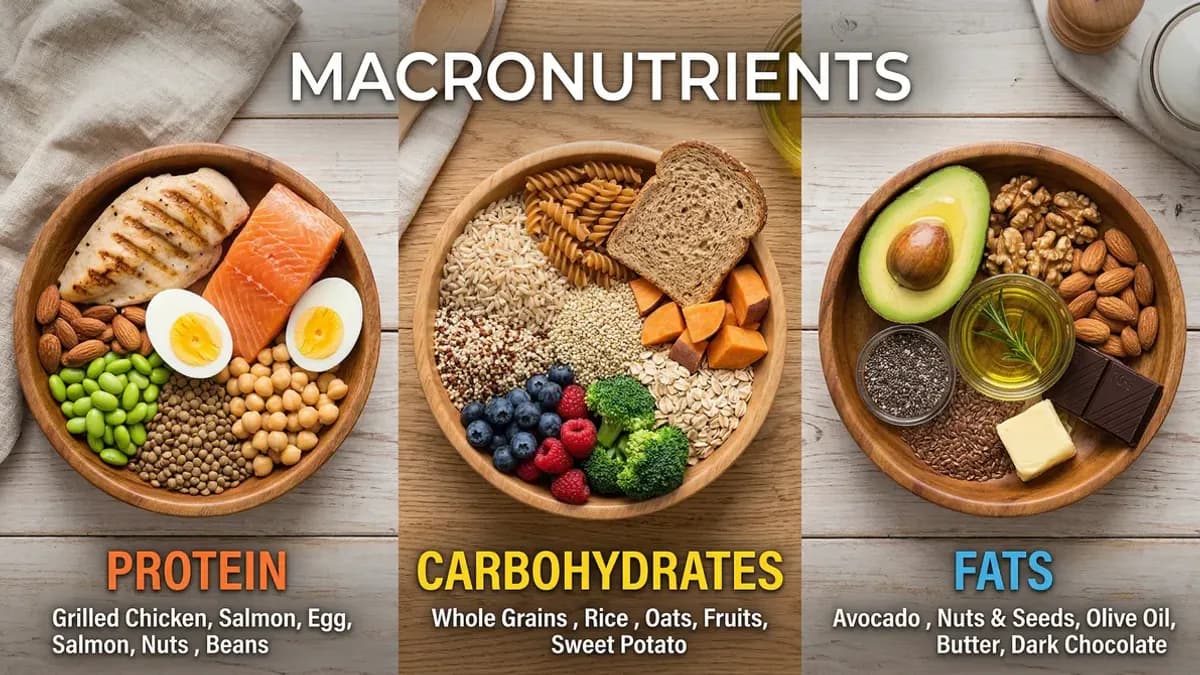
You've probably seen the term everywhere: tracking macros, hitting your macros, macro-friendly meals. But what are macros, exactly? And why do so many people focus on their macro split alongside — or even instead of — calories? This guide explains everything from scratch, with no jargon.
Key takeaways
- Macros is short for macronutrients: the three major nutrients that provide your body with energy
- Protein supplies 4 kcal/g and builds muscle; carbohydrates supply 4 kcal/g and are your primary fuel; fat supplies 9 kcal/g and is essential for hormones and vitamins
- Every calorie you eat comes from one or more of these three macros
- The ratio of macros you eat shapes your body composition — not just the total calorie count
- Fibre is technically a carbohydrate but behaves differently, providing no usable energy while supporting gut health
The three macronutrients explained
Macronutrients are the nutrients your body needs in large quantities to function. That's what distinguishes them from micronutrients — vitamins and minerals — which your body needs in much smaller amounts.
There are exactly three macronutrients:
- Protein — the body's building material
- Carbohydrates — the primary energy source
- Fat — the energy reserve and hormone factory
Every calorie in your food comes from one or more of these three. There is no fourth category.
Protein: building blocks for muscle and more
Protein is made up of amino acids — the building blocks your body uses for muscle tissue, enzymes, hormones, and immune cells. Every gram of protein provides 4 kilocalories.
According to EFSA, the population reference intake for healthy adults is 0.83 g of protein per kg of body weight per day. Active individuals or those losing weight while trying to preserve muscle may benefit from more — research points to a range of 1.2 to 2.0 g per kg, depending on training intensity and goal.
Good protein sources include:
- Animal-based. Chicken, fish, eggs, Greek yoghurt, cottage cheese, low-fat cheese
- Plant-based. Legumes (lentils, chickpeas, kidney beans), tofu, tempeh, edamame
A notable advantage of protein: it has the highest satiety effect of the three macros. A protein-rich meal keeps you full longer than the same number of calories from carbohydrates or fat.
Carbohydrates: fuel for the brain and muscles
Carbohydrates are the body's preferred energy source — particularly for the brain. Glucose, the end product of carbohydrate breakdown, is the primary fuel for almost all cells. Every gram of carbohydrates provides 4 kilocalories.
Carbohydrates are found in:
- Complex carbohydrates (slow-digesting). Whole grain bread, brown rice, oats, potatoes, legumes — these provide a steadier blood sugar response
- Simple carbohydrates (fast-digesting). Sugar, white bread, fruit juice, sweets — quick energy without prolonged satiety
- Fibre. Technically a carbohydrate, but indigestible as energy. Fibre feeds beneficial gut bacteria and supports digestion
Fat: essential, not the enemy
Fat spent decades with a bad reputation, but it's fundamental to good health. Every gram of fat provides 9 kilocalories — more than double protein or carbohydrates. That makes fat calorie-dense, but not inherently unhealthy.
Fat serves several critical functions:
- Hormone production. Sex hormones like oestrogen and testosterone are synthesised from cholesterol
- Vitamin absorption. Vitamins A, D, E, and K are fat-soluble — without dietary fat, your body can't absorb them
- Cell structure. Every cell membrane in your body is partly made of fat
- Energy reserve. When carbohydrate availability is low, your body switches to burning stored fat
The type of fat matters. Unsaturated fats — from olive oil, avocado, nuts, and fatty fish — are associated with cardiovascular benefits. Saturated fats — from butter, cheese, and red meat — are fine in moderate amounts.
Fibre: the overlooked carbohydrate
Fibre is sometimes called the 'forgotten macro'. Technically it's a carbohydrate, but it isn't broken down by the body for energy. Its role is distinct: fibre feeds beneficial gut bacteria, supports regular digestion, and helps you feel full for longer after eating.
How many macros do you need per day?
Your ideal macro split is personal and depends on your goal, body weight, and activity level. A general framework:
| Macro | General recommendation |
|---|---|
| Protein | 0.83–2.0 g per kg of body weight |
| Fat | 20–35% of daily calories |
| Carbohydrates | 40–70% of daily calories |
Want to know exactly how to calculate this for your situation? The guide on how to calculate your macros walks you through the process step by step.
Macros vs. calories: what's the difference?
Calories are the total measure of energy. Macros are where that energy comes from. You could eat 2,000 calories a day — but how those calories are distributed across protein, carbohydrates, and fat significantly influences your body composition, energy levels, and recovery.
Tracking both gives you the full picture. Beginners often start with calories alone — and that works well as a first step. Macros are the next level of detail.
Start understanding your macros today
Now that you know what macros are, you can look at your food with more intention. You don't need to track everything immediately — start by paying attention to how much protein you eat each day — read also about daily protein needs. Pair that with healthy carbohydrates and healthy fats for a complete macro balance.
Download Moveno and instantly see the protein, carbohydrate, and fat content of your meals — just by taking a photo.
Sources
- Voedingscentrum — Eiwitten (Protein) — function of protein and recommended daily intake
- Voedingscentrum — Energy (calories) — caloric values per gram for each macronutrient
- EFSA — Dietary Reference Values for protein — 0.83 g/kg/day population reference intake for adults
- Voedingscentrum — How many carbohydrates per day? — recommended carbohydrate range (40–70% of calories)