
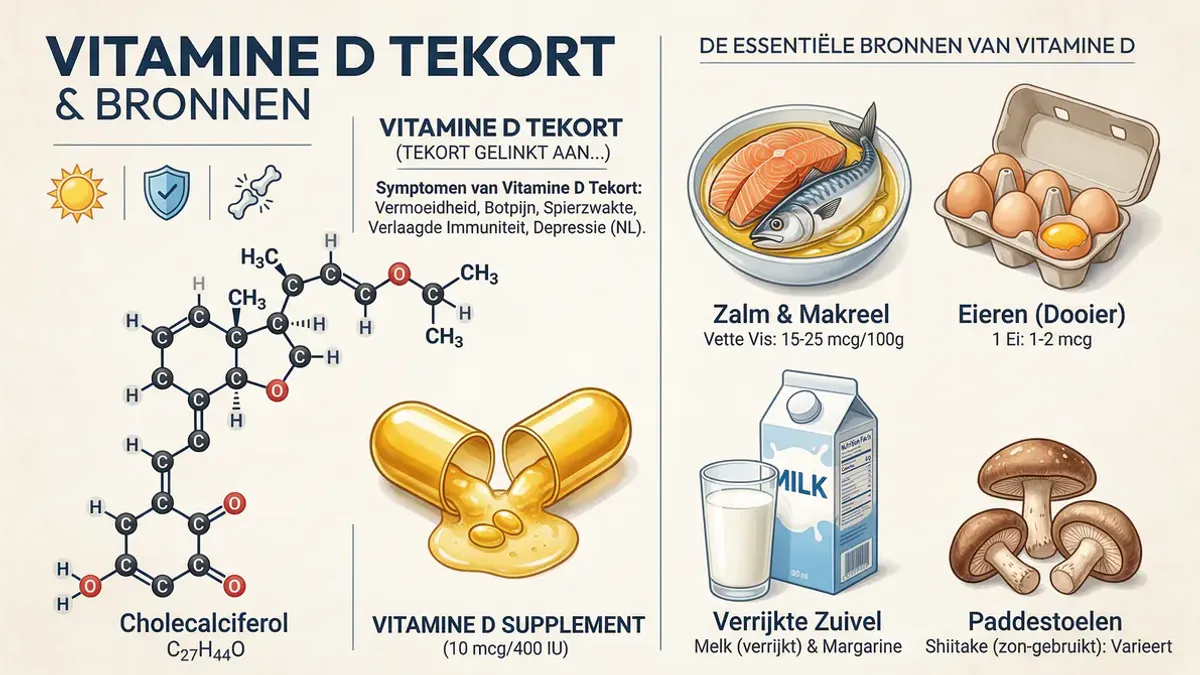
Vitamin D deficiency is one of the most common nutritional deficiencies in the Netherlands, yet it often goes unrecognised. The symptoms are vague and overlap with other conditions: fatigue, muscle pain, low mood. In this article you will find out which symptoms may indicate a deficiency, who is at greatest risk, and what you can do about it.
Key takeaways
- Vitamin D deficiency is widespread, especially in winter months
- Common symptoms: fatigue, muscle pain, bone pain, increased susceptibility to infections
- Diagnosis via blood test at your GP (25-OH-vitamin D)
- Risk groups: older adults, people with darker skin, those who spend little time outdoors, pregnant women
- Treatment: tailored supplementation based on the severity of the deficiency
What is vitamin D deficiency?
Vitamin D deficiency is determined by a blood test measuring the 25-OH-vitamin D level. Interpretation:
| Value | Status |
|---|---|
| < 30 nmol/L | Severe deficiency |
| 30-50 nmol/L | Insufficient |
| 50-75 nmol/L | Moderate |
| 75-125 nmol/L | Optimal |
| > 125 nmol/L | Potentially too high |
A value below 50 nmol/L is considered insufficient by most health organisations.
Symptoms of vitamin D deficiency
A vitamin D deficiency can manifest in a range of complaints. Because these symptoms also occur in other conditions, a deficiency is not always immediately recognised.
Fatigue and low energy
Persistent, unexplained fatigue is one of the most commonly reported complaints associated with vitamin D deficiency. Vitamin D plays a role in cellular energy production and sleep-wake cycle regulation.
Muscle pain and cramps
Vitamin D is involved in muscle function. A deficiency can lead to diffuse muscle pain, cramps, and a general feeling of weakness. In older adults, this is associated with increased fall risk.
Bone pain
Vitamin D regulates calcium absorption for bone formation. Prolonged deficiency can reduce bone density, causing bone pain — particularly in the back, hips, and legs. In severe cases this may lead to osteoporosis in adults or rickets in children.
Increased susceptibility to infections
Vitamin D plays a role in immune defence. People with low vitamin D levels get respiratory infections, flu, and colds more frequently. This partly explains why infections peak in winter — when vitamin D levels are at their lowest.
Depressive feelings and mood changes
Vitamin D receptors are present in brain regions involved in mood regulation. An association has been found between low vitamin D levels and depressive symptoms, though the causal relationship is still under investigation. Seasonal depression (winter blues) is partly linked to reduced vitamin D production.
Poor wound healing
Vitamin D plays a role in producing compounds that help the skin repair itself. With a deficiency, wound healing may be slower.
Hair loss
While hair loss has many causes, a link has been found between vitamin D deficiency and alopecia areata, an autoimmune condition causing hair loss.
Causes of vitamin D deficiency
Insufficient sun exposure
This is the most common cause in the Netherlands. From October to March, the sun is too low in the sky to deliver enough UVB radiation to the skin for vitamin D production. Even in summer, people who spend most of their time indoors or who always use high-SPF sunscreen may not get adequate vitamin D from sunlight.
Skin type
People with darker skin have more melanin, which reduces UVB absorption. They require more sun exposure than lighter-skinned individuals to produce the same amount of vitamin D.
Age
As people age, the skin's capacity to produce vitamin D declines. Those over 70 have a recommended intake of 20 mcg per day, compared with 10 mcg for younger adults.
Overweight
Vitamin D is fat-soluble and stored in adipose tissue. In people with overweight, vitamin D is less readily available to the body, which can result in lower blood levels.
Gastrointestinal conditions
Conditions such as coeliac disease, Crohn's disease, and other conditions impairing fat absorption also reduce uptake of fat-soluble vitamins, including vitamin D.
Who is at greatest risk?
- People who spend little time outdoors (remote workers, those with mobility limitations)
- Older adults (70+)
- People with darker skin
- Pregnant and breastfeeding women
- People with overweight or obesity
- People with gastrointestinal conditions or malabsorption
- Vegans (vitamin D3 is found almost exclusively in animal products)
Diagnosis: when to see your GP
Consult your GP if you have several of the above symptoms and belong to a risk group. A blood test for 25-OH-vitamin D can be requested. Based on the result, the GP can determine whether supplementation is needed and at what dose.
Note: self-supplementing without testing is not always meaningful and can — at very high doses (above 100 mcg/day sustained) — lead to vitamin D toxicity.
Treatment and solutions
Supplementation
For a confirmed deficiency, GPs typically prescribe higher doses depending on severity:
- Mild deficiency (30-50 nmol/L): 25 mcg/day (1,000 IU)
- Moderate deficiency: 50-75 mcg/day (2,000-3,000 IU)
- Severe deficiency (< 30 nmol/L): sometimes a loading dose under medical supervision
Vitamin D3 (cholecalciferol) is preferable over D2 due to its stronger and longer-lasting effect.
Lifestyle
- Spend 15-30 minutes outdoors daily between 11:00 and 15:00, with uncovered hands and face
- Include fatty fish (salmon, herring, mackerel) regularly in meals
- Use fortified products such as margarine and plant-based milks
Winter prevention
The Netherlands Nutrition Centre advises a daily supplement of 10 mcg for all Dutch residents over 50 and specific risk groups year-round. For the general population, supplementation from October through March is sensible.
Tracking your intake
With Moveno, you can track what you eat and instantly see nutritional values including vitamin D. That gives you insight into your intake so you can assess whether supplementation is worthwhile.
Vitamin D and your nutrition plan
Getting enough vitamin D is part of a healthy lifestyle — and so is understanding your overall calorie and nutrient intake. Our beginner's guide to calorie tracking shows you how to easily log what you eat. If you are also working on your weight, use our calorie deficit calculator guide to find the right daily target.