
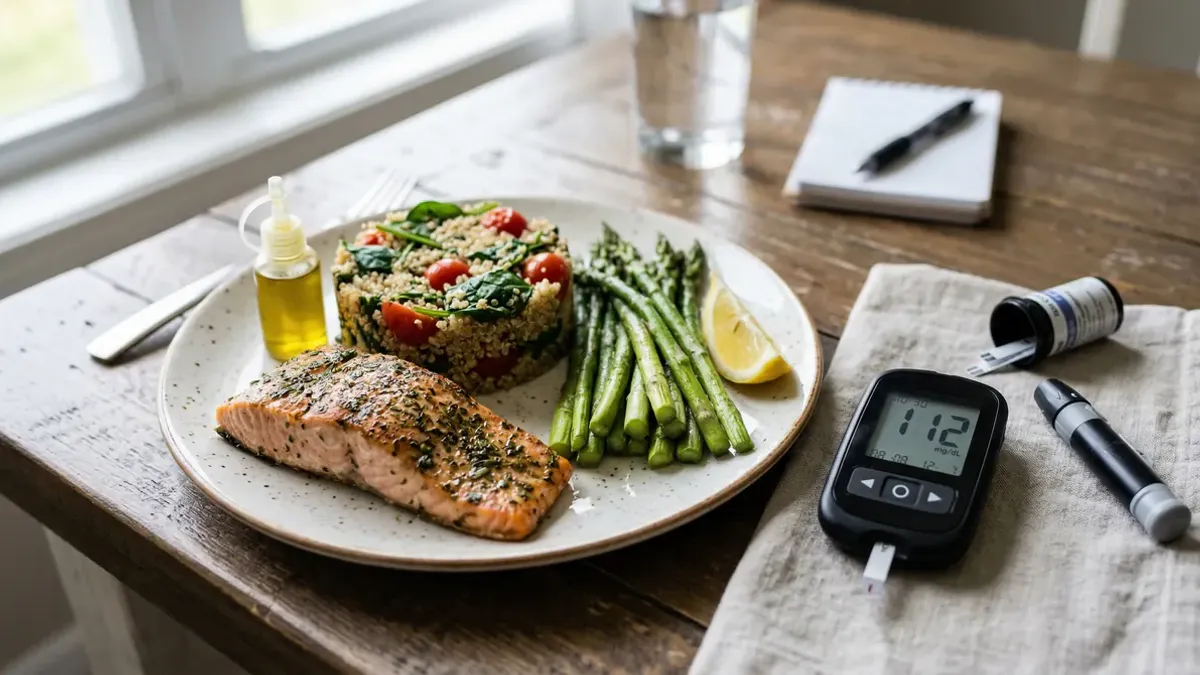
Managing type 2 diabetes through food is one of the most effective tools available. Every meal influences your blood sugar — but that does not mean you need a restrictive special diet. With the right knowledge, you have far more flexibility than you might think.
Key takeaways
- Fibre is your greatest ally. Aim for 30-40 grams per day to slow glucose absorption and stabilise blood sugar.
- The glycaemic index (GI) is useful, but not everything — overall diet quality matters more than obsessing over individual GI values.
- Refined sugars and white refined grains cause rapid blood sugar spikes and are best minimised.
- The Mediterranean diet is the most evidence-backed eating pattern for people with type 2 diabetes.
- Eating at regular times helps prevent blood sugar swings throughout the day.
- Alcohol in moderation: maximum one drink per day for women, two for men — always with food.
What is type 2 diabetes?
In type 2 diabetes, the body becomes less sensitive to insulin, the hormone that moves glucose from the bloodstream into cells. As a result, blood sugar stays elevated. What you eat directly affects how fast and how high your blood sugar rises after meals.
The good news: no foods are completely off-limits. Patterns matter far more than single meals.
Which carbohydrates are best?
Carbohydrates have the most direct impact on blood sugar, but they are not all equal. The Voedingscentrum (Dutch Nutrition Centre) recommends prioritising:
- Wholegrain bread and pasta. Fibre slows glucose absorption.
- Brown rice and wholegrain couscous. Better choices than white varieties.
- Legumes. Lentils, chickpeas and kidney beans have a low GI and a solid protein content.
- Oats. A classic breakfast that keeps blood sugar stable for hours.
- Vegetables and whole fruit. Rich in fibre, vitamins and minerals.
What to reduce: white bread, white rice, sugary drinks, sweets and baked goods. These are high in refined sugars and low in fibre, causing rapid glucose spikes.
Why does fibre matter so much?
Fibre slows the digestion and absorption of carbohydrates, which flattens blood sugar peaks. Research highlighted by the Diabetesfonds confirms that a fibre-rich diet can contribute to better blood sugar regulation.
In practice, aim for 30-40 grams of fibre daily by:
- Eating at least 250 grams of vegetables per day
- Including two pieces of whole fruit
- Choosing wholegrain over refined versions
- Adding legumes two to three times per week
- Snacking on a small handful of unsalted nuts
What is the glycaemic index and how should you use it?
The glycaemic index (GI) ranks how quickly a food raises blood sugar. Foods below 55 are considered low GI and cause slower, more gradual rises. Examples include legumes, most vegetables, dairy and most fruits.
The Voedingscentrum usefully notes that GI is a helpful guide — not a rigid rule. A low-GI food can still be nutritionally poor. Focus on overall diet quality, with GI as one useful signal among many.
1. Low GI (best choices)
Lentils, chickpeas, full-fat yoghurt, apples, pears, wholegrain products.
2. Medium GI (in moderation)
Ripe bananas, pineapple, brown rice, couscous.
3. High GI (limit these)
White bread, white rice, sugary drinks, sweets, glucose sports drinks.
Which eating pattern works best?
The Mediterranean diet is the most-studied and consistently recommended pattern for people with type 2 diabetes. It emphasises:
- Vegetables, fruit, legumes and whole grains as the base of every meal
- Olive oil as the primary fat source — rich in monounsaturated fatty acids
- Oily fish twice a week — salmon, mackerel or herring for omega-3
- Limited red meat — maximum once per week
- Nuts and seeds as everyday snacks
Other patterns that may help: low-carbohydrate eating (always consult your doctor if you use medication), intermittent fasting, and the DASH diet. What works best varies per person.
What is better to avoid?
There are no absolute bans, but these deserve extra attention:
- Refined sugars in soft drinks, juice, sweets, biscuits and cakes — fast energy with no nutritional value
- Processed foods — ready meals and fast food typically contain high amounts of salt, sugar and fat
- Alcohol — maximum one drink per day for women, two for men, always with food (alcohol can cause blood sugar to drop)
- Fruit juice — lacks the fibre of whole fruit and causes rapid blood sugar spikes
Simple daily habits that make a difference
You do not need to overhaul everything at once. Small, sustainable changes add up:
- Swap white bread for wholegrain
- Replace soft drinks and juice with water or herbal tea
- Include vegetables with every meal
- Choose whole-food snacks: a handful of nuts, a piece of fruit, raw vegetables
- Eat at consistent times to reduce blood sugar variability
Want to see exactly what your meals contain in terms of carbohydrates, fibre and calories? With Moveno, you can photograph your food and get instant nutritional insights — no manual searching or calculating required.
Start eating more intentionally today
Type 2 diabetes does not demand perfection. It calls for consistent awareness of what you eat and why. By choosing foods that support stable blood sugar — more fibre, fewer refined sugars, regular mealtimes — you give your body what it needs to function well.
To learn more about tracking what you eat each day, read our guide on food tracking: why it works and how to get started. Want to understand how many calories you need each day? Our beginner's guide to calorie tracking walks you through it, and the calorie deficit calculator guide helps you set a realistic daily target.
Sources
- Voedingscentrum — Diabetes type 2 — dietary guidance for type 2 diabetes, GI and fibre
- Voedingscentrum — How to eat healthily with type 2 diabetes — practical dietary advice
- Diabetesfonds — Fibre and diabetes — fibre for blood sugar regulation
- Voedingscentrum — Glycaemic index — explanation of GI and its role in diabetes management