
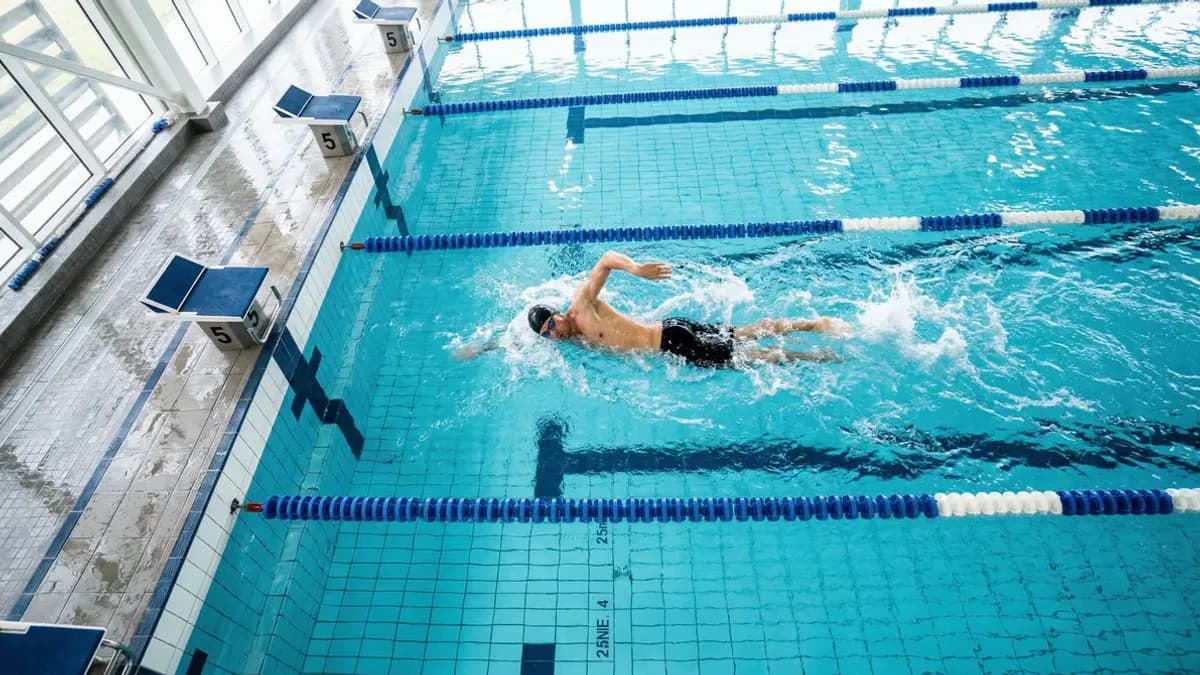
You push off the wall, dive under, and start pulling your first laps. Within fifteen minutes, you feel every muscle in your body working. Swimming is one of the most complete forms of exercise, but how many calories does it actually burn? That varies significantly by stroke, your body weight, and how hard you push.
Key takeaways
- Butterfly burns the most: approximately 394 kcal per 30 minutes at 75 kg.
- Fast freestyle follows at 356 kcal per 30 minutes.
- Breaststroke and backstroke each burn around 298 kcal per 30 minutes.
- Swimming is a full-body workout that engages every major muscle group while being gentle on your joints.
- Watch your appetite after swimming. Cold water can increase your hunger by up to 44 percent.
How many calories does swimming burn per stroke?
Calorie burn from swimming depends on the stroke, your intensity, and your body weight. The Voedingscentrum (Dutch Nutrition Centre) classifies swimming as a moderate-intensity activity that contributes to the recommended 150 minutes of weekly exercise. The values below are calculated using MET values (Metabolic Equivalent of Task) from the Compendium of Physical Activities for a 75 kg person.
| Stroke | MET | Calories per 30 min (75 kg) |
|---|---|---|
| Butterfly | 10.5 | 394 kcal |
| Freestyle (fast pace) | 9.5 | 356 kcal |
| Breaststroke | 7.9 | 298 kcal |
| Backstroke | 7.9 | 298 kcal |
| Freestyle (slow pace) | 6.3 | 238 kcal |
| Aqua jogging | 4.8 | 179 kcal |
Butterfly tops the chart, but it is also the most physically demanding and technically challenging stroke. For most recreational swimmers, freestyle at a moderate pace is the most sustainable way to burn calories consistently.
Why does swimming burn so many calories?
Swimming stands apart from most other sports for three reasons.
- Full-body effort. During freestyle and butterfly, you engage your arms, shoulders, core, back, glutes, and legs simultaneously. Few other popular activities recruit as many muscle groups at once.
- Water resistance. According to the Voedingscentrum, heavier individuals burn more calories per hour precisely because the body must move more mass. Water provides roughly 12 times more resistance than air. Every movement costs more energy than the same movement on land.
- Thermoregulation. Pool water is typically 26 to 28 degrees Celsius, well below your body temperature of 37 degrees. Your body expends extra energy to stay warm.
Swimming vs. other exercises: which burns more?
How does swimming compare to other popular activities? All values below are for 30 minutes at 75 kg.
| Activity | Calories per 30 min (75 kg) |
|---|---|
| Butterfly | 394 kcal |
| Running (10 km/h) | 375 kcal |
| Freestyle (fast) | 356 kcal |
| Cycling (vigorous, 25 km/h) | 300 kcal |
| Walking (brisk, 5.5 km/h) | 131 kcal |
Swimming is comparable to running in calorie burn, but with one major advantage: the impact on your joints is minimal. Water supports your body weight, making swimming particularly suitable for people with knee or back problems, excess weight, or recovering injuries.
Want to compare with cycling? Read how many calories cycling burns. Or check how many calories walking burns.
Why do you get so hungry after swimming?
This is one of the most common pitfalls when swimming for weight loss. Many swimmers notice they are significantly hungrier after a session than after running or cycling.
A study from the University of Florida, published in the International Journal of Sport Nutrition and Exercise Metabolism, confirms this. Swimming in cold water can increase your calorie intake after exercise by up to 44 percent compared to exercising in thermoneutral water. The cause is the cold water itself: your body compensates for the energy lost through thermoregulation by ramping up hunger signals.
The result? If you eat without restraint after swimming, you can easily consume more calories than you burned. Three strategies to prevent this:
- Prepare a healthy snack. Bring a banana, yogurt, or a sandwich to the pool.
- Eat within 30 minutes after swimming. This prevents overeating later due to accumulated hunger.
- Track your food intake. That way you see exactly what comes in after your workout.
Is swimming effective for weight loss?
Swimming can certainly contribute to weight loss, provided you account for your food intake. The combination of high calorie burn and low joint impact makes it an excellent choice, especially if you cannot or prefer not to do other sports.
But weight loss ultimately comes down to your calorie balance: you need to burn more than you consume. Swimming helps on the burning side, but only if you avoid the hunger trap.
A realistic swimming schedule for weight loss:
- Two to three sessions per week, 30 to 45 minutes each.
- Alternate strokes for variety and to target different muscle groups.
- Combine with nutrition tracking. Know what you eat and how much you burn.
Want a complete picture of your daily calorie needs? Check out how many calories per day you need.
Sources
- Voedingscentrum — Physical Activity (Bewegen)
- Compendium of Physical Activities — Water Activities
- White et al. — Increased caloric intake soon after exercise in cold water (PubMed)
Start swimming smarter today
Swimming is one of the most effective ways to burn calories while protecting your joints. Whether you are doing laps to lose weight or simply want to stay active, the calorie burn is impressive.
The key is keeping your post-swim appetite in check. Prepare your snack, track what you eat, and make deliberate choices. With Moveno, you will soon be able to track your nutrition with a simple photo, so you know exactly how your training and food work together. Join the waitlist and see for yourself.