
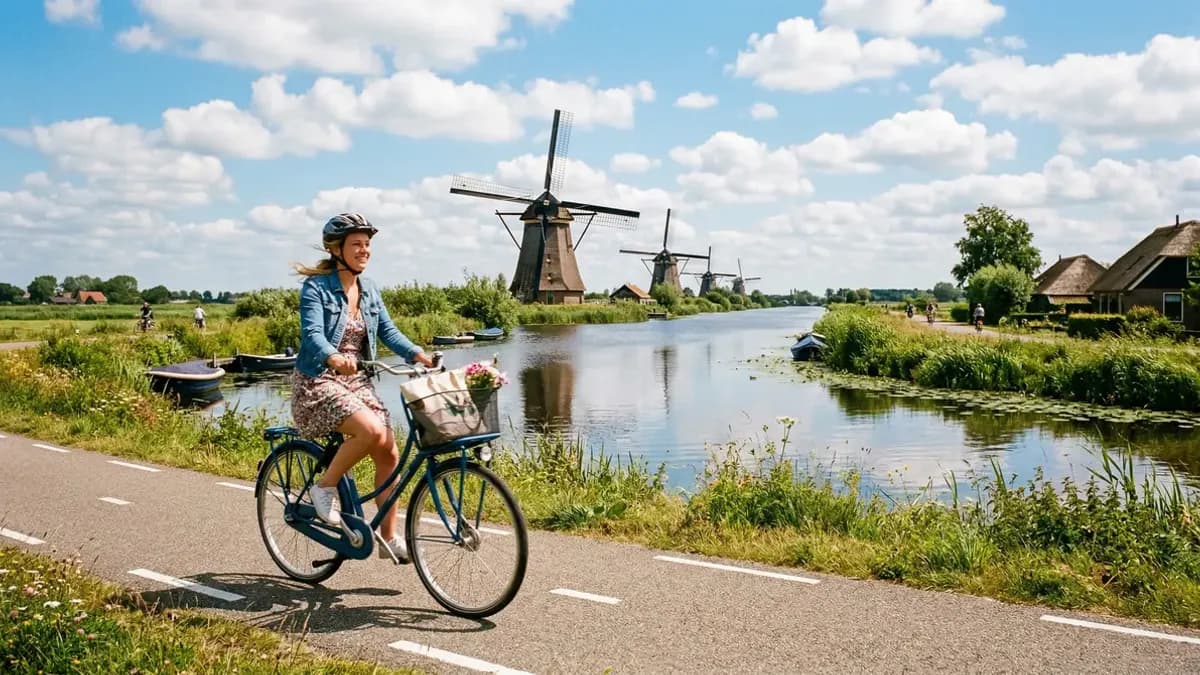
You hop on your bike, pedal to the station or office, and arrive twenty minutes later. Along the way, you have burned a significant number of calories without giving it a second thought. In a country with more bicycles than people, that is great news. But how many calories does cycling actually burn? It depends on your speed, your weight, and the conditions.
Key takeaways
- Cycling burns 300 to 900 kcal per hour at 75 kg, depending on your speed.
- Commuting by bike burns 200 to 280 extra calories per day for the average Dutch cyclist, based on the average commuting distance of 4.8 km each way (CBS statistics).
- Wind, hills, and terrain make a big difference: headwind can increase your burn by 30 to 40 percent.
- Cycling vs. walking. At a vigorous pace, cycling burns two to three times more calories than walking.
- No extra effort needed. Daily bike commuters burn 1,000 to 1,400 extra kcal per work week.
How many calories does cycling burn per hour?
The Voedingscentrum (Dutch Nutrition Centre) classifies cycling, along with walking and swimming, as a moderate-intensity activity. Calorie burn from cycling is calculated using MET values (Metabolic Equivalent of Task) from the Compendium of Physical Activities. The MET value increases as you ride faster. The formula: MET multiplied by body weight in kg equals calories per hour.
| Intensity | Speed | MET | Kcal/hr (75 kg) |
|---|---|---|---|
| Leisure | 15 km/h | 4.0 | 300 kcal |
| Moderate | 20 km/h | 6.0 | 450 kcal |
| Vigorous | 25 km/h | 8.0 | 600 kcal |
| Racing | 30+ km/h | 12.0 | 900 kcal |
| Spinning/indoor | variable | 7.0-11.0 | 525-825 kcal |
These values are for cycling on flat terrain without significant wind. In practice, wind, hills, and bike type can substantially affect your calorie burn.
What determines how many calories you burn while cycling?
Speed is the biggest factor, but far from the only one.
- Body weight. The heavier you are, the more energy it takes to move. A 90 kg person burns about 540 kcal per hour at 20 km/h, while a 60 kg person burns 360 kcal.
- Wind direction. Cycling into headwind can increase your energy expenditure by 30 to 40 percent. With a tailwind, you burn less. In a windy country like the Netherlands, this is no minor detail.
- Terrain. Cycling over hills, bridges, or unpaved paths costs more energy than flat asphalt. Even gentle inclines add up over distance.
- Bike type. A heavy city bike with upright posture costs more energy than a lightweight road bike with an aerodynamic position. But the city bike is what most people ride daily.
How many calories does cycling to work burn?
This is where the numbers get practical. According to data from CBS (Statistics Netherlands), the average cycling commute distance in the Netherlands is 4.8 kilometers each way. Round trip, that is 9.6 kilometers per day.
| Pace | Kcal per 9.6 km (75 kg) | Per work week (5 days) |
|---|---|---|
| Leisure (15 km/h) | 192 kcal | 960 kcal |
| Moderate (20 km/h) | 216 kcal | 1,080 kcal |
| Vigorous (25 km/h) | 230 kcal | 1,150 kcal |
That is 960 to 1,150 extra calories burned per work week, purely from cycling to work. Over a month of 22 work days, that adds up to 4,200 to 5,050 kcal. That is the calorie equivalent of more than half a kilogram of body fat, without setting foot in a gym.
Want to know how many calories you need daily and how cycling fits in? Read how many calories per day you need.
Cycling vs. walking vs. swimming: which burns more?
How does cycling compare to other popular forms of exercise? All values are for 30 minutes at 75 kg.
| Activity | Calories per 30 min (75 kg) |
|---|---|
| Vigorous cycling (25 km/h) | 300 kcal |
| Freestyle swimming (fast) | 356 kcal |
| Running (10 km/h) | 375 kcal |
| Moderate cycling (20 km/h) | 225 kcal |
| Brisk walking (5.5 km/h) | 131 kcal |
Cycling burns less per minute than swimming or running at high intensity, but its biggest advantage is how easily it fits into daily life. You already cycle to work, to the store, to visit friends. Those daily kilometers add up without feeling like exercise.
See also: how many calories does walking burn? and how many calories does swimming burn?.
How to burn more calories while cycling
Want to get more out of your ride? Five practical tips.
1. Vary your pace
Ride at high intensity for two minutes, then easy for three. This interval approach increases your burn compared to a constant pace.
2. Take a longer route
A five-minute detour costs you little time but adds 50 to 100 extra kcal.
3. Choose the hilly route
Cycling over bridges, dikes, or hills demands more from your muscles. Even small elevation changes make a measurable difference.
4. Skip the e-bike occasionally
An electric bike is great for longer distances, but it reduces your calorie burn by approximately 40 to 50 percent compared to a regular bike at the same speed.
5. Ride more often
Consistency matters more than intensity. Cycling 20 minutes every day burns more over a week than a single 90-minute intense ride.
Keep your burn and nutrition in balance
Cycling is an excellent way to burn more calories, but its effect on your weight depends on what you eat. A post-ride snack or extra portion can quickly offset what you burned.
The key is understanding your calorie balance. How much do you burn and how much do you eat? When you know both, you can make informed choices. Read our beginner's guide to calorie tracking for a practical start.
Sources
- Voedingscentrum — Physical Activity (Bewegen)
- CBS — Cycling in the Netherlands
- CBS — Commuting to Work
- Compendium of Physical Activities — Bicycling
Start cycling smarter today
According to CBS, the Netherlands has more than 37,000 kilometers of bike paths. You do not need to train for the Tour de France to benefit. Simply cycling to work, to the supermarket, or around the neighborhood in the evening is enough to burn hundreds of extra calories per week.
With Moveno, you will soon be able to track your nutrition with a photo of your meal, so you know exactly how your cycling kilometers and eating habits work together toward your goals. Join the waitlist and see for yourself.