
"I can't lose weight — I just have a slow metabolism." You've probably heard this before. But what does metabolism actually mean, and how much control do you really have over it? Here's a straightforward breakdown.
Key takeaways
- Metabolism refers to all the chemical processes your body uses to convert food into energy.
- Your basal metabolic rate (BMR) accounts for roughly 60% of your total daily calorie burn, even at rest.
- Muscle mass, age, sex, and thyroid function are the biggest drivers of metabolic rate.
- You can influence your metabolism — though the effects are more modest than most people expect.
- Understanding your calorie intake is the first step: Moveno helps you track it effortlessly with a photo.
What is metabolism?
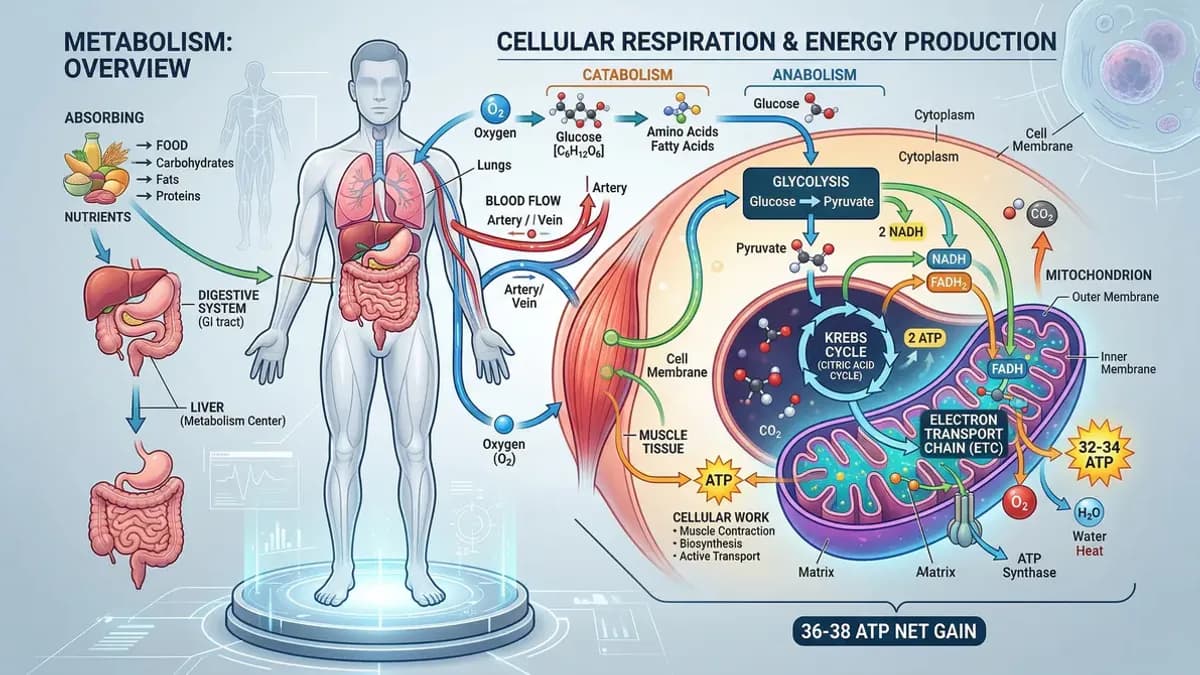
Metabolism is the sum of all chemical reactions happening in your body at any given moment. These processes convert the nutrients from your food into usable energy. Without them, your heart wouldn't beat, your brain wouldn't function, and your muscles wouldn't move.
There are two sides to metabolism:
- Catabolism. Your body breaks down large molecules into smaller building blocks, releasing energy in the process.
- Anabolism. Your body uses that energy to build new cells, proteins, and hormones.
Both processes run continuously — including while you sleep.
How does basal metabolic rate work?
Your basal metabolic rate (BMR) is the energy your body needs simply to keep you alive at rest — breathing, heartbeat, body temperature, organ function. According to Voedingscentrum (the Dutch Nutrition Centre), BMR accounts for approximately 60% of total daily energy expenditure.
The remaining 40% breaks down as follows:
- Thermic effect of food. Digesting and processing food burns energy too — roughly 10% of total expenditure.
- Physical activity. Movement, exercise, and daily tasks account for the remaining 30%.
What this means in practice: even on a completely sedentary day, your body burns more than half its total daily calories just to stay alive.
What determines how fast your metabolism is?
Some factors are largely fixed; others you can change:
- Body composition. Muscle tissue burns more calories at rest than fat tissue. More muscle mass means a higher BMR.
- Age. From around age 30, muscle mass tends to decline gradually, which slowly lowers resting metabolic rate.
- Sex. Men tend to have more muscle mass than women and therefore burn more calories at rest on average.
- Thyroid function. The thyroid gland produces hormones that directly regulate metabolic rate. An underactive thyroid (hypothyroidism) can cause weight gain and fatigue — read more about slow metabolism symptoms.
- Genetics. Your genetic makeup plays a role, but it's less deterministic than most people assume.
Can you speed up your metabolism?
Yes — but the effects are real yet modest. The most evidence-backed approaches:
- Build muscle mass. Strength training raises your BMR because muscle burns calories even at rest.
- Get enough quality sleep. Poor sleep disrupts hormones that regulate hunger and satiety.
- Don't under-eat. When calorie intake drops too low, your body reduces BMR to conserve energy. This is one reason why extreme restriction tends to backfire.
- Eat enough protein. Protein has a higher thermic effect than carbohydrates or fat — your body burns more calories just digesting it.
Want to know how many calories you actually need? Calculating your calorie deficit is the foundation of any sustainable weight management plan.
Metabolism and weight management
Your weight reflects the balance between energy intake and energy expenditure. Metabolism determines a large part of that expenditure — but it's not fixed. It adapts based on what you eat, how much you move, and how much muscle you carry.
This explains why two people of the same weight can have very different calorie needs: body composition, activity level, and thyroid function all contribute.
With Moveno, you can see the calories and nutritional values of any meal by simply taking a photo. No manual entry needed — just genuine insight into your eating patterns.
Start with awareness
Your metabolism isn't a fixed sentence. While genetics and age play a role, building muscle, eating enough protein, and sleeping well can meaningfully shift your energy expenditure over time. Small, consistent habits compound. Also learn how to track calories as a beginner and explore the best protein-rich foods to support your metabolism.
Curious about what a fast metabolism or slow metabolism actually looks like? Our follow-up articles cover the signs and what to do about them.
Sources
- Voedingscentrum — Basaalstofwisseling — explanation of basal metabolic rate and its share of total calorie expenditure
- Voedingscentrum — How many calories do I burn? — breakdown of energy expenditure: BMR, thermic effect, and activity
- Thuisarts.nl — Underactive thyroid — symptoms and causes of hypothyroidism