Key takeaways
- A healthy snack keeps you full between meals without exceeding your calorie budget.
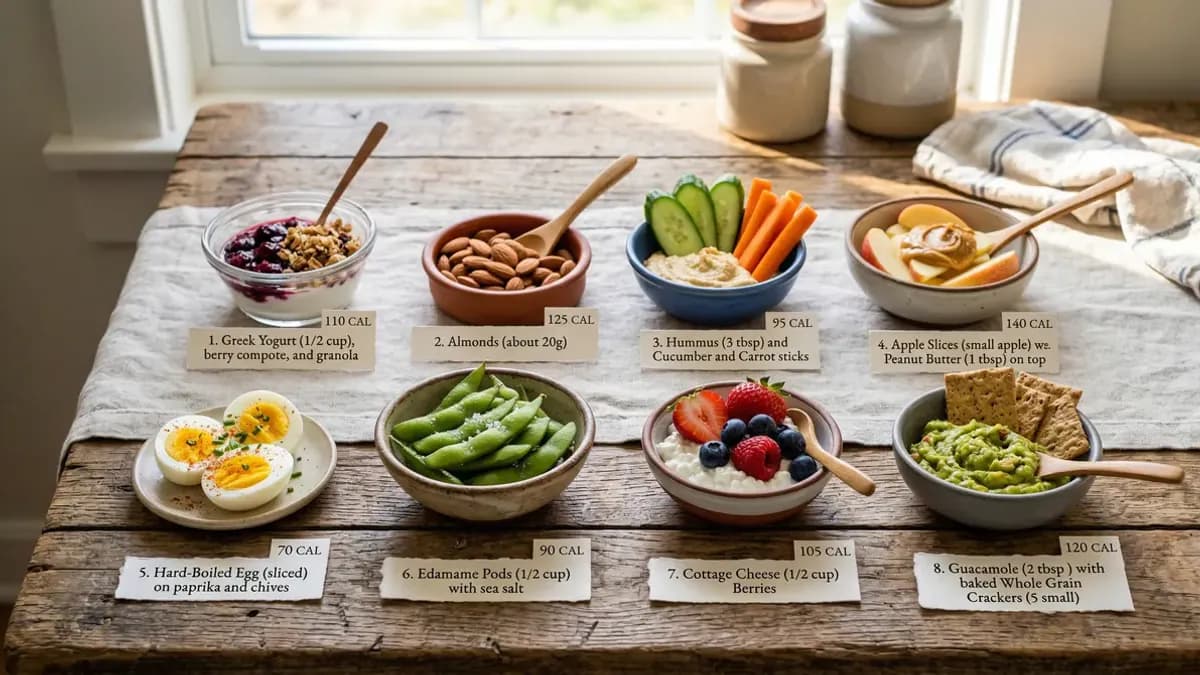
- The best options combine fibre or protein with low energy density: fruit, vegetables, nuts, eggs, or dairy.
- Twenty snacks under 100 kcal are listed below, with calorie counts per serving.
- Preparation and timing matter: snack when there is genuine hunger, not out of habit.
Snacks get a bad reputation — but the science disagrees. Well-chosen between-meal bites help stabilise blood sugar, prevent overeating at the next meal, and deliver extra nutrients. The question is not whether to snack, but what to choose.
What makes a snack healthy?
A good snack meets a few straightforward criteria. It ideally contains dietary fibre or protein — both of which extend satiety. It has a low energy density, meaning a large volume for relatively few calories. And it keeps added sugars to a minimum.
In practice, the best snacks are also the simplest: fruit, vegetables, nuts, eggs, or plain dairy. No complicated preparation needed.
20 snacks under 100 calories
Calorie counts below are indicative; exact values vary by brand or ripeness.
Fruit
- Apple (medium, ~150 g) — 78 kcal
- Mandarin (1 piece) — 40 kcal
- Small banana (~100 g) — 89 kcal
- Handful blueberries (80 g) — 46 kcal
- Handful grapes (80 g) — 55 kcal
Vegetables 6. Cucumber sticks with 1 tbsp hummus — 80 kcal 7. Cherry tomatoes (150 g) — 27 kcal 8. Baby carrots (150 g) — 53 kcal 9. Bell pepper strips (150 g) — 46 kcal
Dairy & eggs 10. Plain low-fat yoghurt (100 g) — 54 kcal 11. Cottage cheese (100 g) — 72 kcal 12. Hard-boiled egg (1 piece) — 78 kcal
Nuts & seeds 13. 10 almonds (~15 g) — 87 kcal 14. 1 tbsp pumpkin seeds — 55 kcal
Grains & crackers 15. Plain rice cake (1 piece) — 35 kcal 16. 2 rice cakes with 1 slice turkey — 83 kcal
Other 17. 1 tbsp natural peanut butter — 94 kcal 18. Dried apricots (3 pieces, ~30 g) — 72 kcal 19. Quark / fromage frais (100 g) — 57 kcal 20. Edamame (50 g, chilled) — 70 kcal
The role of fibre and protein
Snacks containing fibre or protein are more satiating than those dominated by simple carbohydrates. A rice cake with jam and a hard-boiled egg may contain similar calories — but the egg keeps you fuller for considerably longer. Dutch nutrition authority Voedingscentrum recommends limiting added sugars and increasing dietary fibre intake, including between meals.
For more on high-protein snacking, see our article on protein-rich snacks.
Timing: when is a snack worthwhile?
Nutrition experts generally suggest a snack makes sense when more than four hours separate two main meals. Waiting longer raises the risk of overeating at the next sitting. If breakfast is at 07:00 and lunch at 13:00, a mid-morning snack around 10:00 is entirely reasonable.
Snacking out of boredom or habit — without genuine hunger — is a different matter. Learning to distinguish physical hunger from emotional eating is a skill worth developing.
Practical tips for smarter snacking
Prepare in advance. Slice carrots, wash berries, or boil an egg the evening before. Having a healthy snack ready dramatically reduces the chance of reaching for a biscuit.
Choose volume. Vegetables and fruit contain a lot of water, so you can eat a larger portion for the same calories. 150 g of cherry tomatoes is far more filling than 15 g of crisps — for a similar calorie count.
Read the label. Many "healthy" snack bars and flavoured rice cakes contain more sugar than expected. Always check the ingredient list and the "of which sugars" line.
Drink water first. Thirst is often mistaken for hunger. A large glass of water before your snack may be all you need.
Smarter combinations for more nutritional value
A plain rice cake provides little on its own. Top it with cottage cheese and a few cucumber slices, and you have a snack with protein, fibre, and moisture — for under 100 calories.
The same principle applies to plain yoghurt: good on its own, but add a handful of blueberries and a teaspoon of pumpkin seeds and it becomes a genuinely nutritious mini-meal.
Also see our overview of calories in fruit for more snack inspiration.
Healthy snacks are not complicated. A piece of fruit, a handful of nuts, or a boiled egg — simple choices that make your day more nutritious without blowing your calorie budget. The key is not perfection but awareness: knowing what you eat and why.
Sources: Voedingscentrum, Gezondnu – 20 snacks under 100 kcal, WKOF – Healthy snacks