
Key takeaways
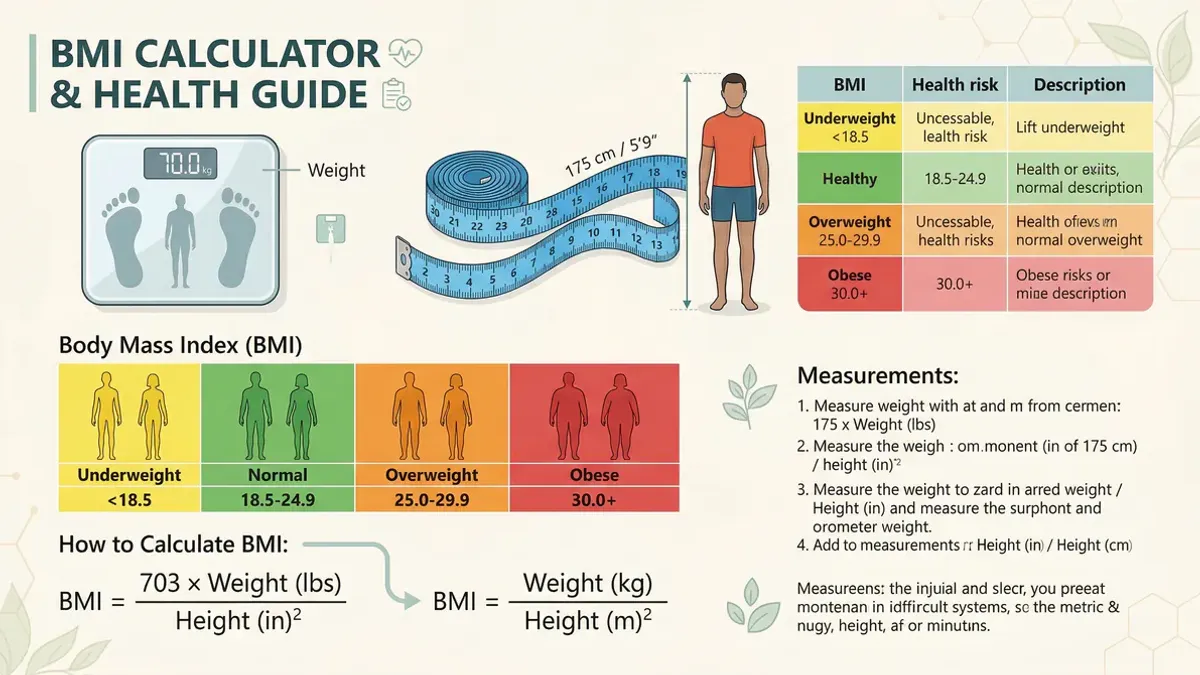
BMI — Body Mass Index — is the most widely used method for quickly assessing whether a person's weight is healthy relative to their height. You calculate it by dividing your weight in kilograms by the square of your height in metres. The result indicates a weight category, but it is not a complete measure of health.
What is BMI?
Body Mass Index is a number that expresses the ratio between your weight and height. It was developed in the 19th century by Belgian mathematician Adolphe Quetelet and has since become the global standard for classifying weight status.
BMI is not a direct measurement of body fat — it is an estimate based on weight and height alone. This gives it limitations, but as an initial screening tool it remains practical and widely used.
How to calculate your BMI
The formula is straightforward:
BMI = weight (kg) ÷ height² (m)
Worked example
You weigh 75 kg and are 1.75 m tall:
- Height squared: 1.75 × 1.75 = 3.0625
- BMI: 75 ÷ 3.0625 = 24.5
A BMI of 24.5 falls in the 'healthy weight' category.
Step by step
- Note your weight in kilograms (e.g. 80 kg)
- Note your height in metres (e.g. 1.78 m)
- Multiply your height by itself: 1.78 × 1.78 = 3.1684
- Divide your weight by that figure: 80 ÷ 3.1684 = 25.2
BMI categories for adults
The World Health Organisation (WHO) uses the following classification:
| BMI | Weight category |
|---|---|
| Below 18.5 | Underweight |
| 18.5 – 24.9 | Healthy weight |
| 25.0 – 29.9 | Overweight |
| 30.0 – 34.9 | Obesity class I |
| 35.0 – 39.9 | Obesity class II |
| 40.0 or above | Severe obesity (class III) |
For people of Asian descent, lower thresholds apply. Overweight begins at a BMI of 23, and obesity at 27.5.
What is a healthy BMI?
A BMI between 18.5 and 24.9 is considered healthy for adults. However, 'healthy' is not the same as 'optimal'. Most epidemiological studies suggest that a BMI of 20–22 is associated with the lowest disease risk for the general population.
For a more detailed look at what a healthy weight means for you personally, see also: calculating a healthy weight: beyond BMI.
Limitations of BMI
BMI is quick and practical, but has significant limitations:
Muscle mass is not accounted for. A well-muscled athlete with low body fat may have a BMI of 27 or more — technically 'overweight' on paper, but metabolically healthy.
Fat distribution is invisible. Visceral fat (belly fat) carries far greater health risks than fat stored around the hips or thighs. Two people with identical BMIs may face very different health risks depending on where their fat is distributed.
Age and sex play no role. Women naturally carry a higher percentage of body fat than men at the same BMI. Older adults lose muscle mass over time, which can cause body fat to rise while BMI remains unchanged.
Ethnic background. As noted above, health risks associated with a given BMI can vary between ethnic groups.
Additional measurements for a fuller picture
Use BMI as a starting point, but combine it with:
- Waist circumference: Over 94 cm for men or 80 cm for women indicates elevated cardiovascular risk
- Waist-to-hip ratio: Over 0.9 (men) or 0.85 (women) is a risk factor
- Body fat percentage: Provides direct information on body composition; healthy ranges are approximately 15–20% for men and 25–30% for women
- Blood markers: Blood pressure, blood glucose, and cholesterol provide a more complete health picture
BMI in children and adolescents
For children and teenagers (ages 2–18), different standards apply. BMI is expressed as a percentile for age and sex. A BMI above the 85th percentile indicates overweight; above the 95th percentile indicates obesity. Always consult a paediatrician for interpretation.
When BMI is not sufficient
There are situations in which BMI gives a misleading result:
- Elite athletes and bodybuilders: High muscle mass inflates BMI
- Older adults: Muscle loss leads to an underestimate of body fat
- Pregnant women: Weight gain during pregnancy is not meaningful in a BMI context
- People with oedema: Fluid retention can artificially elevate weight
In all these cases, additional measurements are essential for a reliable assessment.
Practical applications
BMI is most valuable as:
- A starting point for a conversation with a GP or dietitian
- A monitoring tool over time — changes in BMI are relevant
- A tool for population-level research — not for individual diagnosis
If you want to track your calorie intake and body weight progress, Moveno makes it easy. By logging your meals daily, you gain insight into your eating habits and energy balance — the foundation of sustainable weight management. Read our calorie tracking beginner's guide, calculate your calorie deficit, and learn how to boost your metabolism.
Sources
- World Health Organisation. (2021). Body mass index - BMI. who.int/europe/news-room/fact-sheets/item/a-healthy-lifestyle---who-recommendations
- Nuttall FQ. (2015). Body Mass Index: Obesity, BMI, and Health: A Critical Review. Nutrition Today. doi.org/10.1097/NT.0000000000000092
- Rothman KJ. (2008). BMI-related errors in the measurement of obesity. International Journal of Obesity. doi.org/10.1038/ijo.2008.87
- Keys A. et al. (1972). Indices of relative weight and obesity. Journal of Chronic Diseases. doi.org/10.1016/0021-9681(72)90027-6
Want to take control of your weight? With Moveno, track your calorie intake by simply photographing your meals.