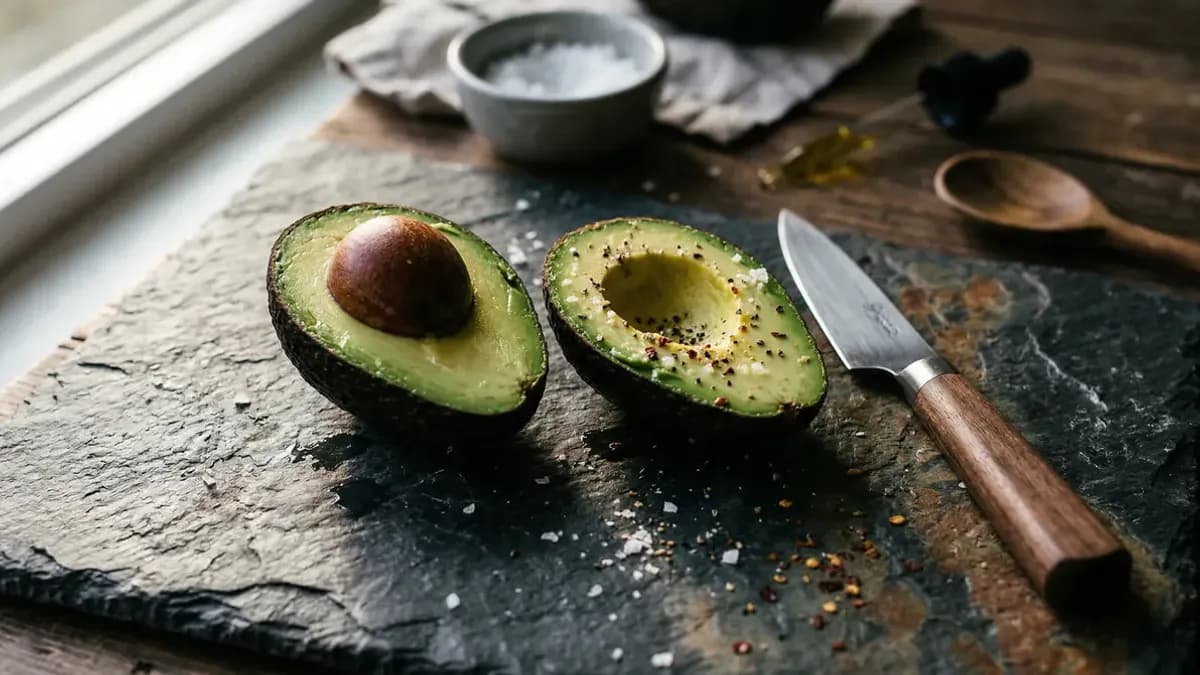
You add half an avocado to your salad, thinking it is a healthy choice. Then you check the label and see it contains almost as many calories as a chocolate bar. So is this creamy green fruit actually good for you, or is it quietly sabotaging your nutrition goals? The answer depends less on the avocado itself and more on how much you eat and what the rest of your day looks like.
Key takeaways
- High in energy. A whole avocado (about 180 grams of flesh) contains roughly 335 calories and 33 grams of fat.
- Healthy fat source. Most of the fat is monounsaturated (oleic acid), which may help support healthy cholesterol levels.
- Nutrient-dense. Avocado delivers more potassium than a banana (485 mg vs. 358 mg per 100 grams), plus vitamins K and E.
- Portion size matters. A quarter to half an avocado per serving fits comfortably within a balanced eating pattern.
- Satiety advantage. The combination of healthy fats and fibre creates a strong feeling of fullness, which can naturally reduce overall intake.
How many calories are in an avocado?
A whole medium avocado contains approximately 335 calories for 180 grams of edible flesh. Per 100 grams, that works out to about 186 calories, making avocado by far the most calorie-dense fruit you will find at the supermarket.
For comparison, a medium apple delivers around 56 calories per 100 grams, and a banana about 89 calories per 100 grams. The avocado sits in a completely different league. But calories alone do not tell the full story.
| Nutrient | Per half avocado (~90 g) | Per 100 grams |
|---|---|---|
| Energy | ~167 kcal | 186 kcal |
| Total fat | ~16.5 g | 18.4 g |
| Saturated fat | ~1.9 g | 2.1 g |
| Carbohydrates | ~1.6 g | 1.8 g |
| Fibre | ~2.8 g | 3.1 g |
| Protein | ~1.8 g | 2.0 g |
Source: Voedingscentrum (Dutch Nutrition Centre), based on NEVO food composition data.
Why is avocado considered healthy despite the high calorie count?
The calories in avocado come primarily from fat, but the type of fat matters enormously. The majority is monounsaturated fat, specifically oleic acid. This is the same type of fat found in olive oil and nuts.
Research suggests that replacing saturated fat with unsaturated fat may contribute to lower LDL cholesterol (the "bad" cholesterol), which is beneficial for cardiovascular health. So while avocado is calorie-dense, those calories come from a nutrient your body can use constructively.
Beyond the healthy fats, avocado provides:
- Potassium. At 485 mg per 100 grams, avocado contains more potassium than a banana (358 mg). Potassium plays a key role in blood pressure regulation.
- Vitamin K. About 26 percent of the recommended daily intake per 100 grams. Essential for blood clotting and bone health.
- Vitamin E. Roughly 10 percent of the recommended daily intake per 100 grams. Acts as an antioxidant.
- Fibre. 3.1 grams per 100 grams, supporting digestive health. For more on daily fibre needs, see our guide to daily fibre intake.
Can avocado help with weight management?
It sounds counterintuitive: a calorie-dense food that may support weight management. But the mechanism is straightforward. The combination of healthy fats and fibre in avocado creates a strong satiety response. You feel full for longer, which can naturally reduce snacking and overall intake.
The critical factor is portion control. Adding a whole avocado on top of your regular meals adds 335 calories to your daily total. That can easily push you over your target. The strategy lies in the serving size.
Step 1: Choose the right portion
A quarter to half an avocado per serving works well for most people. That translates to roughly 80 to 167 calories, an amount that fits comfortably into a balanced eating plan.
Step 2: Use avocado as a replacement
Spread avocado on toast instead of butter or cream cheese. This way you are not adding extra calories but swapping saturated fat for unsaturated fat. A double benefit.
Step 3: Track your total intake
When you are paying attention to your nutrition, it helps to know exactly what you are eating. Our complete guide to calorie counting offers practical strategies for building this awareness.
How does avocado compare to other fruit?
Avocado is technically a fruit, but nutritionally it behaves more like a fat source than typical fruit. Most fruits are primarily composed of carbohydrates and water with minimal fat. Avocado is the opposite: low in carbohydrates (1.8 grams per 100 grams) and high in fat.
This actually makes avocado a good complement to other fruits in your diet. You can explore the full comparison in our overview of calories in fruit.
| Fruit | Kcal per 100 g | Primary macronutrient |
|---|---|---|
| Avocado | 186 | Fat (unsaturated) |
| Banana | 89 | Carbohydrates |
| Apple | 56 | Carbohydrates |
| Strawberry | 29 | Carbohydrates |
What are the best ways to eat avocado without excess calories?
Avocado is versatile, but not every preparation is equally smart when you are watching your calorie intake.
- On bread. A quarter avocado spread on a slice of whole-grain bread with a pinch of sea salt and lemon juice. Satisfying and roughly 80 calories for the avocado portion.
- In salads. Diced avocado adds a creamy texture to vegetable salads. Combine with tomato, cucumber and a light dressing.
- As guacamole. Homemade with lime, coriander and a pinch of sea salt. Watch the portion size, especially when paired with crisps.
- In smoothies. A quarter avocado creates a creamy consistency without dominating the flavour.
Preparations to limit when calorie-conscious: avocado fries (frying roughly doubles the calories) and large portions of guacamole with tortilla chips (the combination stacks up quickly).
How much avocado can you eat per day?
There is no official upper limit for avocado. It fits within daily fat recommendations as long as you account for your total fat intake. A practical guideline:
- For weight loss. A quarter avocado per day, replacing another fat source rather than adding on top.
- For maintenance. Half an avocado per day fits comfortably for most adults.
- Consider the whole picture. Count avocado as part of your total fat intake, not as a free addition.
The number of calories you need per day varies based on your activity level, age and goals. Our article on how many calories you need per day can help you find your personal target.
Is avocado worth the cost?
A practical consideration: avocados are not cheap. In European supermarkets, you can expect to pay 1 to 2 euros per piece. If you eat half an avocado daily, that is 15 to 30 euros per month.
From a nutritional value perspective, you get a strong return: healthy fats, potassium, vitamins K and E, and fibre. For comparison, a good bottle of olive oil costs a similar amount and lasts longer, but provides less fibre and potassium.
What to look for when choosing an avocado
- Ripeness. A ripe avocado gives slightly when you press it gently. Rock-hard means it needs a few more days.
- Colour. The skin darkens as the avocado ripens. Light green is unripe; dark green to nearly black is ready to eat.
- Storage. Store unripe avocados at room temperature. Once ripe, move them to the fridge where they keep for a few days. Store a cut avocado with the pit still in and a squeeze of lemon juice to prevent browning.
Start building better food awareness today
Avocado is neither a villain nor a miracle food. It is a nutrient-dense ingredient with significant calories from healthy fats that fits well into a balanced diet, provided you mind the portion size. The key is not avoiding calorie-dense foods but understanding what you eat.
With Moveno, you snap a photo of your meal and instantly see all the nutritional values. You know exactly how much avocado you have had and whether there is room left in your daily budget. No guesswork, just clear insight into your food.