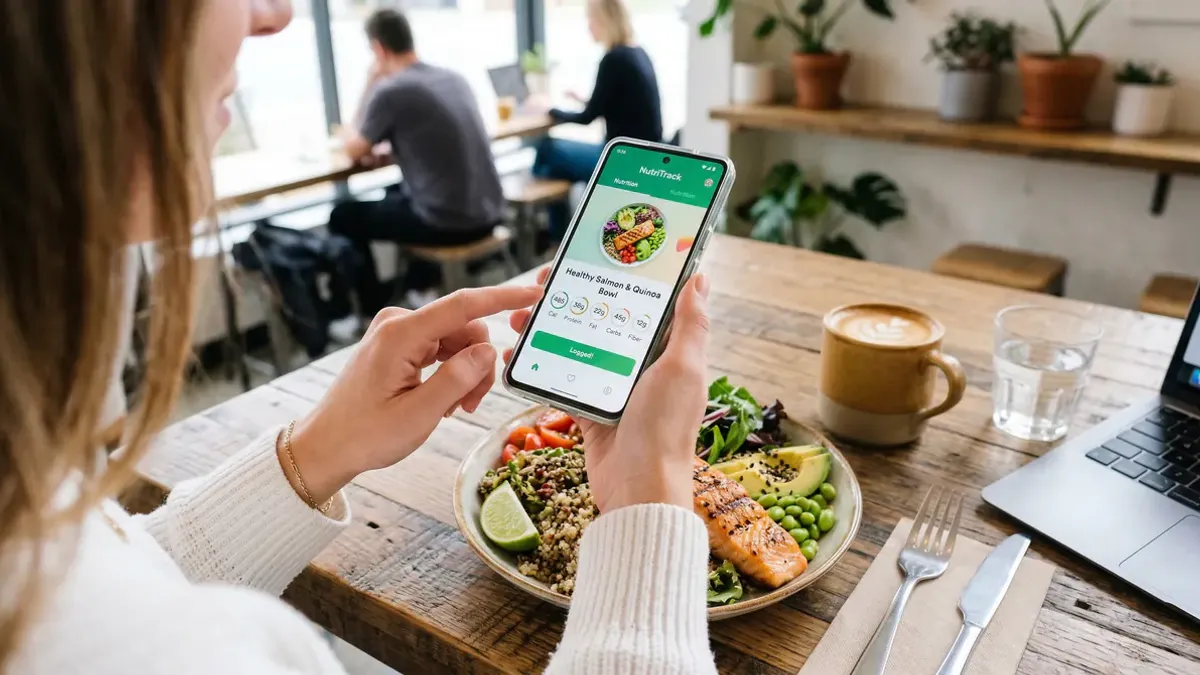

You download a calorie tracking app, log your breakfast, weigh your lunch, and feel great. Day two: same ritual. Day three: you forget a snack but catch up the next morning. Day seven: it starts feeling like a chore. Day fourteen: you haven't opened the app in three days.
Sound familiar? You're not alone. Research shows that the majority of people who start tracking their food intake quit within a few weeks [1][2]. Not because they lack motivation. Not because it doesn't work. But because the process takes too much effort.
In this article, we explore why calorie tracking is so hard to maintain, and -- more importantly -- what you can do about it. With five evidence-based tips grounded in behavioral science.
Why do people quit calorie tracking?
The reasons are more predictable than you might think. They're almost never motivation problems. They're friction problems. A systematic review by Konig et al. (2021) examined 328 individual barriers to nutrition app use and concluded that time investment and complexity were the most common reasons people stopped tracking [3].
1. It takes too much time
This is the number-one reason. Manually logging each meal takes an average of 5 to 10 minutes. With three meals and two snacks, you're spending 20 to 30 minutes per day just entering food data. That's more than three hours per week.
Most people don't have that time. Or more accurately, they don't want to spend that time searching for "whole wheat bread with aged Gouda cheese" in a database with millions of products.
2. The data isn't reliable
You search for "beef croquette" in your calorie tracker and get 47 results. One says 190 kcal, another 280 kcal, and a third claims 95 kcal. Which one do you pick?
This problem is typical of apps with user-generated databases. A validation study by Evenepoel et al. (2020) showed that MyFitnessPal's accuracy varies significantly by nutrient -- reliable for calories and macronutrients, but unreliable for micronutrients like cholesterol and sodium [4]. Anyone can add products, but nobody verifies the data.
For regional foods, this problem is even worse. Most calorie trackers are built for the American market. Traditional dishes from other cuisines often aren't listed, or they have incorrect values.
3. It starts to feel obsessive
There's a fine line between mindful eating and obsessing over every number. Research by Simpson and Mazzeo (2017) found an association between calorie tracking technology use and eating disorder symptoms, although the researchers emphasized that no causal relationship has been established [5]. For most people without a history of disordered eating, temporary tracking poses no risk [6].
The effect intensifies when tracking requires significant effort. The more time you spend with the app, the more eating becomes an administrative task rather than something to enjoy.
4. One bad day feels like failure
You've tracked perfectly for five days, then a birthday party happens. Three slices of cake, a few drinks, and you can't bring yourself to log it. The next day either. And then the routine is broken.
This all-or-nothing thinking is one of the biggest pitfalls. Missing one day feels like failure, and suddenly the barrier to starting again feels insurmountable.
5. The app doesn't understand your food
You make a homemade stir-fry with vegetables. How do you log that? The app knows "chicken stir-fry" as a restaurant dish (680 kcal), but your version with less oil and more vegetables is completely different. You could enter each ingredient separately, but then you're typing for 10 minutes.
This problem hits home-cooks the hardest. Ironically, those are exactly the people who are most consciously engaged with their nutrition.
What does the science say about habit formation?
To understand how to actually stick with tracking, it helps to know how habits work.
Behavioral scientist BJ Fogg of Stanford University describes habit formation as a formula: Behavior = Motivation + Ability + Prompt (also known as the B=MAP model) [7]. All three must be present at the same moment.
- Motivation. You want to eat more consciously or lose weight.
- Ability. You can do the tracking -- it's easy enough.
- Prompt. There's a moment that reminds you to do it.
Most people who quit calorie tracking have sufficient motivation. The problem lies with ability: tracking takes too much effort. When something is too difficult, even the strongest motivation can't compensate.
The solution isn't "more discipline." The solution is making tracking easier.
How to actually stick with calorie tracking: 5 evidence-based tips
1. Radically lower the barrier
Every extra step in the process reduces the chance you'll do it. The ideal workflow: pick up your phone, take a photo of your food, and done. No searching, no scrolling, no portion-size adjustments.
If you use an app that requires manual entry, minimize the number of steps. Save your most-eaten meals as favorites. Use the barcode scanner for packaged products. Round off instead of being exact -- 200 grams of potatoes is good enough, it doesn't need to be 187 grams.
Rule of thumb. If logging a meal takes more than 30 seconds, the odds are high that you'll eventually skip it.
2. Aim for 80 percent, not 100 percent
You don't need to track every bite to gain insight. If you log 80 percent of your meals, you already have a good picture of your eating pattern. That one sandwich you forgot doesn't matter.
Research by Turner-McGrievy et al. (2019) confirms this: tracking at least two eating occasions per day was the strongest predictor of weight loss at six months [2]. Perfection isn't necessary. Consistency is.
In practice. At minimum, track your three main meals. Snacks? If it's easy, go for it. If not, skip them. You'll gain valuable insights from just breakfast, lunch, and dinner.
3. Attach it to an existing routine
The most powerful way to form a new habit is to link it to something you already do. BJ Fogg calls this "habit stacking" [7]. You use an existing trigger as the starting point for new behavior.
For example:
- After serving your plate (existing habit) -- take a photo of your food (new habit)
- After ordering at a restaurant -- scan the menu
- When clearing the table -- check that you've logged everything
By linking tracking to a fixed moment, you no longer have to think about it. It becomes automatic.
4. Focus on insight, not perfection
The goal of calorie tracking isn't to create a perfect diary. The goal is insight. You want to spot patterns: am I eating more than I think? Where are the hidden calories? Have my portions gotten bigger?
You can get those insights after just a few days of tracking. You don't need to measure every gram for a month to discover that your daily sandwich with peanut butter contains 400 kcal instead of the 200 you assumed.
Want to know how to translate those insights into a concrete plan? Read our guide on how to calculate your calorie deficit.
Tip. Track everything for one week, analyze your patterns, and then focus only on the meals where you have the most room for improvement.
5. Choose an app that fits your needs
This sounds obvious, but many people choose the wrong app. They download the most popular one, get frustrated by manual entry, and conclude that calorie tracking "isn't for them." The problem wasn't with them -- it was with the app.
A good calorie tracking app should meet three criteria:
- Know your local foods. You shouldn't have to search for "fried meat croquette Dutch" to find basic items. Curious about the calorie content of common Dutch snacks? Your app should source those values from a verified database.
- Be fast. Logging should take seconds, not minutes.
- Offer reliable data. No database with 47 different values for the same product.
Manual vs. AI tracking: the difference in time and accuracy
The biggest breakthrough in calorie tracking in recent years is AI-powered food recognition. Instead of manually searching a database, you take a photo of your food. The AI identifies what you're eating and returns the nutritional values. A systematic review by Shonkoff et al. (2023) showed that AI-based food recognition is 62 to 99 percent accurate, comparable to -- and sometimes exceeding -- human estimations [8].
This eliminates the biggest problem: friction. The difference in time investment is enormous:
| Step | Manual tracking | AI food recognition |
|---|---|---|
| Open the app | Yes | Yes |
| Search for product in database | 1 to 3 minutes | Not needed |
| Select the correct variant | 30 seconds | Not needed |
| Adjust portion size | 30 seconds | Automatic |
| Confirm | Yes | Yes |
| Total time per meal | 3 to 5 minutes | Less than 10 seconds |
| Time per day (5 meals) | 15 to 25 minutes | Less than 1 minute |
| Time per week | 1.5 to 3 hours | Less than 7 minutes |
The difference between 3 hours and 7 minutes per week might sound extreme, but consider this: those 3 hours are precisely why most people quit. It's not motivation. It's time.
When should you stop tracking calories?
A question rarely asked but worth addressing: when is enough enough?
Calorie tracking is a tool, not a lifelong obligation. The goal is to gain insight into your eating patterns, make more conscious choices, and eventually internalize that knowledge.
Research shows that even temporary tracking contributes significantly to weight loss [1][9]. For most people, four to eight weeks of tracking is enough to:
- Learn calorie density. Discover which meals contain more calories than you thought. Curious about how to read and understand nutrition labels? That knowledge helps enormously.
- Calibrate portion awareness. Learn to estimate what 100 grams of rice or 30 grams of cheese actually looks like.
- Recognize patterns. Do you snack at night? Do you eat more when stressed? You only see these patterns when you track.
- Build a foundation. After a few weeks of tracking, you can eat more mindfully without registering everything.
After that, you can stop daily tracking and do a one-week check-in once a month instead. Or only track meals you're unsure about.
The point is: calorie tracking should make your life easier, not harder.
Frequently asked questions
How much time does calorie tracking take per day?
With manual entry: 15 to 25 minutes per day. With an app that uses AI food recognition: 1 to 3 minutes per day. The difference in time investment is the primary reason some people stick with it and others don't.
Do you need to track every calorie?
No. Tracking your three main meals already gives you a reliable picture of your daily intake. Research confirms that tracking at least two eating occasions per day is the strongest predictor of weight loss [2]. Better to track 80 percent consistently for a month than to track 100 percent for three days.
Is calorie tracking bad for your mental health?
For most people without a history of eating disorders: no. A randomized controlled trial showed that one month of app-based tracking had no effect on eating disorder risk, anxiety, depressive symptoms, or body satisfaction among low-risk women [6]. However, people with a history of disordered eating should be cautious [5]. If tracking causes you stress, stop and consult a healthcare professional.
Does calorie tracking actually help with weight loss?
Yes. A systematic review by Burke et al. (2011) examined 22 studies and found a consistent positive association between dietary self-monitoring and weight loss [9]. Not because tracking itself burns calories, but because it creates awareness. You make different choices when you know what you're eating.
What is the difference between manual and AI tracking?
With manual tracking, you search for each product in a database, select the correct variant, and adjust the portion size. That takes 3 to 5 minutes per meal. With AI food recognition, you take a photo of your plate and the app automatically identifies what you're eating. That takes less than 10 seconds. Over a week, this saves up to 3 hours.
How long should you track calories?
For most people, four to eight weeks is enough to gain the key insights: which meals contain more calories than expected, how large your portions really are, and whether your eating patterns change due to stress or other factors. After that, you can switch to occasional check-ins.
Start with less friction
The reason most people quit calorie tracking isn't a lack of motivation. It's a lack of convenience. The less effort it takes, the greater the chance you'll stick with it. Our calorie counting guide covers exactly how to make tracking stick.
At Moveno, we're building an app that makes tracking your food as effortless as possible. Take a photo, and you know what you're eating. No manual searching, no questionable data, no 5 minutes per meal.
Curious? Join the waitlist and be among the first to try it.
Sources
- Ingels JS, Misra R, Stewart J et al. (2017). The effect of adherence to dietary tracking on weight loss: Using HLM to model weight loss over time. J Diabetes Res, 2017, 6951495. PubMed
- Turner-McGrievy GM, Dunn CG, Wilcox S et al. (2019). Defining adherence to mobile dietary self-monitoring and assessing tracking over time: Tracking at least two eating occasions per day is best marker of adherence within two different mobile health randomized weight loss interventions. J Acad Nutr Diet, 119(9), 1516-1524. PubMed
- Konig LM, Attig C, Franke T, Renner B (2021). Barriers to and facilitators for using nutrition apps: Systematic review and conceptual framework. JMIR mHealth uHealth, 9(6), e20037. PubMed
- Evenepoel C, Clevers E, Deroover L et al. (2020). Accuracy of nutrient calculations using the consumer-focused online app MyFitnessPal: Validation study. J Med Internet Res, 22(10), e18237. PubMed
- Simpson CC, Mazzeo SE (2017). Calorie counting and fitness tracking technology: Associations with eating disorder symptomatology. Eat Behav, 26, 89-92. PubMed
- Jospe MR, Richardson SA, McLeod M et al. (2021). Introducing dietary self-monitoring to undergraduate women via a calorie counting app has no effect on mental health or health behaviors: Results from a randomized controlled trial. J Acad Nutr Diet, 122(2), 352-361. PubMed
- Fogg BJ (2020). Tiny Habits: The Small Changes That Change Everything. Houghton Mifflin Harcourt. See also: behaviormodel.org
- Shonkoff E, Cara KC, Pei X et al. (2023). AI-based digital image dietary assessment methods compared to humans and ground truth: A systematic review. Ann Med, 55(2), 2273497. PubMed
- Burke LE, Wang J, Sevick MA (2011). Self-monitoring in weight loss: A systematic review of the literature. J Am Diet Assoc, 111(1), 92-102. PubMed