
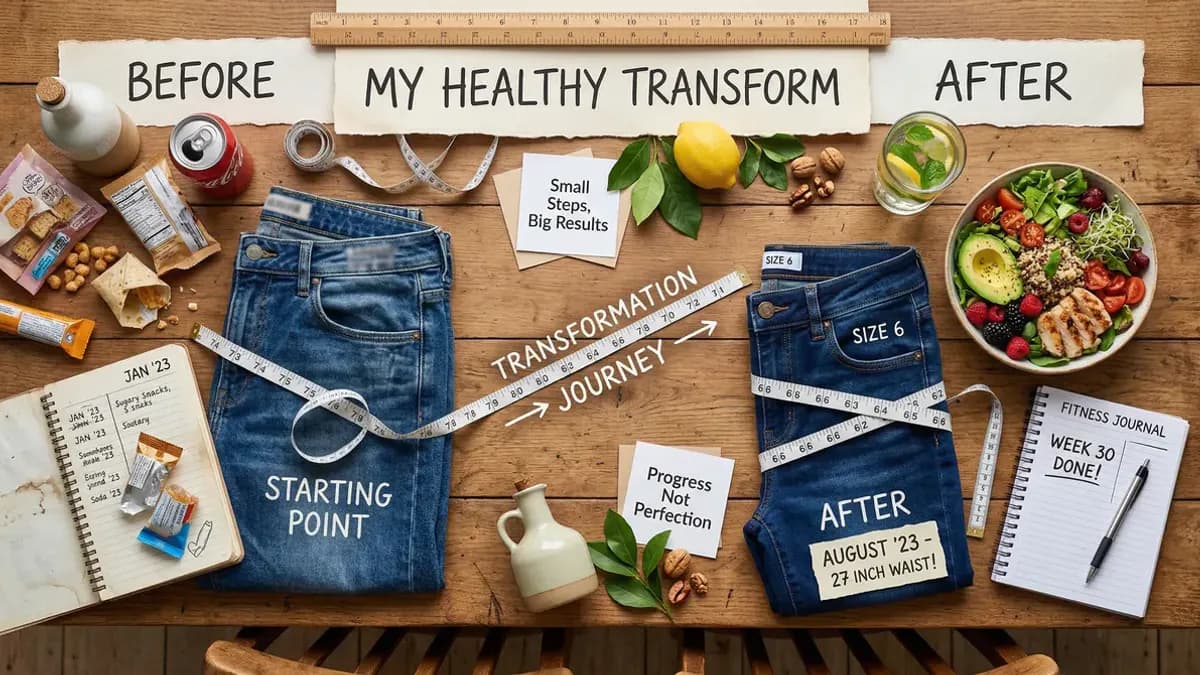
Losing 10 kilos is one of the most common weight loss goals — and one of the most achievable, if you approach it correctly. The number is concrete, the timeframe is realistic, and the health benefits are meaningful. What separates success from failure is almost always the approach, not willpower.
Key takeaways
- A 500-calorie daily deficit produces roughly 0.5 kg of weight loss per week — 10 kilos takes about 20 weeks
- Crash diets cause muscle loss, rebound weight gain, and are rarely sustainable beyond 4 to 6 weeks
- High protein intake (1.6 g per kg of body weight) preserves muscle mass during a calorie deficit
- Combining dietary changes with strength training produces the best long-term outcome
- Most people reach this goal in 4 to 6 months at a sustainable pace
- Tracking what you eat roughly doubles the likelihood of hitting your target
How long does it take to lose 10 kilos?
The honest answer: it depends on your approach.
At a 500-calorie daily deficit, you'll lose roughly 0.5 kg per week. That puts 10 kilos at 20 weeks — approximately 5 months. That sounds like a long time, but it's the pace at which you preserve muscle mass and avoid the rebound that undoes faster approaches.
At a larger deficit of 750 calories per day — sustainable for someone with more to lose — you're looking at around 13 weeks. That's realistic provided your diet remains nutritionally adequate.
What doesn't work: aiming to lose more than 1 kg per week. Above that rate, the majority of what you're losing is water and muscle, not fat. The scale drops quickly, but your body restores that loss as soon as the extreme deficit ends.
Use our calorie deficit calculator to calculate your personal target.
The realistic 20-week plan
Month 1: building the foundation (weeks 1 to 4)
Goal: establish routine without drastic restrictions.
- Calculate your maintenance calories (TDEE) and subtract 400 to 500 calories
- Aim for at least 1.6 g of protein per kg of body weight daily
- Add 2 to 3 movement sessions per week: walking, cycling, or strength training
- Track what you eat — awareness of your habits is the first lever
Expected loss: 1.5 to 2 kg
Month 2: finding the rhythm (weeks 5 to 8)
- Maintain your deficit — it's normal for loss to slow slightly in weeks 3 and 4
- Increase movement: add a daily walk or lengthen your training sessions
- Vary your meals to avoid nutritional gaps
- Weigh yourself weekly, not daily — daily fluctuations are noise
Expected loss: 1.5 to 2 kg
Month 3: the hardest part (weeks 9 to 12)
This is where most people quit. The plateau effect kicks in as your body adapts its metabolism.
- Increase protein slightly (to 1.8 to 2 g per kg of body weight)
- Adjust your calorie target if weight hasn't moved in 3 weeks
- Add strength training if you haven't already — muscle mass raises your resting metabolic rate
- Consider a 1 to 2 week "diet break" at maintenance calories to reset your metabolism
Expected loss: 1 to 1.5 kg (plateau effect)
Months 4 and 5: the final stretch (weeks 13 to 20)
- Maintain your routine — you're close
- Start thinking about maintenance: how will you sustain your new weight?
- Consider narrowing your deficit (to 200 to 300 calories) for a smoother finish
- Keep moving: this becomes critical for keeping the weight off
Expected loss: 4 to 5 kg (remaining)
Which foods work best?
You don't need to follow a specific diet. But a few principles make the process significantly easier.
Eat more protein
Protein is the most important macronutrient for weight loss. It keeps you fuller for longer, prevents muscle breakdown, and has the highest thermic effect — your body burns calories just digesting it. Good sources include:
- Chicken breast, turkey, lean fish (salmon, tuna, cod)
- Quark, Greek yoghurt, cottage cheese
- Eggs
- Legumes: lentils, chickpeas, black beans
- Tofu and tempeh
Eat more fibre
Fibre slows digestion and keeps you satisfied longer. Aim for 25 to 35 g per day through vegetables, fruit, whole grains, and legumes.
Control liquid calories
Soft drinks, fruit juice, alcohol, and full-fat lattes can easily add 300 to 500 calories per day without registering as "food." Switching to water, tea, or black coffee makes a significant difference.
Reduce ultra-processed food
Ultra-processed foods (crisps, biscuits, ready meals) deliver low satiety per calorie — you consume more calories before feeling full. Home-cooked meals give you more control over ingredients and portions.
Strength training or cardio?
Both help, but strength training is essential for long-term success. Muscle mass raises your resting metabolic rate — you burn more calories even at rest.
A combination works best: 2 to 3 strength sessions per week plus daily movement like walking. See how walking for weight loss fits into your plan.
Why tracking makes the difference
Research consistently shows that people who track their food lose significantly more weight than those who don't. You don't need to weigh every gram — a reliable estimate via an app is enough to stay aware.
Moveno makes this easier than any method we've tested: photograph your meal and the AI calculates the nutrition. Home-cooked meals, restaurant dishes, and packaged products are all recognised.
Read our calorie tracking beginners guide if you're starting from scratch.
What if progress stalls?
The plateau effect is normal. Almost everyone experiences it, usually between weeks 8 and 12. Your metabolism adapts to the lower calorie intake — that's not failure, that's biology.
How to break through:
- Audit your tracking — you may be eating more than you think
- Increase your movement level
- Take a 1 to 2 week break from your deficit (maintenance calories)
- Adjust your deficit downward — 400 calories may now be sufficient
After reaching your goal
Losing 10 kilos is a genuine achievement — but maintaining it is the real challenge. Research shows that most people regain half their lost weight within 3 to 5 years unless they actively maintain their habits.
Invest in sustainable behaviours, not temporary measures. Keep moving, keep eating with awareness, and use your app to spot patterns before they pull you back. Also read how to eat healthy to lose weight long-term, how to boost your metabolism, and how much daily protein you need to preserve muscle.
Sources
- Hall, K.D. et al. (2012). Quantification of the effect of energy imbalance on bodyweight — The Lancet. https://doi.org/10.1016/S0140-6736(11)60812-X
- Helms, E.R. et al. (2014). Dietary protein during caloric restriction in resistance trained lean athletes — International Journal of Sport Nutrition. https://doi.org/10.1123/ijsnem.2013-0054
- Donnelly, J.E. et al. (2009). Physical activity intervention strategies for weight loss — Medicine & Science in Sports & Exercise. https://doi.org/10.1249/MSS.0b013e3181949333
- Burke, L.E. et al. (2011). Self-monitoring in weight loss — Journal of the American Dietetic Association. https://doi.org/10.1016/j.jada.2010.10.008