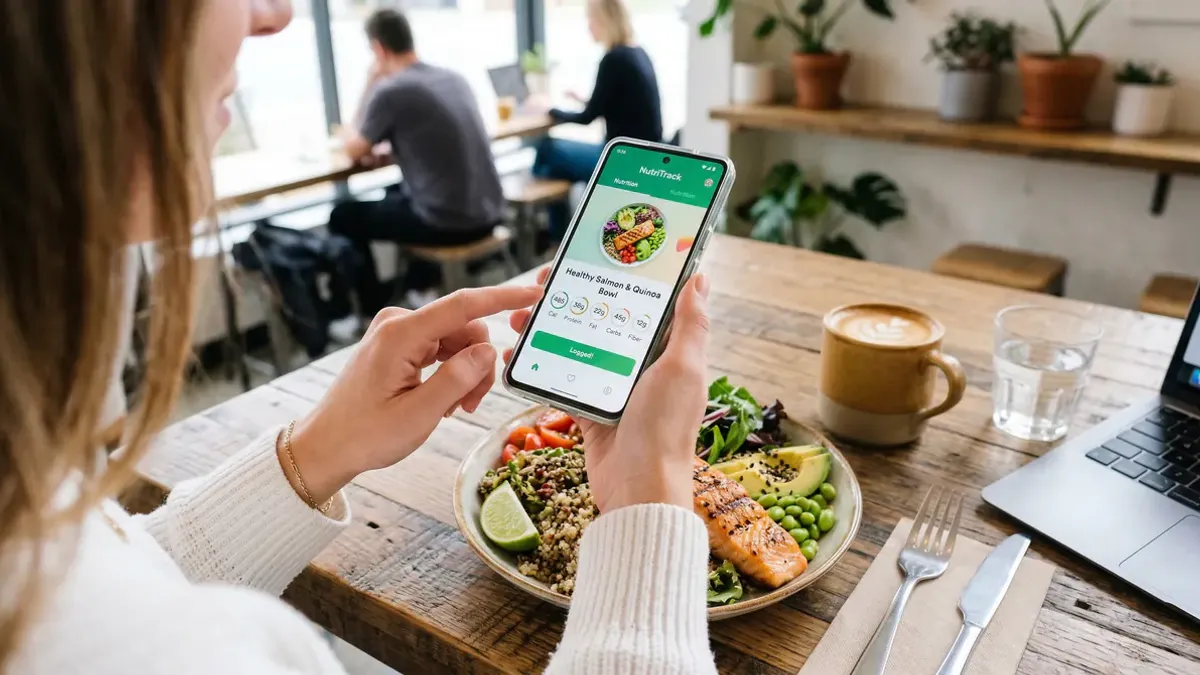

You work 40 to 50 hours a week. You have meetings, kids, errands, a social life. Calorie tracking feels like something for people with unlimited free time. Yet you want to understand what you eat. Not to obsess, but for insight. The good news: you do not need to spend hours on it. With the right approach, calorie tracking takes less than 10 minutes per day.
Research by Goldstein et al. (2019) found that people who track at least two eating occasions per day lose significantly more weight than those who try to track everything or nothing at all [1]. Two meals. Not five. Not every snack. This article gives you seven concrete tips that actually work when time is scarce.
Why do most people quit calorie tracking?
Let us be honest: manually entering every meal is the problem. You eat a sandwich (250 kcal), a coffee (5 kcal), a handful of nuts (175 kcal). You look everything up, type it in, adjust the portions. That takes 5 to 10 minutes per meal. Three meals and a few snacks per day? You are already at 20 to 30 minutes.
Research confirms this: adherence to food tracking apps drops from 5.4 days per week after four weeks to just 1.4 days per week after twelve weeks [2]. People do not quit because they lack motivation. They quit because it takes too much effort.
The solution is not more discipline. The solution is less work.
Tip 1: take a photo instead of typing everything in
The biggest time saver in calorie tracking is AI food recognition. Instead of searching for each ingredient and manually entering it, you take a photo of your plate. The AI recognises what you are eating and estimates the portions.
The difference is dramatic. Manual entry takes 5 to 10 minutes per meal. Taking a photo and confirming the result takes less than a minute. Over a full day, that saves you 15 to 25 minutes.
This is the difference between sticking with it and quitting after two weeks. At Moveno, we are building exactly this feature: you take a photo, the AI recognises your meal, and it calculates the nutritional values automatically.
Tip 2: focus on lunch and dinner, not every snack
When time is tight, just track your two main meals. It sounds like cutting corners, but it is surprisingly effective.
Research on daily calorie distribution shows that lunch and dinner together account for 55 to 70 percent of your total daily calorie intake [3]. The rest comes from breakfast, snacks, and drinks.
Here is what a typical day looks like in numbers:
| Meal | Example | Kcal |
|---|---|---|
| Breakfast | Toast with peanut butter, coffee | 400 |
| Lunch | Chicken wrap with salad | 550 |
| Dinner | Pasta bolognese with side salad | 650 |
| Snacks | Biscuit, coffee, apple | 300 |
| Total | 1,900 |
In this example, lunch and dinner together account for 1,200 kcal, or 63 percent of the daily total. If you track those two meals well, you have captured the majority. Want to know exactly how many calories you need? Read our guide on how to calculate your calorie deficit.
Research by Goldstein et al. confirms that tracking at least two eating occasions per day is the best predictor of weight loss, better than striving for complete recording [1].
Tip 3: eat the same meals on weekdays
This might sound boring, but it is backed by science. The fewer food choices you make, the less mental energy it costs. Research on decision fatigue shows that repeated decisions throughout the day deplete your self-regulation, making you more likely to eat poorly in the evening [4].
In practice: choose three to five fixed dinners that you rotate during the work week.
| Day | Meal | Kcal |
|---|---|---|
| Monday | Chicken stir-fry with rice and vegetables | 550 |
| Tuesday | Spaghetti bolognese | 650 |
| Wednesday | Salmon with potatoes and green beans | 500 |
| Thursday | Bean chili with brown rice | 550 |
| Friday | Homemade pizza with salad | 600 |
After two weeks, you know the calorie values by heart. No more looking things up. You just note the number. That takes 10 seconds per meal.
A study by Ducrot et al. (2017) involving over 40,000 participants found that people who plan their meals in advance have healthier eating patterns and are less likely to be overweight [5].
Tip 4: save your favourite meals
Every decent calorie tracker has a favourites list. Use it. Your standard breakfast (two slices of toast with peanut butter: 500 kcal), your regular lunch (tuna salad sandwich: 450 kcal), your go-to dinner (chicken curry: 600 kcal). Save them once.
The first time takes 5 minutes to enter everything. After that, two taps to add. The difference between spending 10 minutes searching daily or 30 seconds adding becomes noticeable after just one week. Curious how many calories are in popular Dutch snacks? Check our complete ranking of Dutch snack calories.
Tip 5: photograph your meal when eating out
Lunch in the canteen, a sandwich from the bakery, eating out with colleagues. If you frequently eat away from home, this is your biggest challenge. You do not know exactly what is in it, how much butter was used, or how large the portion is.
The solution: take a photo. Yes, it might feel awkward at first. But it takes two seconds and makes a real difference.
Without a photo, you are guessing. With a photo, you have a reference you can enter afterwards or have AI recognise. Especially for meals you regularly eat out, you only need to do this once.
Tip 6: plan your week on Sunday morning in 10 minutes
Sunday morning, coffee in hand. Think about what you will eat this week.
Monday: chicken from the supermarket. Tuesday: pasta with vegetables. Wednesday: leftovers. Thursday: meal salad. Friday: pizza.
It does not have to be elaborate. A list of five dinners on a scrap of paper is enough. It saves you dozens of small decisions during the week, and that adds up.
Fewer choices means less mental strain. And less mental strain means you keep tracking, even on Thursday when you have already worked 40 hours.
Tip 7: accept that not every day will be perfect
You work until seven in the evening. Your partner makes something delicious. You do not have the energy to open the app. So you just eat.
That is completely fine. Perfection is the enemy of progress.
If you track six out of seven days, you have 85 percent visibility. That is more than enough for a realistic picture of your eating pattern. Research by Goldstein et al. shows that long-term consistency matters more than daily accuracy [1].
A missed day is not a reason to stop. It is a normal day.
How much time does calorie tracking actually take?
Let us make it concrete. How much time does calorie tracking cost when you apply these tips?
| Method | Time per day |
|---|---|
| Everything entered manually | 20 to 30 minutes |
| Photo + AI recognition | 3 to 5 minutes |
| Photo + favourites + fixed meals | Less than 5 minutes |
| Only tracking lunch and dinner | Less than 3 minutes |
Less than 5 minutes per day. That is shorter than your daily coffee run. And it gives you something most people lack: insight into what you eat.
How do you start tomorrow?
You do not have to do everything at once. Start with one step.
Week 1. Download a calorie tracker with AI food recognition. Track only your dinner. Nothing else.
Week 2. Add your lunch. Save your three favourite meals.
Week 3. Make a quick meal plan on Sunday morning. Photograph one meal you eat out.
After three weeks, you will have a routine. After six weeks, it will feel normal. Then you will be one of the few busy people who actually has insight into their nutrition. That is not perfection. That is working smart with limited time. For a full overview, read our calorie counting guide.
Want to track calories without the hassle? At Moveno, we are building an app that recognises your food from a photo and calculates your nutritional values automatically. Join the waitlist and get early access.
Frequently asked questions
How much time does calorie tracking take per day?
With manual entry, 20 to 30 minutes. With AI food recognition and saved favourites, less than 5 minutes per day. If you only track your two main meals, it can be done in less than 3 minutes.
Do I really need to track everything to lose weight?
No. Research shows that tracking at least two eating occasions per day is sufficient for significant weight loss [1]. Focus on lunch and dinner, which together account for 55 to 70 percent of your daily calorie intake.
How accurate do I need to be?
Less accurate than you think. Studies show that the frequency and consistency of tracking matter more than exact accuracy [2]. A rough estimate you make every day is more valuable than perfect entries you abandon after two weeks.
Which meals should I start tracking first?
Start with dinner. For most people, it is the largest meal of the day (roughly 35 percent of daily calorie intake). Then add lunch. Together, you will have more than half your daily intake covered.
Does AI food recognition work well enough?
AI food recognition is not perfect, but it is good enough for daily use. The major advantage is that it dramatically lowers the barrier to tracking. An estimate that is 10 to 15 percent off but that you make every single day is far more valuable than perfect manual entry that you quit after two weeks.
Sources
- Goldstein SP, Goldstein CM, Bond DS et al. (2019). Defining adherence to mobile dietary self-monitoring and assessing tracking over time: tracking at least two eating occasions per day is best marker of adherence within two different mobile health randomized weight loss interventions. J Acad Nutr Diet, 119(9), 1516-1524. PubMed
- Harvey J, Krukowski R, Priest J, West D (2019). Log often, lose more: electronic dietary self-monitoring for weight loss. Obesity, 27(3), 380-384. PubMed
- NCBI Bookshelf (2010). Process for developing recommendations for meal requirements: Child and Adult Care Food Program. National Academies Press. NCBI
- Pignatiello GA, Martin RJ, Hickman RL (2020). Decision fatigue: a conceptual analysis. J Health Psychol, 25(1), 123-135. PubMed
- Ducrot P, Mejean C, Aroumougame V et al. (2017). Meal planning is associated with food variety, diet quality and body weight status in a large sample of French adults. Int J Behav Nutr Phys Act, 14(1), 12. PubMed